Introduction:
An actuator is a device that contains electronic components and, when voltage and current are supplied by an ECU, takes action. This can range from adjusting a mechanical position to regulating a specific function within a vehicle or other controlled system. Every modern vehicle contains dozens of actuators in the engine compartment, exterior, and interior.
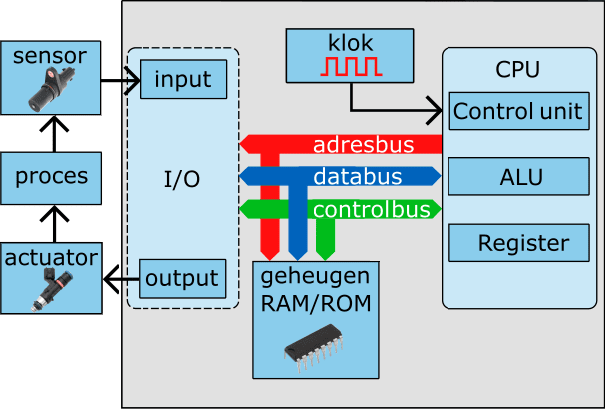
The ECU determines how the actuator should be controlled based on sensor data and the program. Example: when the mixture of a gasoline engine is too lean, the lambda sensor (sensor) measures an excess of oxygen. The ECU drives the injector (actuator) longer until the lambda sensor signal reaches its desired value. The ECU thus has a regulating function. See also the page: process control.
Control of the Actuators:
The ECU passes a current through the actuator by engaging a plus, or in most cases, the ground. The actuators translate electronic signals from the ECU into physical movements or actions. Actuators often contain a coil or electric motor to execute a command. We also find actuators as electric motors (stepper motors), heating elements, or lighting.
Actuators with a Coil:
- Active Carbon Filter Valve
- Ignition Coil
- Common-Rail Pressure Regulator
- Alternator Rotor
- Injector
- Magnetic Clutch Air Compressor
- Camshaft Adjuster
- PWM Controlled Fuel Lift Pump
- Relay
- Wastegate or VGT Actuator
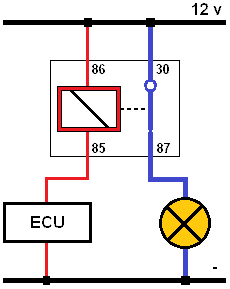
Example: the image next to it shows a relay circuit. The ECU turns the control current of the relay on or off. When pin 85 is switched by the ECU to ground, current flows through the relay coil and it becomes magnetic. As a result of the magnetic field, the switch of the main current is pulled closed.
Actuators with Electric Motor:
- Door Locks
- Electronic Throttle Control or Idle Control Valve
- Electric Adjustable Seats and Mirrors
- Heater Flaps in Heater Unit of Automatic Air Conditioning
- Headlamp Adjustment Motor
- Radiator Fan
- Wipers
- Sunroof
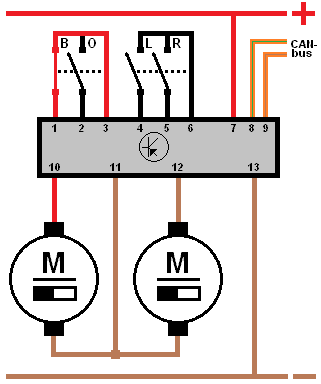
Example: the image next to it shows the diagram of the electric mirror adjustment. One adjustment motor is for vertical adjustment and the other for horizontal. The polarity determines the rotation direction of the electric motors and thus to which side the mirror glass tilts. The ECU determines from the input signals how the adjustment motors are controlled. This can be based on the switch operated by the driver, the memory function, or when engaging the reverse gear.
Actuators as Heating Element:
- Rear Window Defroster
- Battery Pack Heater
- Fuel Filter Heater
- Auxiliary Heater for Interior Ventilation
- Mirror Glass Heater
- Seat Heater
- Steering Wheel Heater
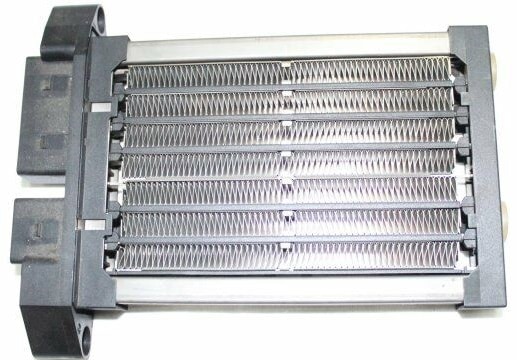
Example: at the moment an actuator has a heating function, the temperature is limited by a PTC. In this example, we see an auxiliary heating element in which glow spirals cause the warming of the incoming interior air. The ECU applies pulsating voltages to one or more glow spirals to bring the component to temperature as quickly as possible, and with reduced current at the desired temperature.
Actuator for Lighting Functions:
- Dashboard (control) lamps
- Lighting in Headlamp and Taillight Units
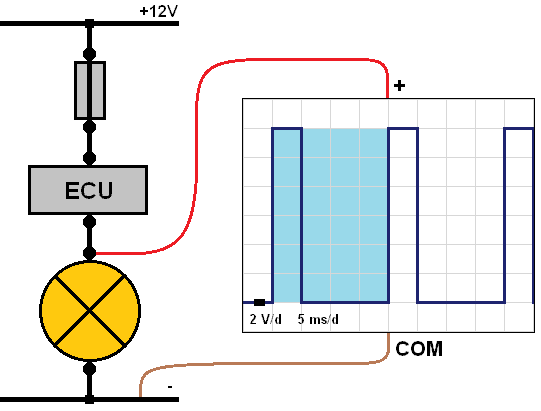
Example: to limit the power of lighting, or to give a lamp multiple functions, bulbs, but also LEDs, are controlled by the ECU. In the image next to it, we see a lamp that is controlled by a duty cycle. The pulse width determines how brightly the lamp will shine. The lamp can now function both as a taillight (25%) or as a brake light (90%).
Related page: