Introduction:
The subframe is a separate component of the bodywork to which parts of the suspension are mounted, such as the control arms, the stabilizer bar, and the steering rack. The subframe absorbs the forces acting on the vehicle while driving. Many cars have both a front and rear subframe. The subframe is attached to the bodywork with bolted connections.
Typically, silent blocks are located between the subframe and the bodywork to dampen vibrations. After loosening the subframe bolts, the vehicle often needs alignment, as it may have shifted over the adjustment points. When dowel pins are involved, the subframe can only be mounted in one way. In that case, alignment is not always necessary unless other adjustment points have been disturbed.
Front Subframe:
The front subframe is also known as a front axle carrier. To attach the suspension components to the subframe, it is equipped with holes with and without threads and recesses with attachment points.
The following images show a subframe of a BMW 3 Series (E90). The first image is of a separate subframe without mounted parts. The second image shows the subframe under the bodywork of the BMW. Here, the subframe is partially loosened to provide extra space when removing the engine. The points where the mounting bolts go in to secure the subframe to the longitudinal beams are indicated with red arrows.


Rear Subframe:
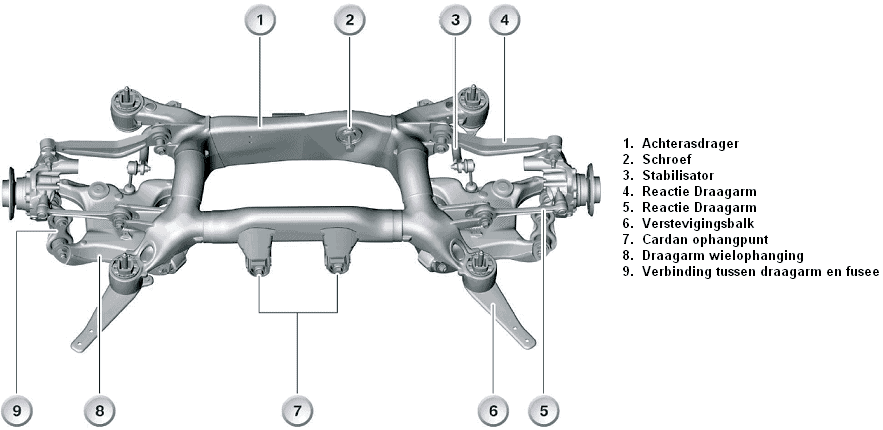
Cars with independent rear suspension also have a rear subframe. As with the front subframe, the suspension parts such as the control arms and stabilizer bar are mounted on it. In vehicles with rear-wheel drive, the rear axle differential (cardan) is also mounted to the subframe.
The following three images show the subframe of a BMW 5 Series (E60) M5.
The first image shows an overview of the attached parts. The second and third images display the subframe in removed and installed conditions from the top side (dismantled) and the bottom side.


Subframe Checkpoints:
During maintenance or inspection, the subframe should be checked at the following points:
- Condition of mounting points: rust and cracking;
- Condition of suspension bushings: cracks, drying and cracking;
- Condition of engine mounts: cracks, drying and cracking;
- Condition of control arm mounting points: rust and cracking;
- Condition of steering gear mounting points: rust and cracking.
In cases of mild rust, a subframe can be welded because it is not a wheel-guiding element. Consult the vehicle inspection manual for the current rust grade. If the subframe displays severe rust damage, has cracks, or is warped due to damage, it must be replaced.