Introduction:
To prevent the battery from draining, the quiescent current in a parked vehicle should be as low as possible. Electrical systems such as central door locks, possibly combined with an alarm system, must always stand by to receive a key signal or detect a break-in. A quiescent current of less than 40 milliamps (0.04 A) is permissible. Quiescent current is also referred to as “leakage current.”
When the quiescent current is above 40 mA, it indicates a disturbance. An electrical component or system remains active while the car is parked, resulting in a flat battery after the vehicle has been stationary for some time.
An unseen and unheard electrical consumer causing a disturbance is referred to as a “parasitic drain.” This differs from a “silent consumer.” When a battery is dead after standing overnight, it doesn’t necessarily mean there’s a parasitic drain. A battery’s internal resistance increases with age, and at low temperatures, the resistance increases further. An old battery might function well in the summer but cause starting issues in winter. Lights left on don’t fall under this, as they are easily visible.

When faced with a dead battery, first check the battery’s charge state and capacity. A battery may be defective after multiple deep discharges. A new battery will face the same issue unless the root cause is addressed. This page outlines steps to identify a parasitic drain.
Measuring Quiescent Current:
To confirm a parasitic drain and rule out issues with the battery or charging system, attach a current clamp around the battery’s ground cable. Alternatively, use the Amps setting on a multimeter for series measurement; handle with care to connect the multimeter’s probes to the negative cable and battery before disconnecting the battery post. Disconnecting the post before attaching the multimeter will make the vehicle lose power, which is undesirable.
In this example, we use the simplest method to measure quiescent current: with a current clamp. To ensure a reliable measurement:
- all consumers must be off;
- the car must be in sleep mode;
- the doors should be locked without triggering the alarm.
To access fuse boxes inside the car (in the dashboard or trunk), open all doors and lock them manually or with a screwdriver. When a car is in sleep mode, opening a door is prohibited: it will wake the car, activiating all CAN and other networks, illuminating interior lights and the instrument panel, preventing a quiescent current reading.
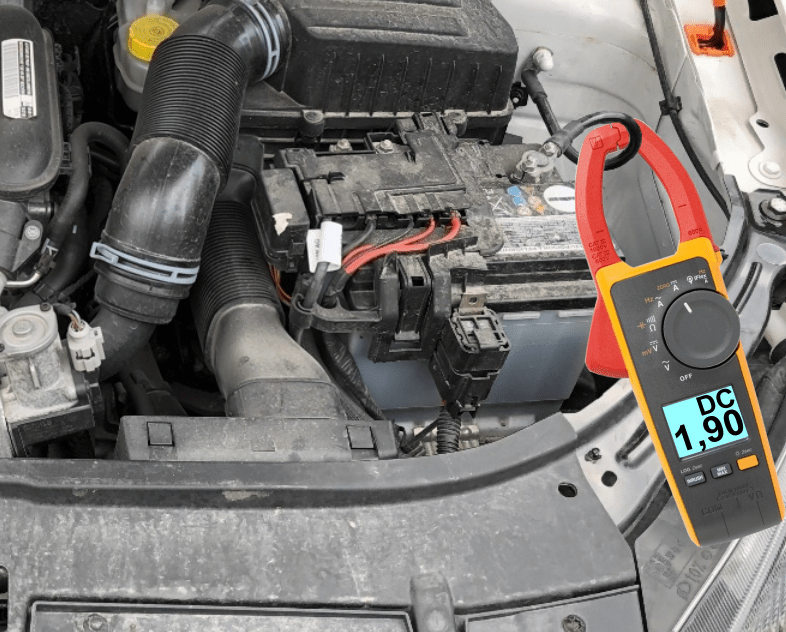
After locking all doors, it can take up to 30 minutes for the vehicle to enter sleep mode. Attach the current clamp to the battery ground cable (see image below) and read the current.
The previous section stated that the quiescent current should not exceed 40 mA (0.04 A). Here, we measure a current of 1.90 A. The quiescent current is excessive.
Instead of a digital display current clamp, use one with an oscilloscope for longer term quiescent current analysis over several minutes or even hours.
Identifying a Parasitic Drain:
The previous section shows that the quiescent current is too high. The battery discharges because an electrical component remains on. Check the fuse box for the fuse protecting this component from excessive current. The 1.90 A current passes through one of the fuses in the fuse box.
A common mistake is removing one fuse at a time from the fuse box. When the right fuse is pulled, the quiescent current drops to nearly 0 A. Identifying the circuit the fuse belongs to reveals the active component. Yet, this might inadvertently resolve an issue temporarily. For example, disconnecting an ECU’s power could reset it, remaining fault-free for weeks or months. You cannot be certain of a temporary or permanent fix.
The correct diagnosis method is measuring voltage drop across the fuse.
A fuse has internal resistance. With no current, the voltage drop is 0 mV. Current flow causes a voltage drop. The image below shows a 20 A fuse’s voltage drop measurement.
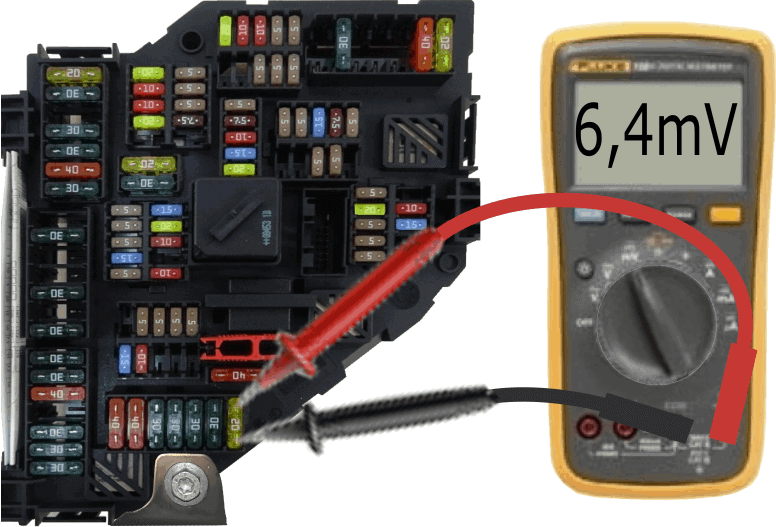
The 6.4 mV voltage difference across the fuse is found in our voltage drop chart: fuse voltage drop. The chart shows that a 6.4 mV drop in a 20 A standard fuse corresponds to a 1893 mA current.
- The 6.4 mV drop corresponds in the chart to a 1893 mA current through the fuse. This is: 1.893 A
- The quiescent current measured by the current clamp is: 1.9 A;
- The consumer behind the fuse uses 1893 mA of current;
- Quiescent current without this consumer is 7 mA;
- thus: the current through the consumer + the car’s quiescent current without this consumer is: 1893 + 7 = 1900 mA = 1.9 A.
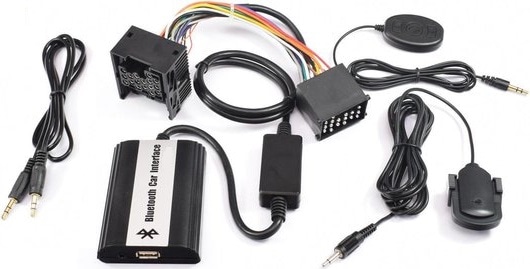
In the workshop documentation, find the fuse’s purpose in the layout diagram. In this example, the fuse protects an aftermarket Bluetooth car kit from overload. Disconnecting the Bluetooth module’s cable drops the quiescent current to 7 mA immediately, indicating the module remains active.
The following image of the Bluetooth module is used to illustrate the device hidden behind the dashboard, where its activation state is not visible. The client may have noticed this if their phone stayed connected after the car was turned off, but otherwise, no indicators. The module requires repair or replacement.
Common Causes:
A parasitic drain often comes from aftermarket or added equipment not originally included in the vehicle. Consider hands-free kits (previous example), aftermarket central door locking, devices in the 12-volt socket (hidden in the trunk or center console), or a relay that remains engaged: terminals 30 and 87 remain connected, allowing current flow without relay activation. Also, check the glovebox or trunk light; especially in older cars, faulty switches leave them on without ECU detection, or disable during sleep mode.