Measuring piston ring clearance:
Pistons are often fitted with two compression rings and one oil scraper ring. When we replace piston rings, the clearance in the piston ring groove and the ring gap must be checked.
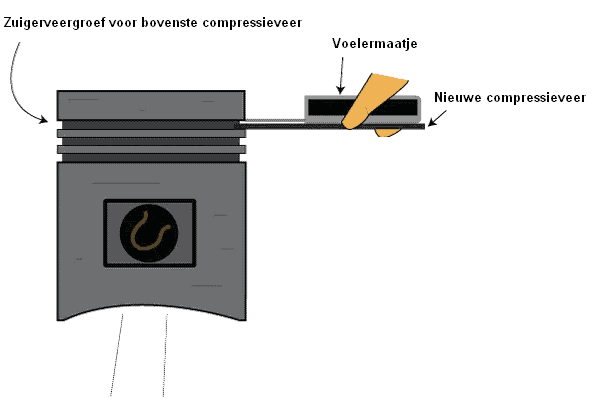
The following image shows the measurement where the clearance in the piston ring groove of the piston is checked. A feeler gauge and a new compression ring are simultaneously inserted into a piston ring groove. The clearance should, in most cases, only be between 0.025 and 0.050 mm.
Measuring ring gap:
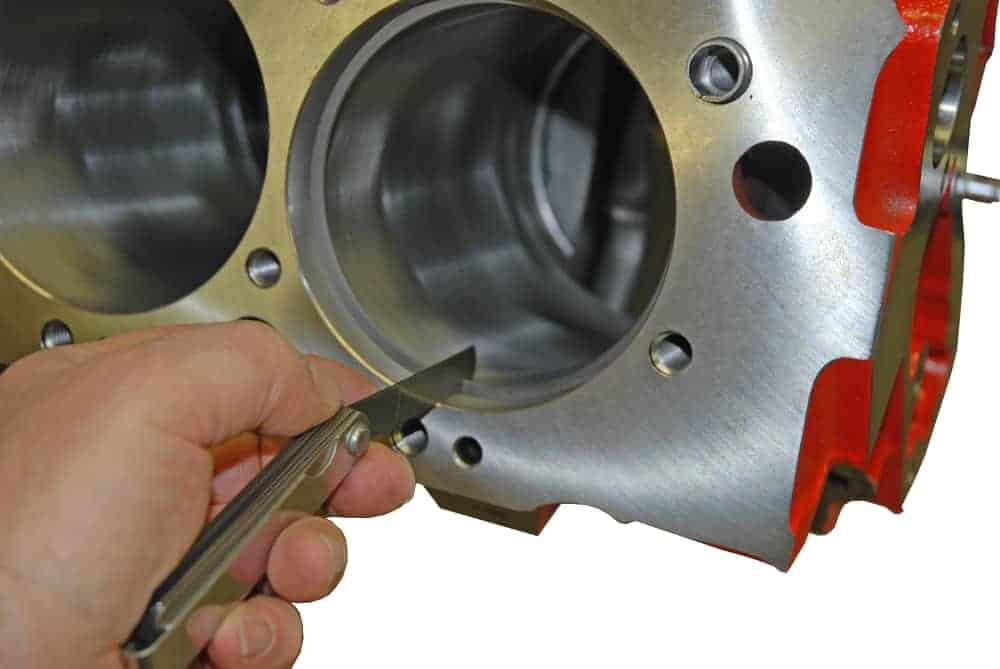
The ring gap is the space between both ends of a piston ring in the mounted position. To measure the ring gap, we place the piston ring in the respective cylinder. We keep the piston ring relatively high in the cylinder; any wear on the cylinder wall (often around the middle) does not affect the measurement.
With a feeler gauge, we check how much space (read: ring gap) is present between the ends.
- A gap that is too large results in many leakage gases and thus compression loss;
- With too small a ring gap, or no ring gap, friction, and thus wear, or even a seizure may be caused.
A rule of thumb is a clearance of 0.05 mm per centimeter of piston diameter.
Installing piston rings:
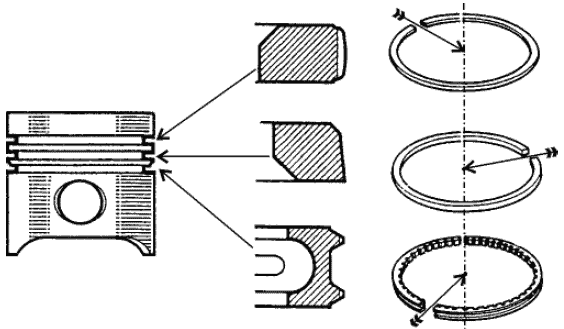
When performing installation tasks, one must pay close attention to the correct installation position. In most cases, the piston rings are marked with “Top” or “Oben”. This marking must point towards the piston crown (top).
The piston rings should also be positioned accordingly. In the example, the piston ring gaps are staggered 120 degrees from each other. Always avoid having the piston ring gaps directly aligned with each other.
Related pages: