Fuel trims (LTFT and STFT):
Fuel trims are formed from the data of the oxygen sensor. Fuel trims are used in a gasoline engine to maintain the ideal air/fuel ratio for complete combustion, which is 14.7 kg of air to 1 kg of fuel, known as the stoichiometric mixture.
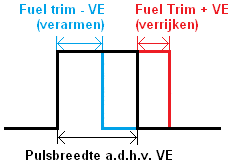
Fuel trims act as a corrective factor to adjust the base amount of injected fuel when necessary. It considers the wear and contamination of engine parts, sensors, and actuators. Using fuel trims, exhaust emissions are kept within legal norms throughout the vehicle’s lifespan. In a positive fuel trim, the ECU tries to enrich the lean mixture. In a negative fuel trim, the opposite occurs; the rich mixture is made leaner. Consequently, the control pulse of the injector is made longer or shorter.
The following image shows the fuel trims for a rich mixture (-25%) and a lean mixture (+25%).
- The negative fuel trim means that the injectors need to inject less fuel.
- The positive fuel trim means that the injectors need to inject more fuel.
At a fuel trim of 0%, no compensation is required because the stoichiometric mixture ratio is present at that moment.
There are two types of fuel trims;
- Short Term Fuel Trim (abbreviated as STFT) refers to what the engine management is doing at the moment to adjust the air/fuel mixture. The STFT constantly changes while the engine is running due to short-term adjustments and temporary changes. This is also known as the “short-term adjustment.” The STFT resets when the engine is turned off.
- Long Term Fuel Trim (abbreviated as LTFT) consists of adaptive learning values that are formed from the STFT over a longer period. This is also called the “long-term adjustment.” The LTFT is stored in the “Keep Alive Memory” (KAM), which is not reset when the engine is turned on and off. The LTFT is stored in the readiness test. It can only be cleared with diagnostic equipment or by disconnecting a battery terminal. The latter is not always possible.
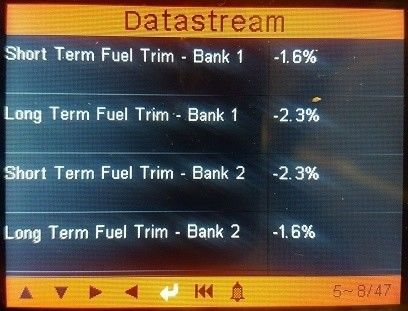
Both the STFT and LTFT values should be as close to 0% as possible. Depending on the condition and usage conditions of the engine, LTFT values can vary from 5 to 8%. The LTFT and STFT values indicated by the reading device in the image below are within tolerances and are, therefore, okay.
In the above image, the STFT and LTFT of “Bank 1” and “Bank 2” are displayed. This engine, therefore, has two cylinder banks, indicating a V-engine. It’s often indicated which is cylinder bank number 1 and number 2 on the engine. Otherwise, consult the engine specifications if in doubt.
Fuel trim values exceeding 10% often indicate a problem. There might not yet be an error code stored. For fuel trims lower than -20% or higher than 20%, the engine management will store an error code related to a rich or lean mixture.
The LTFT values remain constant for a long period because these values are measured and stored in the readiness test over a long timeline (see the OBD page). The STFT values frequently fluctuate over the screen during varying engine loads due to a throttle that opens or closes further.
Studying the fuel trims can be helpful in diagnostics. In cases where there are no faults or when the fault is not related to the complaint, fuel trims can provide insights. When the LTFT is slightly less than 10%, no fault is stored, but it indicates that the mixture is on the lean side.
The emergence of STFT and the transition to LTFT:
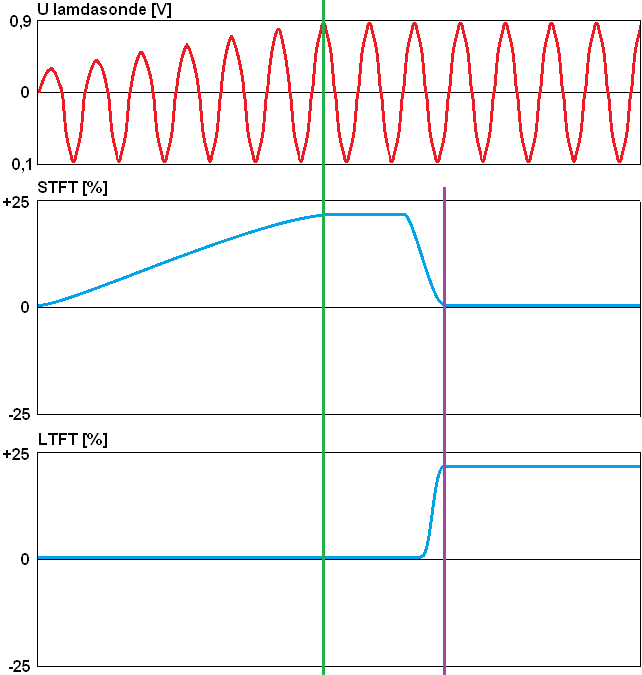
The top part of the next image shows the voltage progression of the oxygen sensor (zirconium/switching sensor), the middle part shows the short term, and the bottom part shows the long-term adjustment.
The oxygen sensor signal becomes negative (0.1 volts) but not sufficiently positive (0.25 volts). The engine management recognizes this as a lean mixture.
To enrich the mixture, additional fuel is injected. This correction is reflected in the STFT percentage: the blue line rises. At that moment, nothing changes with the LTFT.
As the STFT rises, the oxygen sensor continuously measures a richer mixture. The STFT continues to rise until the voltage has reached the desired value of 0.9 volts. This point is indicated by the green vertical line.
Now that the STFT has assumed a certain value, it is kept constant for a period. If it turns out that the oxygen sensor signal is correct, the LTFT adopts the value of the STFT. The purple vertical line indicates the moment of this transition.
The STFT drops to 0%, and the LTFT has adopted the positive value. The percentage exceeds the threshold value of 10%. The MIL will illuminate. Thanks to the corrective factor, the engine will continue to run properly.
After repairing the issue, one can erase the learning values. This is not necessarily required: the fuel trims will naturally adjust again.

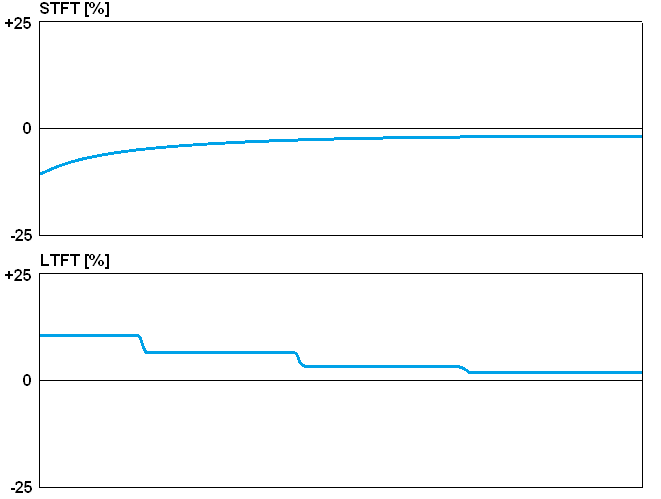
Example: a vacuum leak has caused an LTFT of 7.8%. After the repair, a test drive is made. Now that there is no longer false air, the correction now results in a rich mixture. The STFT immediately picks this up and turns negative. The following four images are taken at different times during the test drive.
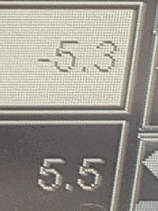
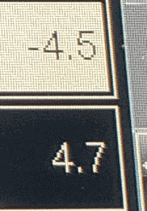
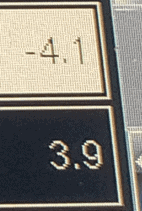
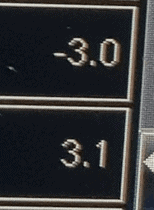
The LTFT in the previous image is 5.5%. To compensate for this, the STFT is -5.3%. This is also seen in the second, third, and fourth images: the positive LTFT value is compensated by a negative STFT value.
The following graphs indicate the percentage over time.
- Before the repair, the STFT was 0% and the LTFT positive;
- During the test drive after the repair, the STFT starts negative to offset the LTFT value
- The LTFT decreases step by step: between each correction, the value remains constant for a while;
- The LTFT eventually becomes 0%
For a technician, it is important to look at this: are the STFT and LTFT values mirrored after the repair:
- +15 and -15, or
- -5 and +5.
This indicates that the resultant is 0%, meaning the repair was successful.
Possible causes of a rich mixture (negative fuel trim):
- Faulty fuel injector; if the injector is leaking, more fuel will enter the combustion chamber than the engine management has calculated and controlled.
- Air supply issue in the engine due to a heavily clogged air filter or blockage in the intake.
- Problem with the oxygen sensor; a defect or a clogged hole through which the oxygen sensor measures the oxygen content in the outside air.
- Problem in the fuel supply due to a defective fuel pressure regulator or an issue with the fuel return.
- Incorrect coolant temperature.
- Problem with EGR.
- Compression loss.
- Insufficient valve clearance.
Possible causes of a lean mixture (positive fuel trim):
- Leakage in the exhaust, causing not all exhaust gases to be measured by the oxygen sensor.
- Vacuum leak, for instance in the intake hoses of the engine (between the mass airflow sensor and the intake valve), a cracked crankcase ventilation hose, a cracked vacuum brake booster hose, etc.
- Faulty fuel injector; it’s injecting too little to nothing.
- Defective or contaminated oxygen sensor.
- Defective or contaminated mass airflow sensor.
- Restrictions in the fuel supply due to, for example, a clogged fuel filter
- Defect in the fuel pump resulting in insufficient fuel pressure.
Possible cause of both a positive and negative fuel trim in an engine with two cylinder banks:
An engine with two cylinder banks (V-engine) has two exhaust manifolds and therefore also two (regulatory) oxygen sensors that can determine the mixture ratio per cylinder bank. If the engine is equipped with a single mass airflow sensor, and when a fault (e.g., cylinder misfire) is read, the fuel trims may show a negative trim on bank 1 and a positive trim on bank 2, for instance:
- bank 1: LTFT -10
- bank 2: LTFT +12
In this case, a correction on bank 1 is made to make the mixture leaner (due to oxygen deficiency), and bank 2 richer (oxygen surplus). This could be due to incorrect distribution timing. Check in this case the timing of the crankshaft relative to the camshafts. Be aware that in electrical timing control (checking the ratio between the crank and camshafts with the scope), there might be camshaft adjustment involved. One may also opt for a mechanical check using locking tools. This doesn’t apply to engines with two mass airflow sensors (one for each cylinder bank).
Related pages: