Introduction:
In chiptuning, the maps in the ECU (engine control unit) are adjusted to achieve higher power output or lower fuel consumption (known as Eco-tuning).
Often, the ignition maps, turbo pressure, and air/fuel mixture composition are adjusted.
Turbocharged or supercharged engines are well-suited for chiptuning, both gasoline and diesel engines. Naturally aspirated engines (those that must draw in air themselves) are rarely suitable for chiptuning. Power and torque often increase by only a few percent, which is hardly noticeable during driving.
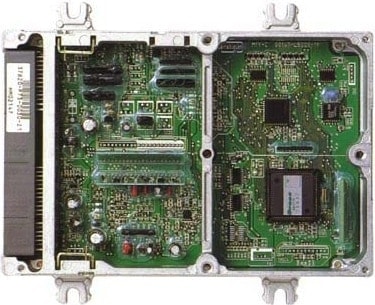
You might wonder why car manufacturers do not directly give a car more power. Usually, the reason is that global emission standards are deliberately met by specific settings, or that a single type of car has multiple engines with the same cylinder capacity but different power outputs. Tuning cleverly plays into this. After tuning, the car must of course still meet legal emission standards.
Chiptuning:
Adjusting Ignition Map:
Every gasoline engine has a certain advance ignition. In chiptuning, the ignition advance limit is slightly increased.
For example: In a certain engine with factory software, the ignition varies between 30 and 40 degrees before TDC at an engine speed of 4700 rpm. When increasing the engine speed to 5000 rpm, the engine will switch to 0 degrees of ignition advance.
The tuner will raise the limit at 5000 rpm to, say, 5200 rpm before switching to 0 degrees of ignition advance. This results in a power gain because the combustion pressure is higher at this engine speed.
Turbo Pressure:
By increasing the maximum turbo pressure, a greater amount of air enters the cylinders. By adjusting the fuel amount (injection time) accordingly, significant power gains are achieved. The turbo pressure is regulated by the wastegate, which opens at a certain pressure (e.g., 0.8 bar). The tuner will increase this pressure to, for instance, 1 bar. The valve will only open when a boost pressure of 1 bar is reached.
Injection Time:
By adjusting the injection time, a larger amount of fuel can be supplied to the incoming air. When the turbo pressure is increased (more incoming air) and more fuel is injected, a substantial power gain is achieved.
Not only must the maps of the ignition, turbo pressure, and injection time be adjusted, but also the maps of all sensors and actuators of the engine.
As an example, the knock sensor: If its maps are not changed, this knock sensor will react to the injection time not matching with factory values. This results in a fault code in the ECU (and it might end up in a limp program). Therefore, each map of every sensor must be programmed to account for the adjustments made.
Software Chiptuning:
Nowadays, all chiptuning is loaded into the ECU software. Through the OBD connector, the software is read from the car’s ECU, adjusted, and then reloaded.
Many tuners offer complete packages for various engine types. This software is thoroughly tested and stored.
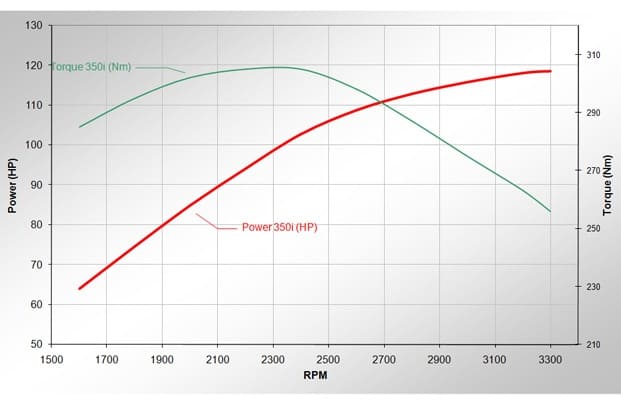
If the car owner has made modifications to the engine themselves (such as a larger turbo, larger intercooler, different injectors, etc.), a new tuning program must be written. The car is usually placed on a dynamometer. The values in the ECU are read and adjusted. By then performing additional power tests, one can determine if the desired results were achieved by examining the power and torque curve graphs. If the torque or power line has a significant drop somewhere, this may indicate poor programming. By adjusting the software multiple times and rerunning tests, a precise power and torque curve is achieved (see image).
Replacing the Original Chip (Hardware):
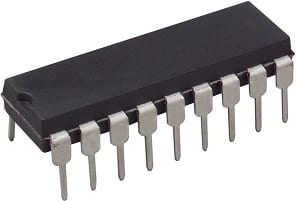
The original chip is removed from the ECU and a new chip with the preprogrammed tuning software is soldered in. These chips cannot be programmed via the OBD connector. However, this is an older technique and is no longer applied to current new cars.
Installing an Extra ECU:
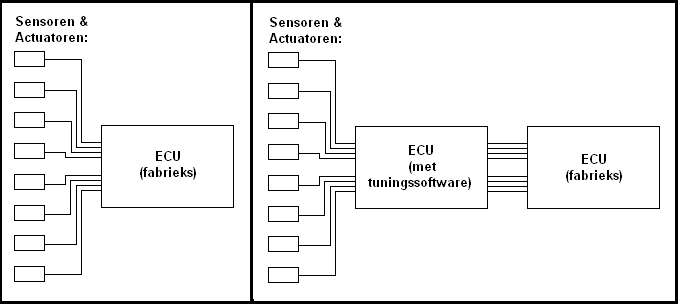
In this tuning method, a separate ECU with a cable set is supplied. The original ECU is retained, and an extra ECU with tuning software is connected. The cable set is simply a bypass system between two ECUs. This technique is becoming more common in the tuning of, among others, Volkswagen vehicles. The left diagram shows the original ECU, and on the right, the ECU with tuning software connected to the original ECU.
Powerbox:
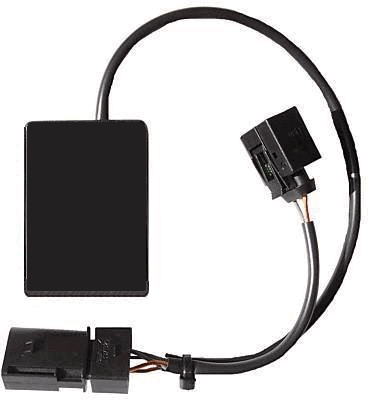
A powerbox is usually the cheapest but also the worst way to tune. The powerbox manipulates the input signals to the ECU, meaning that the signals the sensors send to the ECU are modified. Typically, the signals from the fuel (rail) pressure, temperature sensors, and the mass airflow sensor are altered. The consequences include rising fuel pressure/rail pressure and an incorrect air/fuel ratio due to the adjusted air mass meter signals.
The power output will have slightly increased (less than with chiptuning), but the lifespan of the engine components will decrease significantly. Additionally, internal engine contamination will increase. Therefore, a powerbox is not recommended.
Related Pages: