Introduction to Brake Fluid:
Brake fluid transfers the force exerted by the foot on the master cylinder to the wheel cylinders. It is composed of polyglycol derivatives with various additives. It is a thin fluid with a low freezing point that can quickly move through narrow pipes and passages.
The image shows the brake fluid circuit of a passenger car. The system is cross-separated;
- Front left with rear right;
- Front right with rear left.
The master cylinder pressurizes the system. The brake fluid moves through the lines to the disc brakes and/or drum brakes.

The brake system of an average passenger car contains approximately 0.25 to 0.5 liters of brake fluid. This small amount must withstand pressures up to 15,000 kPa at very high temperatures.
Most of the heat is dissipated via the brake discs/drums to the surrounding air. A small portion enters the brake fluid through the brake shoes/pads and the wheel cylinders. Components of brake fluid can attack paint and varnish. If brake fluid comes into contact with the paint layer, it must be thoroughly rinsed with water immediately.
Vapour-Lock:
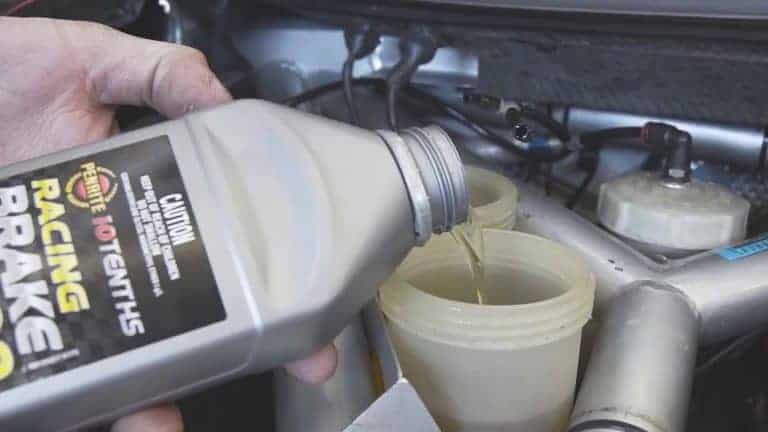
Vapour-lock occurs when the brake fluid boils; for example, when the car is stopped after prolonged braking or driving slowly without braking. The cooling effect of airflow is then minimal. When brake fluid boils, the boiling point is exceeded. Therefore, it must have a high boiling point to prevent vapor lock formation. With vapor in the brake system, no pressure can be built up.
Properties of Brake Fluid:
Brake fluid must meet certain requirements to ensure the reliability of the brake system. Also, it offers protection for the internal components; consider the cups in the master cylinder and the inside of the brake lines. This section mentions several properties.
Boiling Point:
The boiling point is indicated by a DOT code. DOT stands for “Department Of Transport”.
When brake fluid boils, vapor bubbles form. These vapor bubbles are compressible, resulting in less pressure being built up. Water also causes corrosion in the brake system. Therefore, brake fluid must have a high boiling point. Two types of boiling points are used:
- Dry boiling point: this is the boiling point of new, packaged brake fluid.
- Wet boiling point: this is the boiling point when the brake fluid has absorbed approximately 3.2% water. Brake fluid is hygroscopic (absorbs water). Water lowers the boiling point of the brake fluid. At 1% water, the boiling point is reduced by about 25 degrees.
| Brake Fluid Requirements | DOT 3 | DOT 4 | DOT 5 | DOT 5.1 |
| Dry Boiling Point: | 2056F | 2306F | 2606F | 2606F |
| Wet Boiling Point: | 1406F | 1556F | 1806F | 1806F |
Brake fluid should be replaced every two years because moisture and dirt gradually contaminate it, thus lowering its boiling point over time.
Hygroscopic:
Hygroscopic means the brake fluid absorbs or binds water. Water causes corrosion in the brake system and leads to vapour-lock.
Viscosity:
Brake fluid must maintain the correct viscosity (thickness) at high and low temperatures.
Foaming:
Brake fluid must not be foaming.
Protection:
Brake fluid must provide protection against corrosion in, for example, the brake pipes and hoses.
Related Pages: