Torsional vibrations:
The crankshaft is loaded in two ways: bending and torsion. The bending forces occur when a connecting rod is pushed down by a power stroke. Torsional forces arise because one part of the crankshaft wants to rotate while the other part does not (twisting). When these twisting forces are removed, the crankshaft springs back to its original state. Thus, all pistons exert force on the crankshaft. A torsional vibration is not only dangerous at certain high rotational frequencies, but the vibration can also be amplified by a combustion force that is stronger than another (for example, with a defective coil).
Vibration damper:
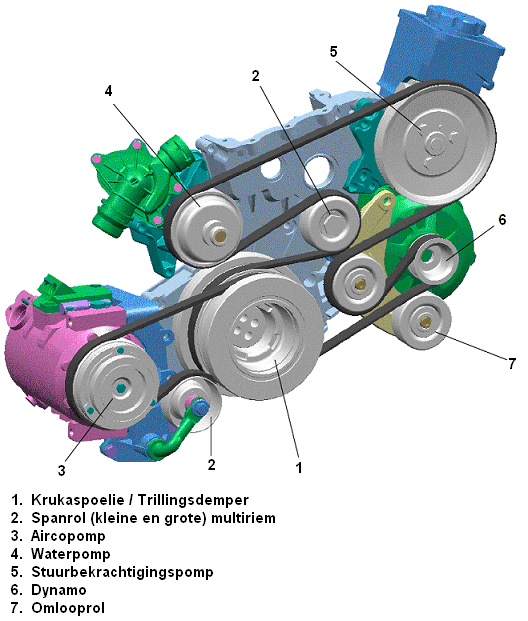
The vibration damper attached to the crankshaft is used to dampen torsional vibrations as much as possible. This torsional vibration damper also serves as the serpentine belt pulley, over which the serpentine belt runs (see image below). The vibration damper consists of two metal parts with a rubber ring in between. One metal part is fixed to the crankshaft, and the other part acts as a flywheel. Due to the elasticity of the rubber between them, a certain amount of movement is possible. This has a damping effect on the vibration, thereby reducing it. The vibration damper is not capable of completely eliminating all vibrations, but it can limit them.
Related pages: