Introduction:
The purpose of the suspension system is to absorb the movements of driving over road irregularities as effectively as possible, so that maximum driving comfort is maintained. The handling is also affected by the suspension. When the suspension is very soft (think of old American cars) the handling will be considerably worse than a car with a stiff suspension. This is because a very softly sprung car loses its grip upon rebound (e.g., during hard braking or taking sharp turns). The pressure of the tires on the road surface is much less with a fully extended wheel than with a compressed wheel, and therefore will slide much faster. Also, when taking sharp corners at high speed, the chance of breaking free is very high because the grip of the tires on the inside of the corner is minimal.
When a very softly sprung car drives over a hilly, paved road surface, the car will sway a lot upon rebound. When the car is fully extended, the pressure on the tires is less, so braking and steering is not or hardly possible at that moment.
In a car with stiff suspension, especially sports cars or lowered cars, the grip when taking sharp turns on all 4 wheels will be maximized. The sway bar and tire size also have a great impact on this. When a lowered car drives over a hilly, paved road surface, the car will remain firmly on the road and will not experience problems with sudden hard braking in an extended state.
The soft and stiff springs (in cars with coil springs) deal with a spring constant. To optimize a car’s suspension (depending on the design), softer springs for comfort (linear springs) or stiffer springs for sportiness (progressive springs) can be installed. More on this in the Spring Constant chapter, further down the page.
McPherson:
The main advantage of the McPherson strut is that the spring and shock absorber are combined. This saves a lot of space and is also easy to design when designing the car. As a result, production costs are low.
The McPherson suspension is a further development of the suspension with two transverse control arms (also called a double wishbone design). The upper control arm is replaced by the piston rod of the shock absorber, which also absorbs lateral forces. Therefore, in case of a collision with the wheel (by another vehicle or when driving over a curb), the piston rod is usually directly damaged. It deforms very quickly and thus becomes bent. The complete shock absorber must then be replaced.
The McPherson suspension is always applied at the front of the car. Struts are also sometimes used on the rear axle, but they are not of the McPherson type. In rear suspension, coil springs and shock absorbers are often mounted separately.
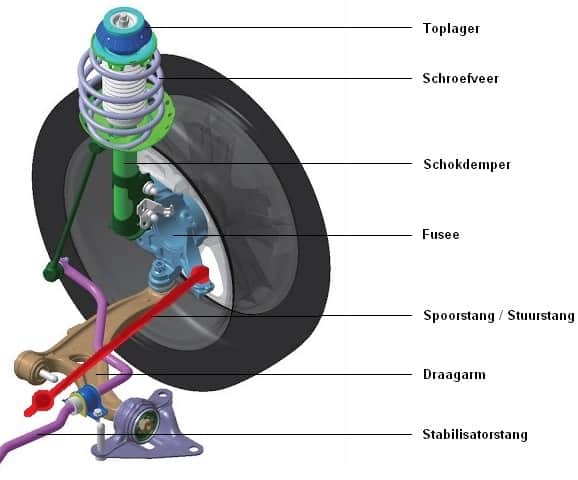
On top of the strut is the top bearing. The top bearing allows steering movements. The strut is often attached to the body under the hood with bolts. This is thus a fixed point. The top bearing, located beneath it, ensures that the complete strut can rotate smoothly relative to the upper fixed point. This system with a supportive function and a pivot point with a top bearing is called the McPherson system.
Coil Springs:
The operation of a coil spring is based not on bending as you might initially think, but on torsion (twisting). When the spring is compressed, the spiral rod is twisted. The entire vehicle’s weight is supported by the coil springs. The coil spring is trapped between the top bearing and the lower spring cup. When the vehicle compresses, the top bearing pushes the coil spring down. As it twists, a counterforce is generated. This counterforce is ultimately the spring action. The more counterforce the spring exerts, the stronger the spring is.
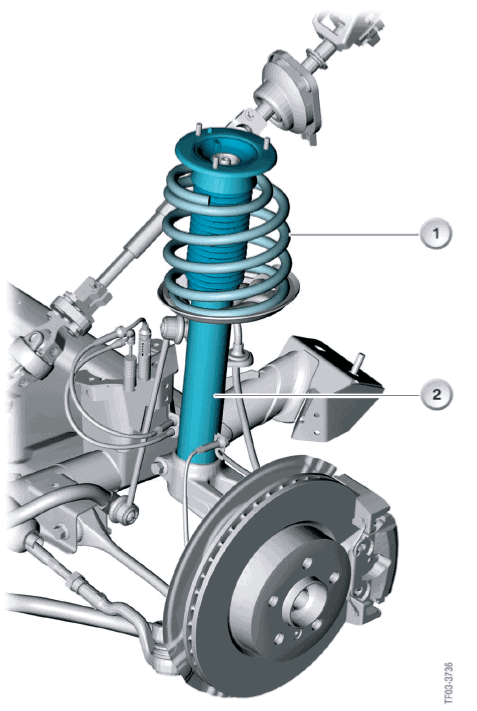
Spring Constant:
The compliance of a spring is indicated by the spring constant. The spring constant of a linear coil spring is different from that of a progressive coil spring. In a linear spring, the distance between all coils is equal. In a progressive spring, these distances are not equal; the coils will be closer together at the top or bottom of the spring than elsewhere. The difference between these two types of springs is shown in the image:
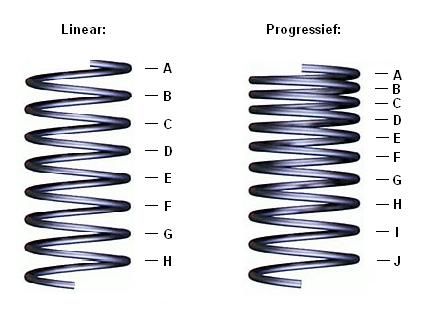
In a linear spring, the spring always compresses a certain distance under a certain weight. Below is an example of the spring travel of a linear spring:
- +100 kg additional load compresses the car by 2 cm.
- +200 kg additional load compresses the car by 4 cm.
- +300 kg additional load compresses the car by 6 cm.
There is now a proportional relationship between weight and distance for this linear spring. Below, the compression of a linear spring is depicted; the greater the force on the spring, the greater the spring travel. The lines are perfectly straight because the distance between all coils of the spring are equal to each other.
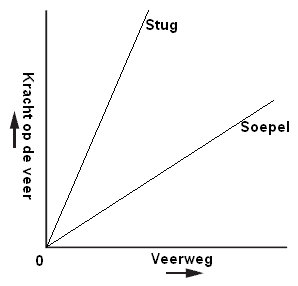
In a progressive spring, there is no direct relationship between weight and distance. This spring becomes increasingly stiff as it compresses further. The first section compresses easily, but with increased load, it compresses less. This is because the coils at the top are closer together. Below is an example of the spring travel of a progressive spring:
- +100kg additional load compresses the car by 2 cm.
- +200kg additional load compresses the car by 3 cm.
- +300kg additional load compresses the car by 3.5 cm.
Below is the graph of a progressive spring. At first, with increasing force on the spring, the spring travel also increases. The line is not perfectly straight, but slopes upward. This means that if the force on the spring continues to increase, the spring travel becomes less. The car will therefore compress less with increasing force on the spring.
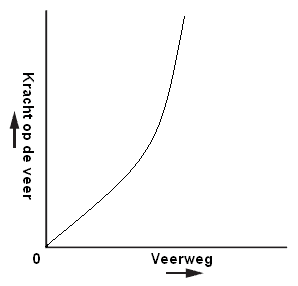
Automobile designers are always looking for the best balance between comfort and the driving characteristics of the vehicle. By adjusting the progressivity of the spring (placing more or fewer coils closer together), the spring travel can be adjusted. The diameter of the coil itself also greatly influences the amount of torsion possible. For each car, this will be different. Even for the same type of car with different engine sizes, types of engines (gasoline or diesel), or sport packages, there are all different types of springs.
Lowering springs often compress a lot in the initial section, so the car stands lower above the road in the neutral position. Therefore, it must be more difficult for the car to compress, so the springs are made extra progressive. Otherwise, the vehicle would hit the road surface too quickly. Because the springs compress less easily, the vehicle becomes stiffer; this is considered unpleasant by some people.
Leaf Springs:
Leaf springs consist of multiple layers mounted on top of each other. The uppermost layer is called the main leaf. The more layers a spring has, the stronger and stiffer it becomes. In the past, they were occasionally mounted on passenger cars. The leaf spring back then usually consisted of a few layers, sometimes just the main leaf. They are still used in commercial vehicles, though these are, of course, much thicker. The middle of the leaf springs is attached to the axle and the ends to the body or chassis. The springing action is achieved by the bending of multiple layers in the middle of the total length.
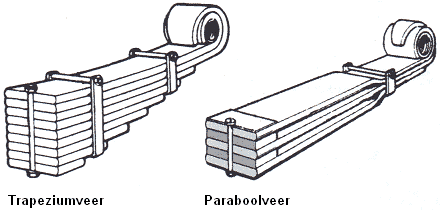
There are 2 different types of leaf springs:
- Trapezoidal Spring: The leaf lengths vary, and they are all the same thickness throughout.
- Parabolic Spring: All leaves are the same length and are thicker in the middle than at the ends. There is also space between the leaves. Parabolic springs are more flexible than trapezoidal springs and have less mass.
Air Suspension:
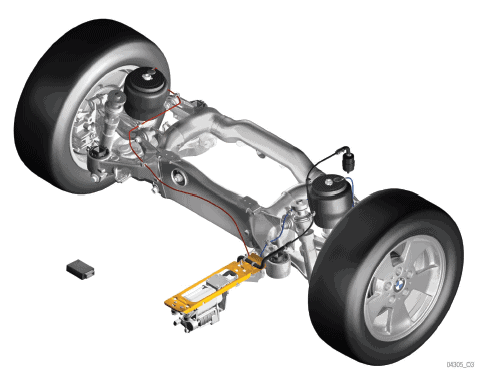
Air suspension is less commonly used than coil springs on passenger cars. It is used, for example, in an Audi A8, BMW 7 series, or X5. These cars often have air suspension on all four wheels. Some cars have struts with coil springs in the front and air suspension in the rear.
The image shows a rear suspension with air bellows. Inside the car (often in the lower part of the trunk), there is a pump that pumps air into the air bellows. The air bellows expand in length, allowing the weight of the car to rest on them. Often, there is a sensor on a control arm that detects how much the car is compressed under load (people sitting in the back, or a heavy trailer). Based on these measurements, the air pump can inflate the air bellows a bit more, so the car does not tilt backward.
Torsion Suspension:
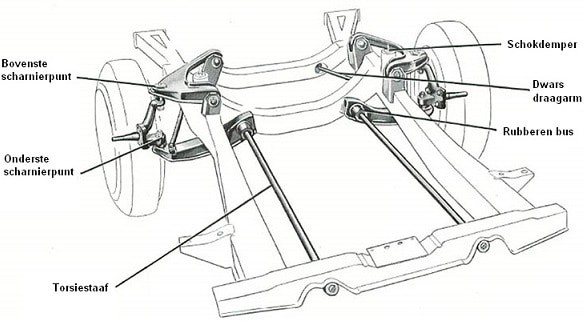
Torsion is another word for “twisting”. Torsion suspension was primarily used in the past on American cars. The lower control arm of this design is connected to the body via a torsion bar. When the vehicle compresses, the upper and lower pivot points move. The control arm into which the torsion bar is inserted will want to pivot around the torsion bar. However, that is not possible because the torsion bar has a fixed connection within the control arm. The other end of the torsion bar (in the image at the bottom) is fastened to the body.
This means that when the wheel compresses, the rod is stressed by twisting. This twisting builds resistance (the further the wheel compresses, the more the torsion bar is twisted). The compression becomes heavier as the torsion increases. This entire front axle suspension of the car works on this principle. That is also one of the reasons why old American cars compress and rebound so easily and smoothly.
Hydropneumatic Suspension:
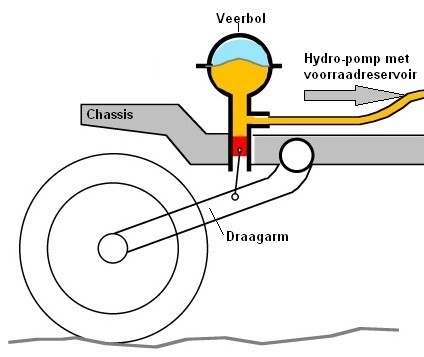
Hydropneumatics is a combination of hydraulics and pneumatics. This system has been used by Citroën since the 1950s and is still found in their models.
In the sphere, there is compressed gas (represented in the image in blue) that is compressible. The hydraulic fluid (represented in yellow) is not. As the wheel compresses, the red piston is pushed up by the control arm, compressing the gas chamber. The blue space becomes smaller as a result. When the wheel rebounds and the piston moves downward, the system returns to its original state. The springing and damping action is generated by compressing this pressurized gas.
The system can be adjusted by controlling the oil quantity (in yellow). By adding extra oil to the system under heavy load, which happens automatically thanks to the hydraulic pump, the ride height increases. The vehicle will then be lifted higher on its springs. When the load is removed (or people get out), the oil in the system returns to the reservoir via a pressure valve. The ride height will then decrease.