Subject:
Steering Error:
The Ackermann principle ensures that when steering, one wheel steers more than the other wheel. For more information, see the page Ackermann Principle and toe-out on turns.
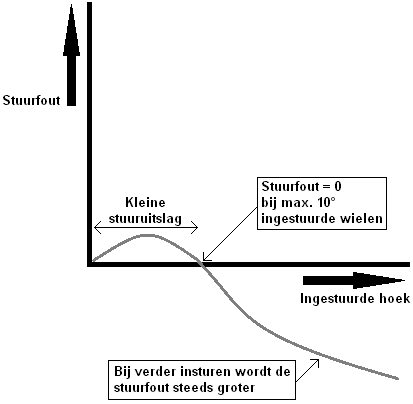
Upon reviewing the mentioned pages, it will be clear that the left front wheel and the right front wheel each have a different steering angle. Thus, a steering error almost always occurs. The steering error means that the two steered angles are not equal to each other, and therefore one wheel has more slip than the other. There is only one situation where no steering error occurs. This is during steering with a small steering angle, up to approximately 10 degrees (see image).
On the X-axis in the image is the steered angle, and on the Y-axis the steering error. In the bottom-left corner (thus at X = 0), the car is driving straight ahead. The line under “Small steering angle” runs positively over the X-axis. This line indicates that the steering error at a maximum of 10 degrees of steering is 0. Thus, at a maximum of 10 degrees of steering, there is no steering error. There is no slip on the front wheels at this angle. This is deliberately designed this way because when driving at high speeds (e.g., on the highway), steering is often around 10 degrees. At high speeds, the front wheels have no slip with a maximum of 10 degrees of steering, ensuring maximum grip. When steering further, the steering error becomes significantly larger. This is generally not a problem since it’s usually in the city at lower speeds. At lower speeds, the steering error has less impact than at higher speeds.