Introduction:
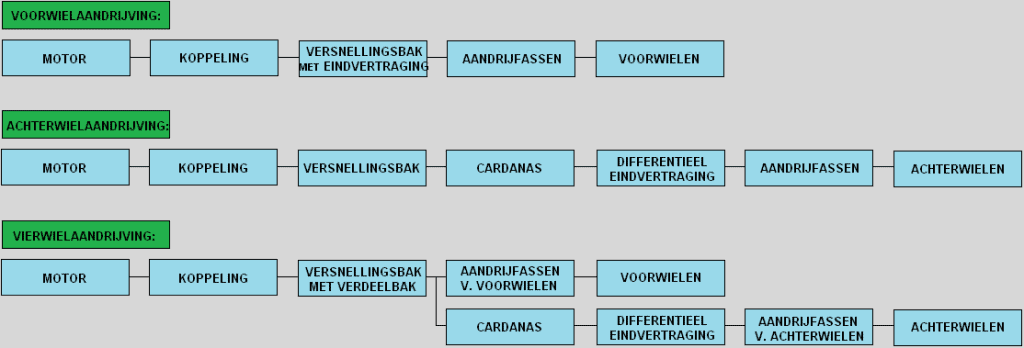
Front-wheel or rear-wheel drive indicates which wheels transmit the engine’s driving forces. Most car manufacturers choose front-wheel drive. The engine provides the driving forces. In a manual transmission vehicle, the transmission is operated with the clutch, whereas in an automatic transmission vehicle, this occurs within the transmission itself. The power eventually reaches the wheels through the drive shafts.
Front-Wheel Drive:
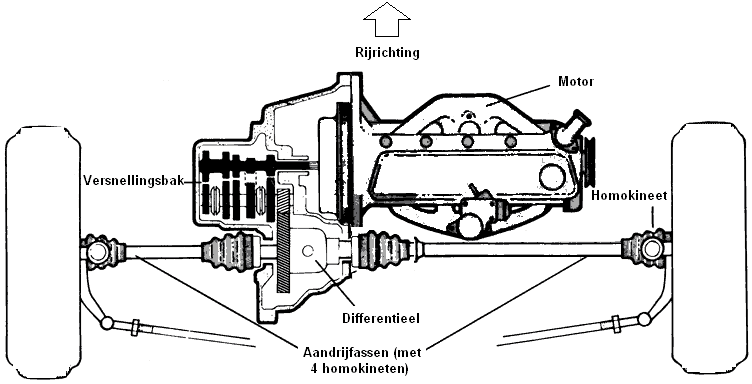
In front-wheel drive, the front wheels are connected to the transmission (with an internal differential) via the drive shafts. The engine is usually transversely mounted to save space. Car manufacturers often choose front-wheel drive. It is cheaper than rear or all-wheel drive because it uses fewer materials, saves space, and is less prone to vibrations compared to rear-wheel drive.
Rear-Wheel Drive:
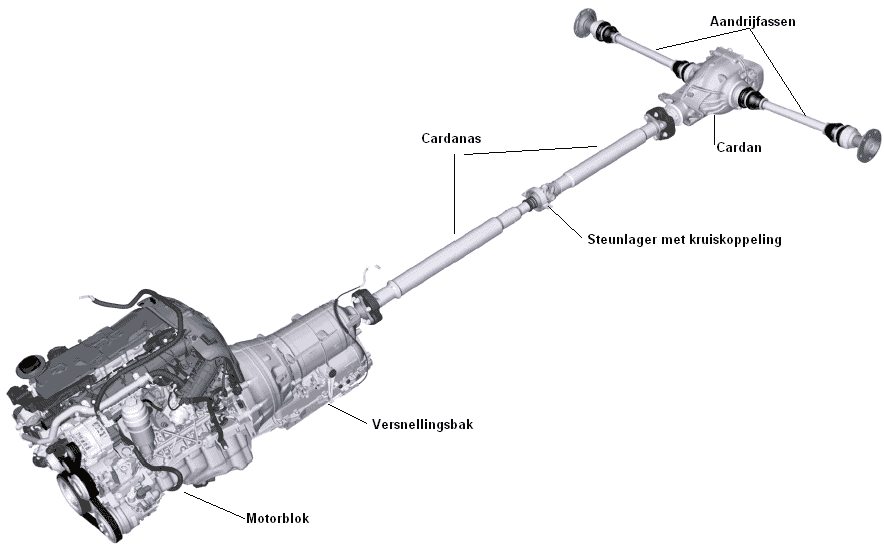
In cars with rear-wheel drive, the engine is longitudinally mounted. A driveshaft (or propeller shaft) runs under the car from the transmission to the differential (hidden above the exhaust).
Cars with high power and rear-wheel drive are often more susceptible to oversteer (where the car makes a larger corner than needed, with the rear wanting to overtake the front). Therefore, options like ASR are not a luxury. Rear-wheel drive is used less often by manufacturers compared to front-wheel drive. Primarily, high-power cars (including BMW and Mercedes) use rear-wheel drive. They also aim for an ideal weight distribution between the front and rear axles. By placing the engine longitudinally, the transmission is positioned under the center console within the interior. This places the transmission closer to the rear axle. Thus, the center of gravity shifts more towards the rear.
Another advantage is that more power can be transferred to the road surface in this manner. When accelerating aggressively with a car with over 250 hp, the weight on the car’s rear wheels increases significantly, just as the weight on the front wheels increases when braking. When accelerating, the weight on the rear wheels increases, reducing the chance of slipping significantly compared to if the car were front-wheel driven.
Cars with rear-wheel drive also have a specially shaped fuel tank, since the driveshaft and differential are mounted under it. A saddle tank with an additional jet fuel pump is fitted.
All-Wheel Drive:
In cars with all-wheel drive, as the name implies, all four wheels are driven.
The advantage is that all engine power can be used for acceleration without wheel slippage, and there is much more grip on unpaved roads. Off-road vehicles often have all-wheel drive because, with the help of the ASR system, sufficient power can often be transmitted on surfaces where a front-wheel or rear-wheel drive vehicle would get stuck (think of snow, sand, or mud). Additionally, high-performance cars with significant power may also feature all-wheel drive.
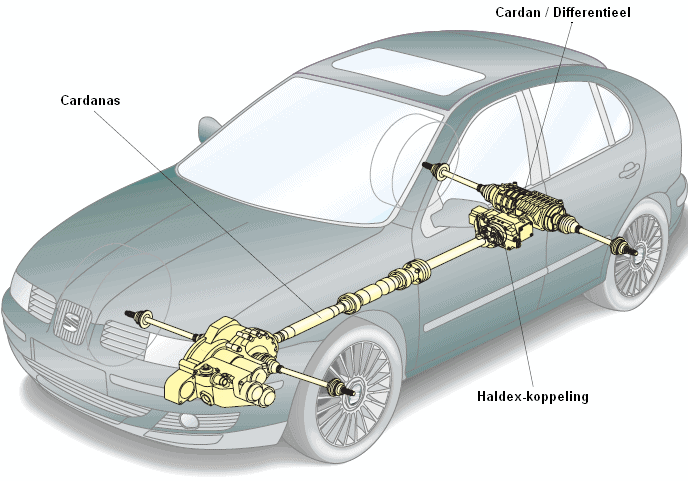
There are various systems in which there is no permanent drive to all four wheels simultaneously. This website describes two different systems: the Haldex coupling and a transfer case mounted on the transmission.
Haldex Coupling:
Used in VAG brands, such as VW, Audi, Seat, and Skoda. The Haldex coupling is located at the rear axle and controls the driving forces from the driveshaft to the wheel drive shafts. The front wheels are constantly powered.
Click here for more information about the Haldex coupling.
Transfer Case:
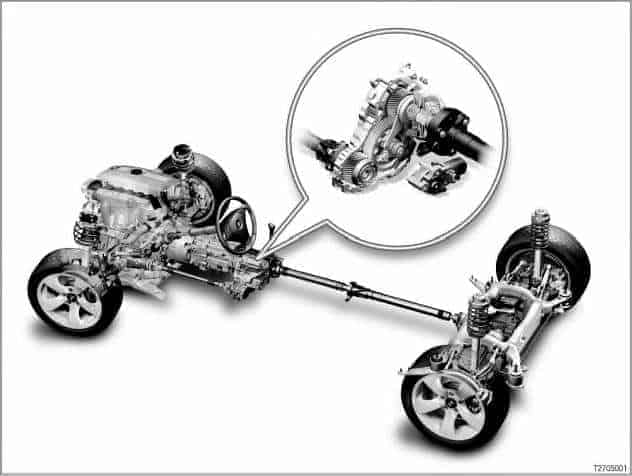
Used in brands such as BMW. The transfer case is mounted on the transmission and regulates the driving forces to the front wheels.
The rear wheels are directly connected to the transmission and are always driven.