Introduction:
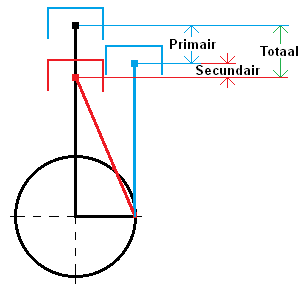
The up and down (translating) movement of the piston is converted into a rotational motion by the crank-connecting rod mechanism. The piston moves in one straight line up and down. This is called the primary piston movement. However, the connecting rod moves not only up and down but also laterally. Due to the lateral movement of the connecting rod, the piston travels a slightly greater distance. In addition to the greater distance, the piston also reaches its highest speed at this point. This extra distance is called the secondary piston movement.
The piston movement is shown in the image. The top blue piston indicates the TDC (Top Dead Center). The blue piston on the right in the middle shows the distance of the primary piston movement (i.e., where the connecting rod is not angled). The lower red-colored piston indicates the extra distance created by the rotation of the crankshaft and the angled position of the connecting rod; this is the secondary piston movement.
When the crankshaft is rotated 90 degrees, the piston speed is at its highest. The secondary piston movement accounts for a greater distance traveled. By adding the distance of the secondary movement to that of the primary movement, the total distance traveled by the piston can be determined.
The ratio between the length of the crank pin and the length of the connecting rod determines the magnitude of the secondary movement. The secondary piston movement also affects the piston speed and piston acceleration.
Primary and secondary piston movements:
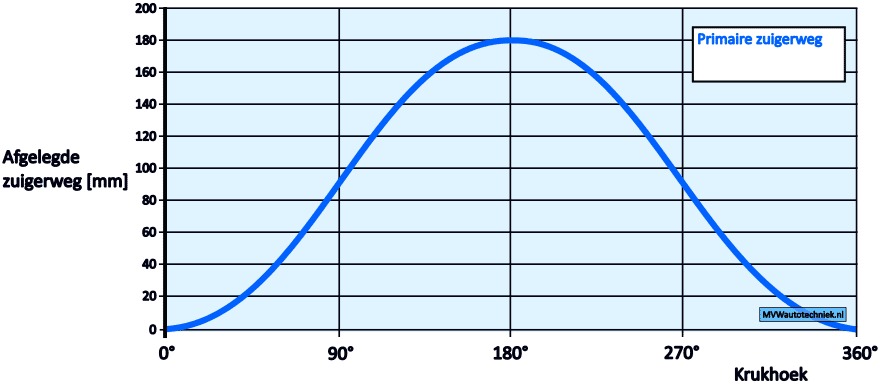
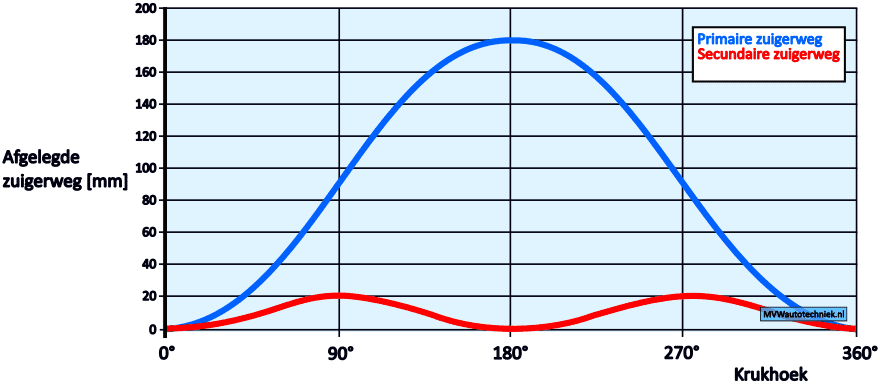
The primary and secondary piston movements are shown as distances traveled in graphs in this section. The sum of the primary and secondary piston movements is the total piston movement. Below, the composition of the total piston travel is explained.
Primary piston movement:
The force in the direction from TDC to BDC and the force from BDC to TDC together cause a vibration that occurs once per crankshaft revolution. Therefore, this force is also known as the primary force. The primary force makes a primary movement.
- The primary piston movement is 0 at 0° crankshaft rotation and also 0 at 180°;
- When looking solely at the primary piston movement, the piston is midway through the stroke (thus also midway through the cylinder) at 90° crankshaft rotation, namely at 90 mm.
Secondary piston movement:
The lateral movement of the connecting rod causes the secondary piston movement. The greater the ratio between the crank pin and connecting rod length, the greater the secondary force, and thus the secondary movement is.
- At TDC, the secondary movement is 0;
- At 90° crankshaft rotation, the secondary movement is maximal;
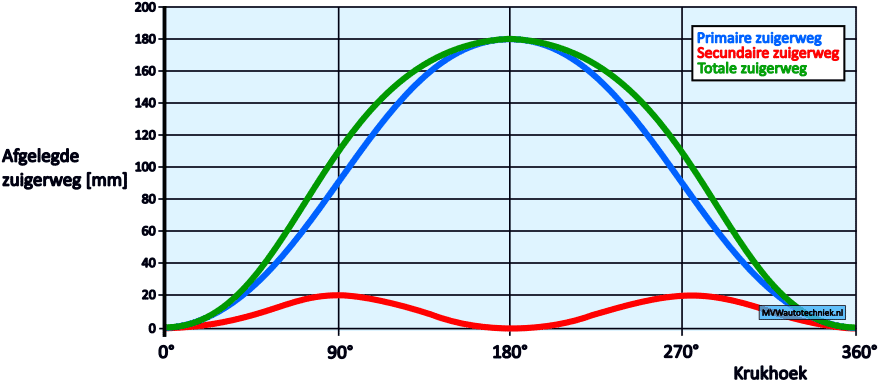
- The distance the piston travels during the secondary movement is added to the primary movement. This is the actual path the piston has traveled.
Actual piston movement:
The actual piston movement is formed by the sum of the primary and secondary piston movements. In the graph, this is readable as “total”.
- The piston is already halfway through the stroke it makes in the cylinder before the crankshaft is rotated 90 degrees. In the graph, we see that the piston has traveled 110 mm at 90 degrees. That is 61% of the total stroke;
- The length of the crank pin, and thus the crank to connecting rod ratio (often referred to as lambda), are determining factors for the secondary and thus the total piston travel.
The secondary piston movement enhances engine vibrations. In an engine with four or fewer cylinders, where the secondary forces are relatively large, balance shafts are used to limit engine vibrations.
Piston Speed:
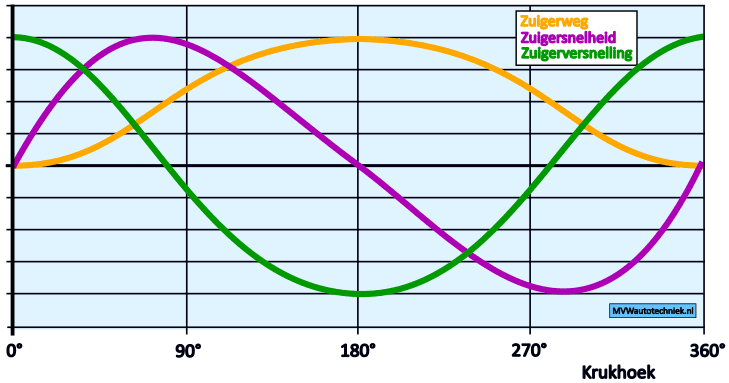
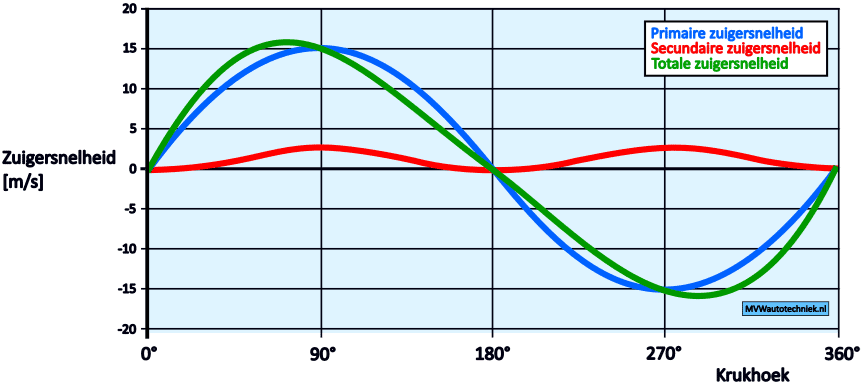
During the power process, the piston reverses its direction of motion at BDC and TDC. At BDC and TDC, the piston speed is zero. This is because the piston changes direction at these points. As the piston moves from TDC to BDC, the piston speed increases. Around the 90-degree crankshaft rotation, the primary piston speed reaches its maximum value. This is due to the positive acceleration of the piston during the downward movement. However, as the connecting rod angle increases, the secondary piston speed begins to play a role. The secondary piston speed is related to the tilt of the connecting rod and causes an extra contribution to the total piston speed. Because of this secondary piston speed, the total piston speed reaches its maximum value earlier than the primary piston speed alone would cause. This typically occurs before the 90-degree crankshaft angle. In the diagram below, we see that the total piston speed is already about 75% maximum.
Piston Acceleration:
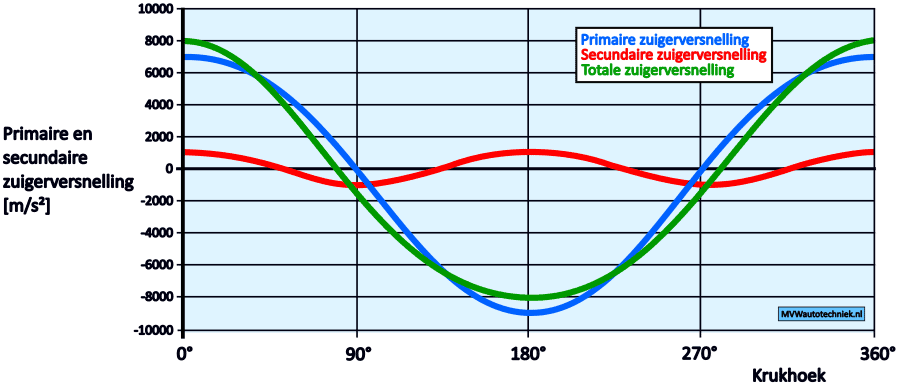
In the previous section, piston speed was covered. In the graph, it can be seen that the piston speed is zero at TDC and BDC, and increases and decreases while moving down and up. With piston acceleration, we look at the acceleration and deceleration of the piston within the cylinder.
When the crank angle is 0 degrees, the piston is at the top of its stroke, ready to start its downward movement. The piston acceleration is maximum at this point. This is due to the abrupt change in the movement direction of the piston, from standing still at the highest point to beginning the downward movement. As it moves toward TDC, the acceleration decreases. The primary piston acceleration is 0 at 90 degrees of crankshaft rotation. In the previous section, we can see that the piston speed decreases again at 90 degrees. Between 90 and 180 crankshaft degrees, the piston decelerates until it reaches TDC. In the graph, this deceleration is seen as negative acceleration.
The secondary piston acceleration once again arises from the tilt of the connecting rod. An engine with an off-axis connecting rod has the connecting rod already at a slight angle when the piston is at TDC. As a result of the secondary piston acceleration, the total piston acceleration increases in the initial crankshaft degrees.
Overall overview of piston travel, speed, and acceleration:
In the previous sections, the primary, secondary, and total movements and speeds were discussed for each graph. In this overview, we see the totals in one graph.
- During the downward movement of the piston, the piston travel increases (from 0 to 180°);
- The piston reversed its direction of motion between the previous stroke and the current stroke. Due to the sudden change in direction, piston acceleration is maximum from 0 crankshaft degrees;
- The piston speed gradually increases, and is maximum before the crankshaft is rotated 90°;
- At 180°, both the piston speed and acceleration are 0;
- During the upward movement to TDC, the graphs of piston acceleration and speed reverse.