Introduction to Ohm’s Law:
Voltage, current, and resistance are interdependent. If the voltage increases with constant resistance, the current also increases. If the resistance increases and the voltage remains constant, the current decreases. Using a formula from “Ohm’s Law,” one of these three factors can be calculated if two are known.
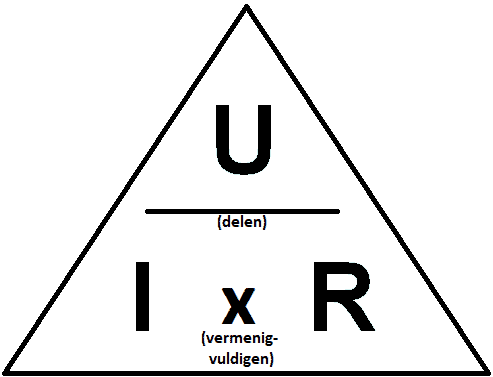
The three symbols can be arranged in a triangle. This page clarifies computing with Ohm’s Law through a number of examples.
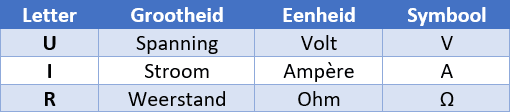
The following table shows the letters, quantities, units, and symbols of voltage, current, and resistance. It’s important to keep or memorize this table.
On the page: “basic electronics” the fundamentals are explained.
When we know the current (I) and resistance (R) in a circuit, we can calculate the voltage (U). We take out the triangle and cover the letter of what we want to calculate, in this case, U. What remains is: I * R. By multiplying the current by the resistance, we obtain the voltage.
The same goes for the current: covering the I leaves U / R. Dividing the voltage by the resistance value gives us the current.
Lastly, we can also calculate the resistance. Covering the R gives: U / I. Dividing the voltage by the current gives the resistance value.

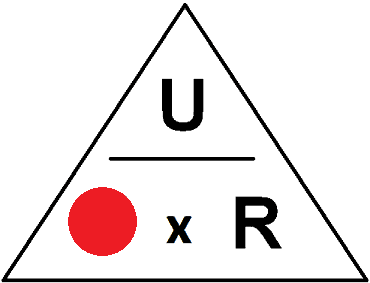

The following sections include three examples in which we calculate using the triangle of Ohm’s Law.
Calculating Voltage:
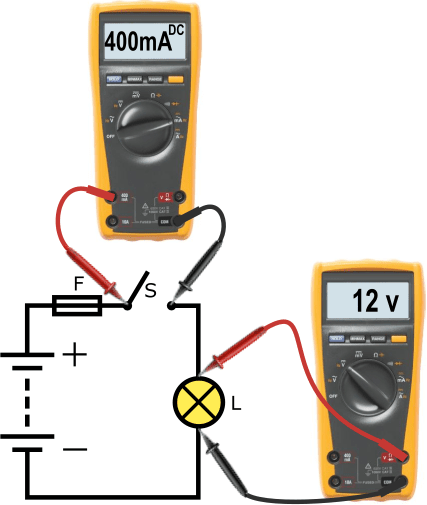
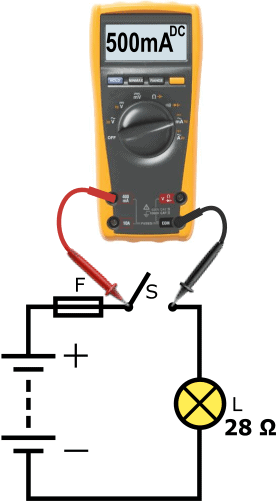
In this schematic, the multimeter is connected in series with the lamp. Therefore, the switch is opened and measured across the switch. The multimeter is set to mA. See the page “basic electronics” for more information about measuring current.
We measure a current of 500 mA and the resistance value of the lamp is known: it is 28 ohms. Using Ohm’s Law, we calculate the voltage of the lamp. We cover the U and see that we need to multiply I by R to get the U value.
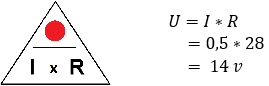
We assume there are no losses (hence interference-free). In that case, the battery voltage is 14 volts and the voltage across the lamp is 14 volts. The lamp uses the 14 volts to illuminate.
Calculating Current:
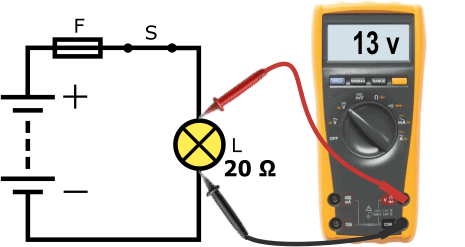
The switch is closed and the lamp is on. The voltage is measured parallel to the lamp using the voltmeter. The voltage is 13 volts. The resistance value is again known and amounts to 20 ohms.
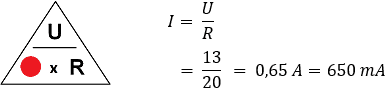
The current of 650 milliamps flows through the entire circuit and is not consumed.
Calculating Resistance:
The resistance value of a lamp when it is on differs from when it is off. While it is conducting current and it’s heated, we can determine the true resistance value using the measured voltage and current. Again, we use the triangle of Ohm’s Law and this time cover the R.
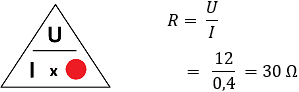
The resistance is 30 ohms.