Topics:
Lock Cylinder:
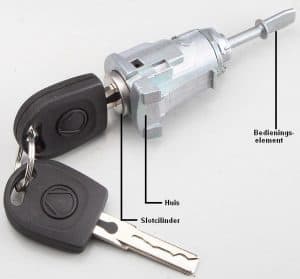
When the correct key is inserted into a lock cylinder, the key can be turned. The actuator at the back of the lock cylinder sends an open/close command to the door lock. With the wrong key, the lock cylinder cannot be turned. That makes perfect sense. This page explains how the shape of the key blade determines if the lock cylinder can rotate within the housing.
Situation 1: Key inserted into the cylinder lock:
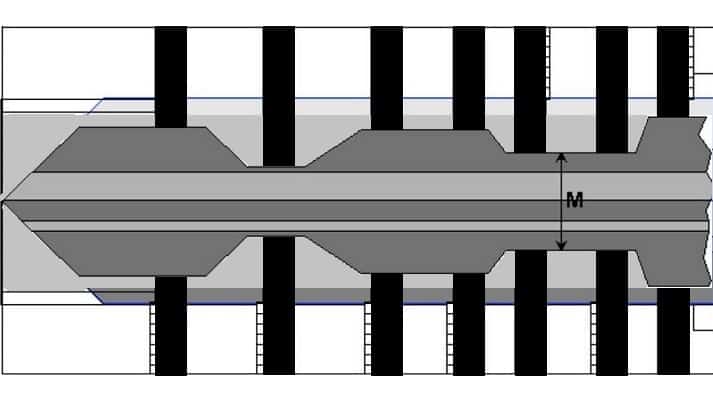
The image below shows a lock cylinder with a key blade inside. The black wafers are now positioned according to the shape of the key blade. Both the top and bottom are smooth. The wafers do not protrude from the top or bottom.
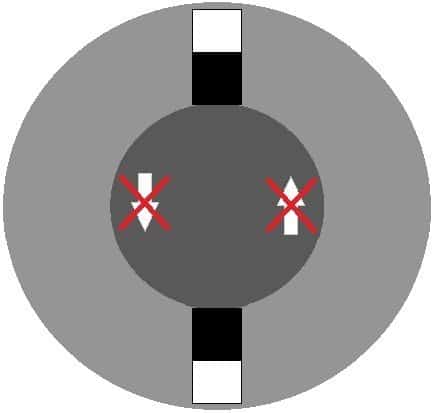
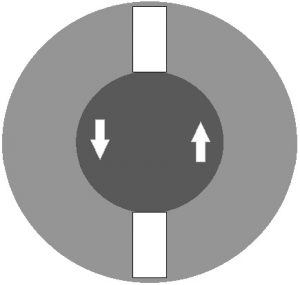
The image on the right shows the front view of the lock cylinder. The outer round section is the housing, and the darker interior part is the lock cylinder. The white sections at the top and bottom are the spaces where the wafers can sit when the key is removed, or when the wrong key is inserted into the cylinder. In this case, with the correct key (see the image above), the wafers fit within the cylinder lock. They do not protrude, so the lock cylinder can rotate within the housing.
Situation 2: Key removed from the cylinder lock:
In the image below, the key has been removed from the lock cylinder. The springs in the wafers move them into position.
One wafer moves upward and the other downward. At this point, the cylinder lock is blocked.
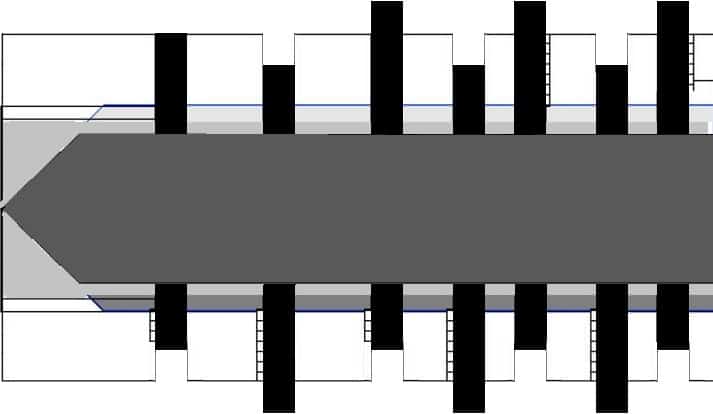
Because the wafers have repositioned after the key is removed, the lock cylinder can no longer rotate within the housing. The black wafers in the image above have been pushed outward by the internal springs. They are now jammed between the gray walls of the housing. The lock cylinder cannot rotate within the housing until the key is reinserted, causing the black wafers to move back inward and allowing the cylinder to rotate within the housing again.