Topics:
Length:
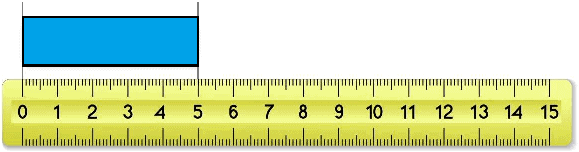
Length is a one-dimensional measure. a0 We can measure the length of various objects. The size of this object is expressed in a unit of length. The unit of length is also referred to as the length measure. Using the ruler in the image below, a length of 5 cm is measured.
The length measure can be expressed in the following units:
- millimeter (mm)
- centimeter (cm)
- decimeter (dm)
- meter (m)
- decameter (dam)
- hectometer (hm)
- kilometer (km)
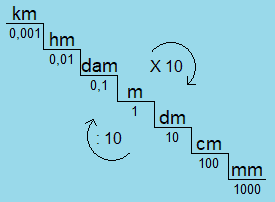
Between each unit of length, the step is a factor of 10. From large to small, we multiply by 10 and vice versa, divide by 10.
The image above shows that 1 meter is equal to 0.001 km and 1000 mm.
From small to large is times 10.
mm -> cm -> dm -> m -> dam -> hm -> km
From large to small is divided by 10.
km -> hm -> dam -> m -> dm -> cm -> mm
Surface Area:
Surface area is a two-dimensional measure. We express the surface area of a certain area or object in a surface unit. The surface is calculated by multiplying the length by the width.
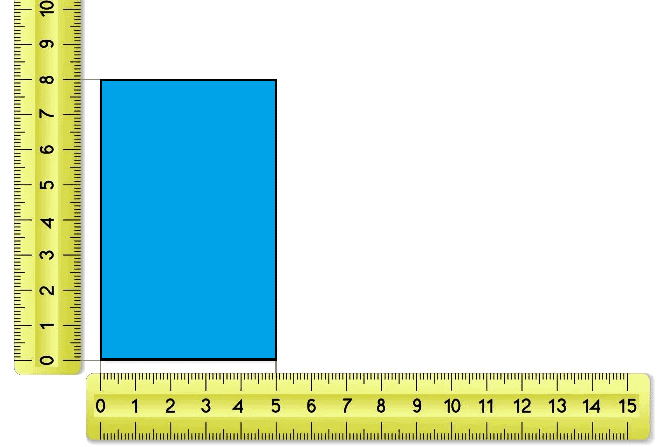
An object with a length of 8 by 5 centimeters has a surface area of (8*5) = 40 cm b2. a0
- square millimeter (mm b2)
- square centimeter (cm b2)
- square decimeter (dm b2)
- square meter (m b2)
- square decameter (dam b2)
- square hectometer (hm b2)
- square kilometer (km b2)
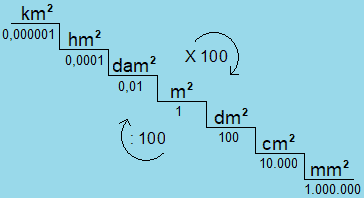
In automotive engineering, for example, we deal with the frontal area of a passenger car which measures 1.9 m b2. This is equivalent to 19000 cm b2.
From small to large is times 100.
mm b2 -> cm b2 -> dm b2 -> m b2 -> dam b2 -> hm b2 -> km b2
From large to small is divided by 100.
km b2 -> hm b2 -> dam b2 -> m b2 -> dm b2 -> cm b2-> mm b2
1 hm b2 = 1 ha.
A square hectometer (hm b2) is also called a hectare (ha). One hectare is an area of 100 x 100 meters and is equal to 10,000 m b2.
1 dam b2 = 1 are.
A square decameter (dam b2) is also called an are. One are is equal to an area of 100 m b2.
Volume:
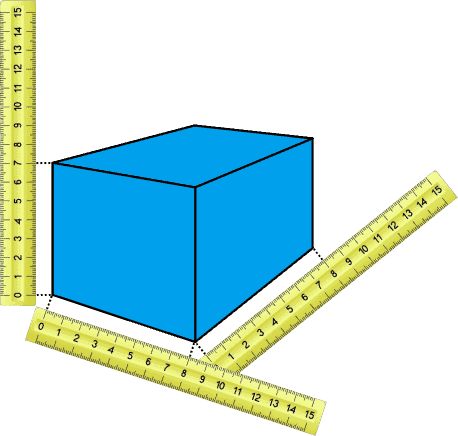
Volume is a three-dimensional measure. With volume, we deal with the length, width, and depth measure. Multiplying the length, width, and depth gives the volume. A cube with a length of 7 cm, a width of 8 cm, and a depth of 8 cm has a volume of: 7*8*8 (l*w*h) = 448 cm b3.
- cubic millimeter (mm b3)
- cubic centimeter (cm b3)
- cubic decimeter (dm b3)
- cubic meter (m b3)
- cubic decameter (dam b3)
- cubic hectometer (hm b3)
- cubic kilometer (km b3)
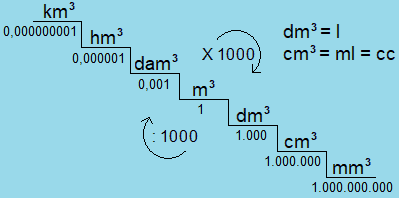
From small to large is times 1000.
mm b3 -> cm b3 a0-> dm b3 a0-> m b3 a0-> dam b3 a0-> hm b3 a0-> km