Fuel Rail:
A fuel rail is mounted on engines that use high-pressure injection systems, such as common-rail diesel engines and, increasingly, gasoline engines. The high-pressure pump delivers pressure that remains on the fuel rail. All injectors or sprayers are connected to it. Each injector or sprayer injects at a different time. As a result, there is always a regular pressure “loss”, which is compensated by the high-pressure pump. Further down this page, the differences and pressures of the rails in gasoline and diesel engines are described in more detail.
The fuel rail not only supplies the sprayers and injectors with fuel, but it also ensures that the pressure fluctuations caused by the pump are damped. This way, the sprayers and injectors do not experience any issues from it. A fuel rail always has a supply line (from the pump), a return line (which goes back to the tank), a pressure sensor, and a pressure control valve.
Rail Pressure Sensor:
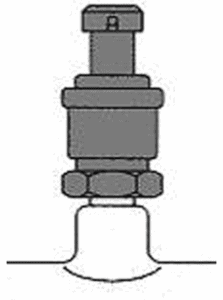
The rail pressure sensor is a MAP sensor (a piezoresistive semiconductor sensor). This sensor transmits the pressure in the fuel rail to the ECU. In case of a pressure difference, a different voltage will be transmitted, which the control unit recognizes.
If the pressure becomes too high, the pressure control valve will reduce the pressure. More fuel will then go to the return section (and be returned to the tank). At too low a pressure, the fuel pump will increase the pressure on the fuel rail.
Fuel Rail on a Diesel Engine:
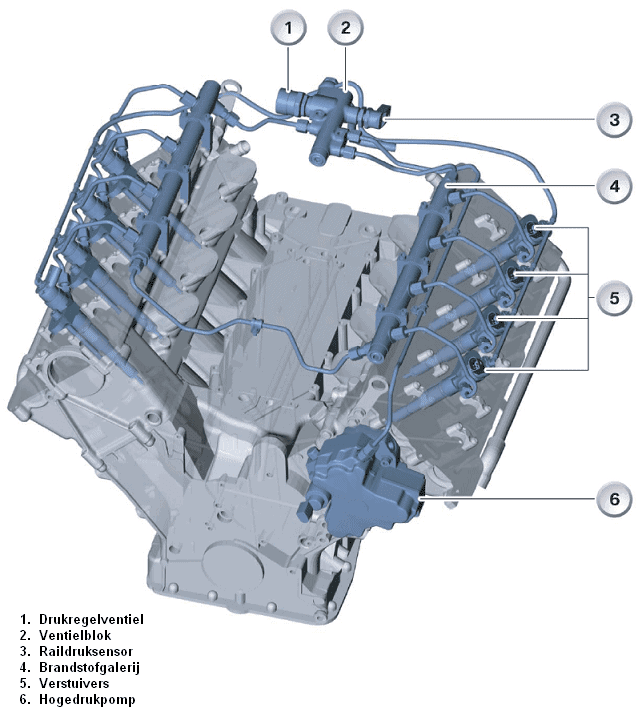
Below is an image of a V8 common-rail diesel engine from BMW. Here it is clearly visible how the line goes from the high-pressure pump to the valve block and then branches to both fuel rails. Each cylinder bank has its own rail. In this engine, a valve block is chosen so that the pressure control valve and rail pressure sensor are centrally mounted and therefore do not need to be duplicated.
From the fuel rail, there are metal lines with large couplings going to the sprayers. This is necessary because the pressure in the rail can reach up to 1300 bar.
Fuel Rail on a Gasoline Engine:
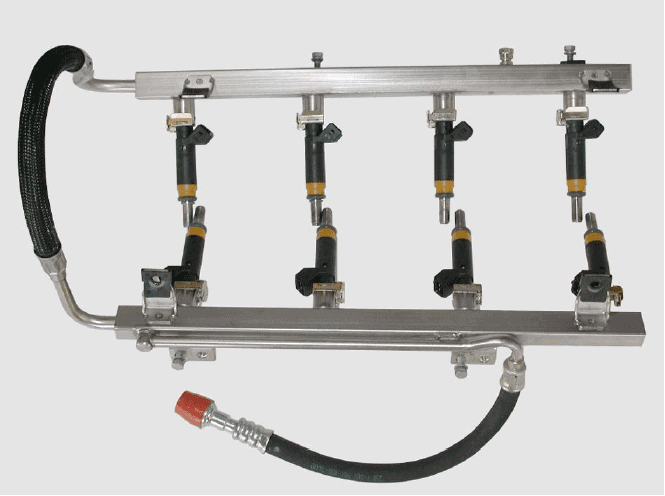
In the image, two fuel rails of a V8 gasoline engine are depicted. These fuel rails are very different from those of the diesel engine. The injectors in the gasoline version are simply mounted to the fuel rail with clips, unlike the diesel engine, where the sprayers are mounted to the rail with separate lines and large couplings. In the gasoline engine, the pressure rises to between 3 and 8 bar, with the clips (with which the injectors are attached to the rail) being sufficient to withstand these pressures.