Topics:
Introduction:
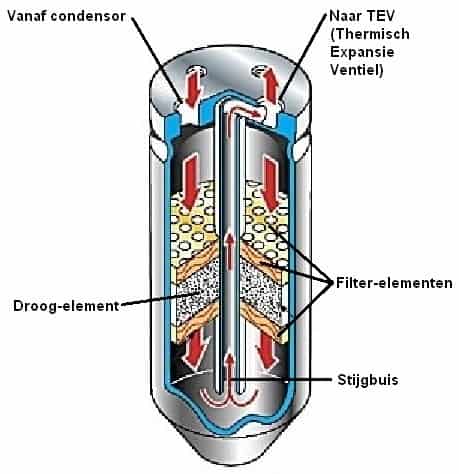
The receiver-drier/filter element (2 functions in 1 component) is installed in air conditioning systems with a TXV valve (Thermostatic Expansion Valve). The receiver-drier/filter element (hereafter simply called “the receiver-drier”) is installed between the condenser and the TXV valve. Often the receiver-drier is attached to the condenser, and sometimes they even form a single assembly.
The refrigerant is routed from the condenser through the receiver-drier in liquid form. The compressor provides the pressure and circulation of the refrigerant in the system. The condenser has already converted the refrigerant from a gaseous state to a liquid state, allowing it to be filtered more effectively.
Operation:
One of the receiver-drier’s tasks is to remove dirt and moisture from the refrigerant. It is crucial to keep the A/C system free of moisture. If moisture is present in the system, for example due to a saturated desiccant element, there is a risk that it will freeze at a certain point in the system, such as at the evaporator, because this is the coldest point. This can lead to blockages and reduced cooling capacity of the A/C system. As a result, the vehicle interior will warm up. After the A/C has been switched off for about fifteen minutes, the evaporator has had time to thaw, and the A/C will function normally again for a few minutes.
The desiccant element is filled with silica gel or silicate beads containing moisture-absorbing silicate crystals. These beads absorb moisture from the refrigerant as efficiently as possible. The other internal filter elements ensure that wear particles and dirt are trapped. The clean and dry refrigerant then leaves the receiver-drier via the standpipe (see image) and is then routed to the TXV (Thermostatic Expansion Valve), which is mounted to the evaporator, where the refrigerant continues to flow.
Another function of the receiver-drier is storing refrigerant. This storage allows any gas bubbles to escape, so the expansion valve receives a constant flow of refrigerant (in liquid form). This smooths out pressure pulsations. This can be compared to the operation of an accumulator.
Maintenance:
The receiver-drier/filter element can become saturated when the desiccant element (the silica gel or silicate beads) has absorbed so much moisture that it is no longer absorbent. The moisture is absorbed once and is never released again. When the receiver-drier/filter element can no longer function effectively due to the large amount of moisture, this is referred to as “saturation”.
Over time (often years) there is a risk of saturation, especially if the A/C system has been evacuated and recharged multiple times using an A/C service machine. Each time the machine is connected, or when work is performed on the system where lines are disconnected, a small or large amount of outside air can enter the system. The receiver-drier/filter element immediately absorbs all the moisture present in the outside air into the A/C system. Therefore, it is advisable to replace the receiver-drier/filter element after work on the A/C system.
Another cause of saturation can be incorrect installation of the receiver-drier/filter element. When a new element is installed, protective caps are present. These caps should only be removed when the corresponding lines of the system are being installed. If these protective caps are removed too early and the lines are only installed on the receiver-drier a few minutes later, the desiccant element is exposed to outside air for too long. This can already allow a certain amount of moisture to enter. Therefore, it is wise to replace the complete receiver-drier/filter element every time the system is evacuated and recharged.
This can be compared to replacing an oil filter in a vehicle when changing the engine oil.
Related page: