Topics:
- Lubrication System
- Engine Oil Level
- Functions of Lubricating Oil
- Properties of Lubricating Oil
- Additives
- Contamination of the Lubrication System (including sludge)
- Consequences of Driving Too Long with Contaminated Engine Oil
- SAE Specifications (Viscosity / Viscosity Index)
- ACEA Specifications
- API Specifications (American)
Lubrication System:
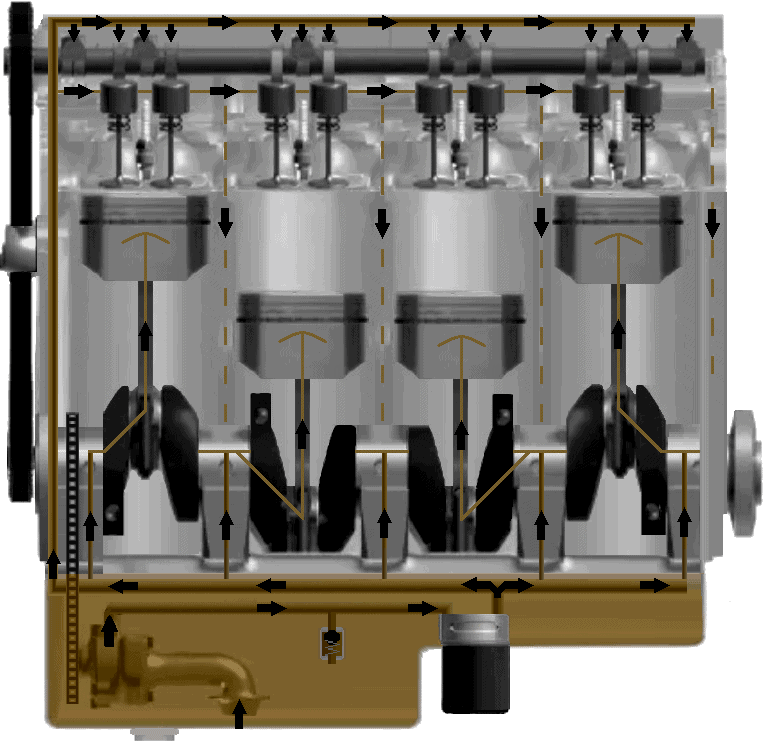
The lubrication system ensures that the engine oil is pumped and filtered throughout the entire engine. Because there is a lot to discuss, the topics “oil” and “lubrication system” are separated. The current page explains everything about engine oil, and the construction and operation of the lubrication system are explained on the lubrication system page.
Engine Oil Level:
The importance of the engine oil level is often underestimated. The level must not be too high or too low.
Many people forget to check their oil level regularly. Especially if the vehicle is not equipped with an electronic oil level sensor, there is a danger that the oil level drops well below the minimum before action is taken.
The ideal situation is when the oil level is at max. (second dipstick from the left in the image).
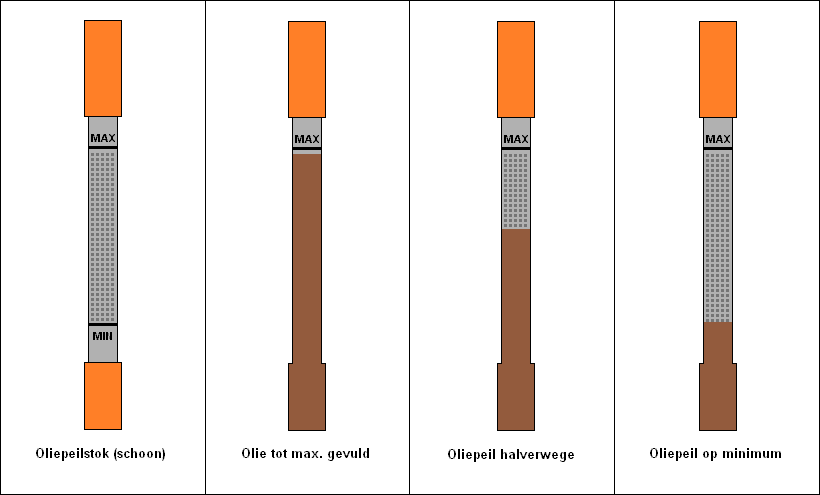
If the oil level is at minimum (fourth dipstick), it often requires topping up by half or a whole liter. First add half a liter, and after checking the level, top up the oil until it reaches max. If the oil level is halfway (third dipstick), nothing needs to be topped up in principle. Naturally, it is advisable to do so.
If the oil level is minimal, this does not immediately mean it is detrimental to the engine. It is the minimum level where the engine can operate. During engine design and testing, the running test engine is tilted at all possible angles, which can also occur in practice. The oil screen must not dry out in any of these cases, and the lubrication system must not be endangered. The minimum oil level is determined with this information.
A minimal oil level does lead to faster oil aging in the engine. The same oil has to assume all tasks that more oil would normally handle. The oil heats up faster, and its lubricating properties deteriorate sooner. It is therefore best to keep the level at or near the maximum marker on the dipstick.
If the oil level is less than minimal or is not even visible on the dipstick anymore, oil must be added immediately to prevent engine damage.
An excessively high oil level is also not good. From half a liter of excess oil (above max.), the crankcase pressure can increase. More oil can then enter the combustion chamber (via the crankcase ventilation in the intake manifold, or along the pistons upwards via the cylinder wall). In the latter case, this involves more than a liter of excess oil. With a too high oil level, the catalytic converter may be damaged. Due to increased crankcase pressure, (unburned) oil enters the combustion chamber past the piston rings, ending up in the catalytic converter, where it immediately adheres to the interior. This can lead to premature failure. Oil deposits adhering to the interior of the catalytic converter cannot be undone.
One or two millimeters above max. is not harmful. However, if the level is higher than this, some of it must be drained or extracted.
Functions of Lubricating Oil:
Engine parts that move against each other need lubrication. The lubrication system supplies the moving parts with lubricating oil. The engine’s lifespan largely depends on the oil’s quality. Therefore, it must be regularly changed. Always replace the oil filter when changing the oil.
Lubricating oil has the following functions:
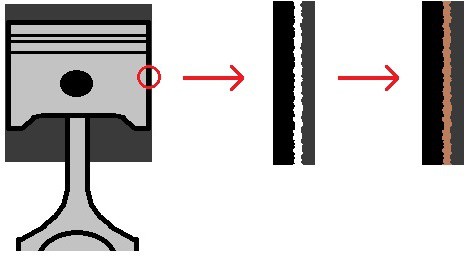
- Lubrication: The oil is meant to prevent metal-on-metal contact. It forms a thin layer between the parts, reducing friction and thus wear. The image shows a piston in a cylinder. When feeling the piston or the cylinder wall, it might seem completely smooth. If the highlighted part is greatly magnified under a microscope, one can see this is not the case, as shown after the first red arrow.
- Cooling: Parts such as valve guides, pistons, cylinder walls, etc., partially dissipate their heat through the lubricating oil.
- Sealing: The piston in the cylinder is gas-tightly sealed with oil. Thus, the oil also significantly contributes to compression.
- Cleaning: Dirt and wear particles are carried by the oil to the filter.
- Sound Damping: The oil film between metal parts also partially dampens metal noise.
- Power Transmission: The oil must also be able to transmit forces, such as in hydraulic lifters. A certain pressure is built up within a lifter, which the oil should not compress.
Both the piston material and the cylinder wall contain small irregularities. These irregularities are unavoidable, no matter how well the material is processed. When these irregularities interlock, which happens if no oil film is present, friction occurs. The irregularities rub against each other.
By applying an oil film (the right section), the rough parts are pushed apart by the motor oil. The parts do not touch, and the heat generated is carried away via this oil film to the rest of the motor oil. This oil film also ensures sealing, minimizing the amount of combustion gases from the combustion chamber above the piston entering the crankcase.
Properties of Lubricating Oil:
- Animal oil: This oil is obtained by boiling, extracting, or pressing bones (neatsfoot oil) and animal fat. Animal oil is added to mineral oils and is no longer used as a full lubricant.
- Vegetable oil: This oil is made from plants. Vegetable oils are also known as fatty oils. They have excellent lubricating properties because they adhere well to the material. However, vegetable oils quickly age due to oxygen in the air and are therefore not suitable for long-term use. The oxidized oil thickens and contaminates parts that need lubrication.
- Mineral oil: The raw material for mineral oil is crude petroleum, which consists of various compounds of carbon and hydrogen. Advantages of mineral oils are that they are cheaper and age less quickly than animal and vegetable oils. The disadvantage is that mineral oils adhere poorly to metal.
- Compound oil: This is a blend of mineral oil with 5 to 20% vegetable or animal oil. By adding other oils, adhesion to metal is improved. Compound oils readily absorb water and age faster than mineral oil.
- Synthetic oil: This oil is created in a laboratory. It results from combining small molecules into larger molecules.
Advantages of synthetic oil:
- Low viscosity (thus, less frictional resistance)
- Better resistance to oxidation
- Less sensitive to high temperatures
- Natural cleansing effect (detergency)
Additives:
Synthetic lubricating oil is also enhanced with additives such as:
- Detergent additives act as dirt dissolvers; they loosen dirt particles from internal engine parts and carry them away to the oil filter.
- Anti-oxidation additives counteract oxidation. Oxidation means deterioration by oxygen. If the oil oxidizes, it ages and thickens, making it more difficult to pump. Therefore, synthetic oil with these anti-oxidation additives will last much longer than cheap mineral oil.
- Anti-wear additives combat wear. One type of additive counteracts wear at high temperatures, another at low temperatures.
- Viscosity index improving additives ensure that temperature has less impact on the oil’s viscosity. Oils with viscosity index improving additives are called multigrade oils.
The additives wear out as the motor oil ages. If maintenance intervals are exceeded and the same oil is used for too long, the additives will lose their effectiveness. The engine will become internally contaminated because the oil no longer lifts dirt off the parts. Timely oil changes are therefore very important. See the section “Consequences of Driving Too Long with Contaminated Engine Oil” for more information.
Contamination of the Lubrication System (including sludge):
After some time, engine oil becomes contaminated by combustion products, fuel particles, and wear particles. Because the oil gets dirty, it needs to be changed after a certain period. If the engine is run for too long with old oil or if the wrong oil is used, the lubrication system can become heavily contaminated, leading to significantly increased engine wear. The oil gradually turns into a sludge-like substance. This sludge is also called ‘sludge’. There are two types of sludge:
White/Gray Sludge:
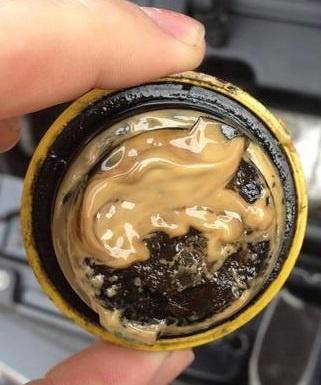
This sludge is a mixture of water vapor and oil. It occurs with frequent short trips, where the oil does not warm up sufficiently. It deposits on the still cold parts of the engine (usually the valve cover or crankcase ventilation hoses). It is often visible when the oil cap is removed (see image).
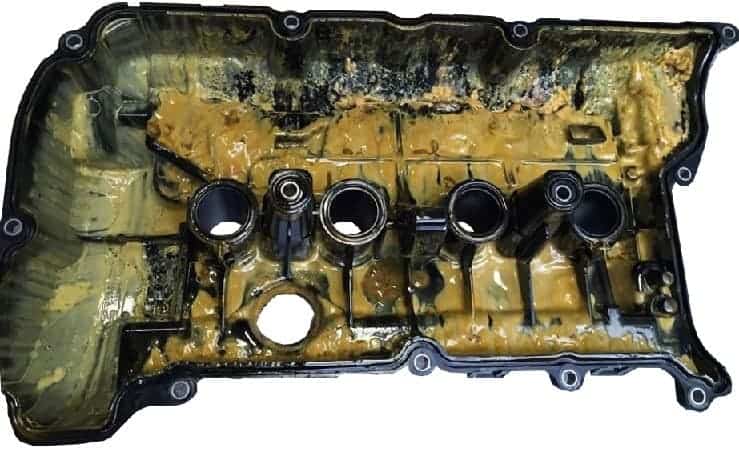
If this kind of sludge is present in the engine, it’s advisable to take a long drive, allowing the engine to warm up fully, so the sludge disappears automatically. It’s also best to change the oil then. It is possible that there is a significant amount of sludge in the engine, as seen in the image below. This is the underside of a removed valve cover from a Mini. This car was driven on numerous short trips such that the oil rarely warmed up adequately. By flushing the engine with special engine flush (available in many different types) and subsequently changing (rinsing) multiple times, a large part of this sludge can be dissolved. However, it’s better to remove the valve cover, as it’s usually the coldest part of the engine, where the most sludge will be found. Be sure also to check the crankcase ventilation hoses, as they will undoubtedly contain sludge as well.
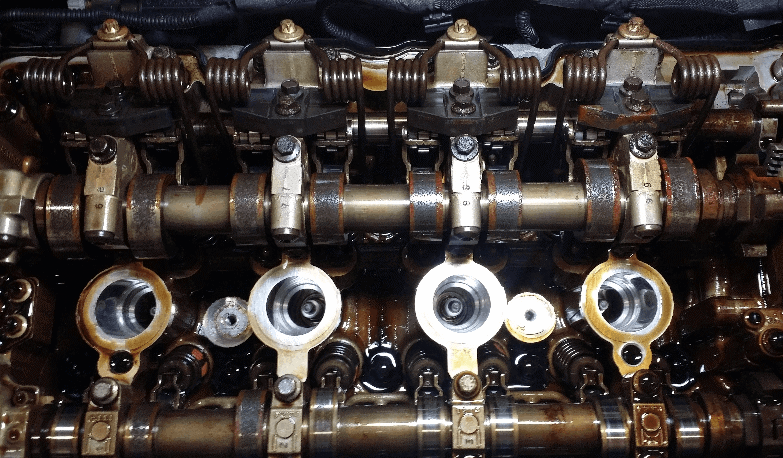
When the sludge remains in the engine for an extended period, the moisture in this sludge can damage engine components. Below is a photo of the camshafts from the same Mini from which the valve cover was removed. Especially from the intake camshaft (the top one in the photo), the coating is severely damaged by moisture. The exhaust camshaft looks better but also has significant damage on several cams.
Black Sludge:
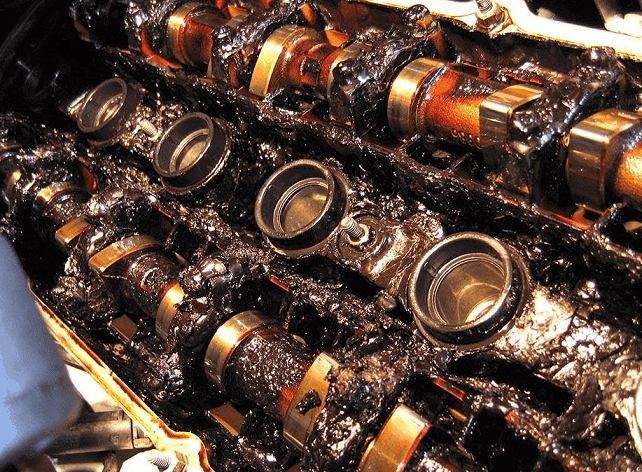
This sludge is very bad for the engine. It is a black, sticky, hard layer that deposits on the internal parts of the engine. In the photo below, black sludge is visible.
The danger is that the lubrication oil channels and the oil screen will clog, preventing proper oil circulation. This form of sludge results from stop-and-go traffic, short distance driving, excessively rich fuel system settings (carburetor), poor crankcase ventilation, high combustion temperatures combined with very old engine oil not changed on time.
Black sludge can be removed if this ‘muck’ is still soft. When a minimal amount of sludge is detected, the oil should be immediately changed, and the filter replaced. If the sludge sits in the engine longer and becomes completely caked, it’s challenging (using engine cleaning agents and removing/installing parts like the oil pan, oil screen, etc., or in the worst case, impossible to remove from lubrication channels.
Consequences of Driving Too Long with Contaminated Engine Oil:
Today, automakers set the oil replacement interval at max. 30,000 km or 2 years. Sometimes that is too long, and the engine oil has been dirty for quite a time before it is changed. Aged (or poor quality) oil causes black sludge (described above). Moisture can also enter the engine oil, and it will acidify due to combustion gases. Oil absorbs moisture; so, when a car sits unused for a year, the engine oil is not unchanged just because of inactivity. The oil has absorbed moisture and has reacted with oxygen (thereby thickening). The oil should be replaced, as its lubricating ability will not be guaranteed.
For frequent short trips or if the car is rarely used, it is sometimes wise to shorten the maintenance intervals to 15,000 to 20,000 km instead of 30,000 km. According to research, more than half of cars aged 4 to 6 years old drive with poor oil, even when serviced every 30,000 km or 2 years. Continuing to drive with oil to save costs is even worse. Oil that has been used this long has largely lost its lubricating properties and effective additives. The oil then no longer picks up dirt, resulting in internal engine contamination and faster wear. This leads to costly repairs, such as seized piston rings, worn camshafts, or a defective turbo. A car engine with 200,000 km that has run too long on old oil will have the same wear as an engine that has run 400,000 km with good oil. Therefore, it is unwise to skimp on fresh engine oil.
Always replace the oil filter when changing the oil.
This also applies to (automatic) transmission oil. Often it is indicated as “lifetime” oil; oil that does not need replacing. However, even this oil will acidify and become contaminated. This happens with every oil. Therefore, transmission oil must also be periodically replaced.
SAE Specifications (Viscosity / Viscosity Index)
The SAE specification indicates the viscosity of the oil (the thickness). Viscosity is the thickness of the oil at a particular temperature. A thick oil has high viscosity, and a thin oil has low viscosity. Viscosity is therefore dependent on temperature. Oil is tested at various temperatures to establish the viscosity index. The coding of the viscosity index is always on the packaging, e.g., 5W30 or 10W40. The letter before the W indicates the viscosity at low temperatures, and the letter after the W indicates the viscosity at high temperatures.
Oil with too low a viscosity can cause low oil pressure. The thin oil is pressed through the channels too easily, so there’s no proper pressure build-up.
Oil consumption can also increase with too low a viscosity because the oil more easily enters the combustion chamber via piston rings, and thin oil can evaporate faster, with the vapors entering the combustion chamber via the crankcase ventilation system.
The viscosity index of motor oil cannot be compared with that of transmission oil. For example, the viscosity index of transmission oil is often 75W90. This does not mean it is thicker than 10W40 motor oil. It should be seen as a ratio. If transmission oil were to have the 10W40 specification, it could be mistakenly used as motor oil by an inattentive person. Because the numbers now differ so much, a careful person will quickly notice.
ACEA Specifications (European)
ACEA specifications are tailored to European driving and usage conditions. ACEA specifications are the former CCMC specifications (CCMC changed to ACEA in 1990). There are ACEA specifications for:
- gasoline engines
- light diesel engines (light duty diesel engines) with a max. speed of more than 3500 rpm, both direct and indirect injection.
- heavy diesel engines (heavy duty diesel engines) which refer to slow-revving, directly injected diesel engines.
Gasoline Engines: | Light Diesel Engines: | Heavy Diesel Engines: |
ACEA A1-96 | ACEA B1-96 | ACEA E1-96 |
ACEA A2-96 | ACEA B2-96 | ACEA E2-96 |
ACEA A3-96 | ACEA B3-96 | ACEA E3-96 |