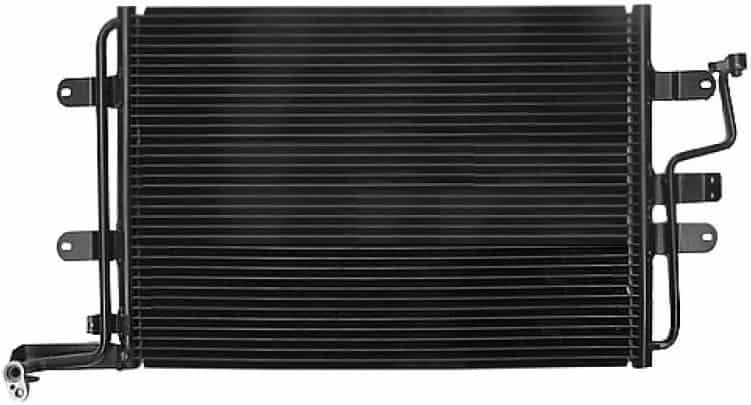
Condenser:
The condenser has an important function in a car’s air conditioning system. Here, the refrigerant releases heat and changes from gas to liquid.
From the A/C compressor, the refrigerant enters the condenser in the form of a superheated vapor. This is because the refrigerant has absorbed a lot of heat while cooling the air in the car. In the condenser, the refrigerant is cooled and the temperature drops below the boiling point. As a result, it changes into a cool liquid.
The condenser is somewhat similar to the radiator and is mounted at the front of the vehicle, in front of the radiator. Like the radiator, the condenser functions as a heat exchanger. It consists of bent tubes in a kind of serpentine arrangement, allowing the airflow from vehicle speed or from fans to pass through. In some vehicles, we find condensers that are water-cooled.
In the image below, the refrigerant inlet is located at the upper left and the outlet at the lower right. The “filter / drier element” can be placed next to the condenser or attached to it. This element helps remove moisture and dirt from the refrigerant, keeping the air conditioning system operating efficiently.
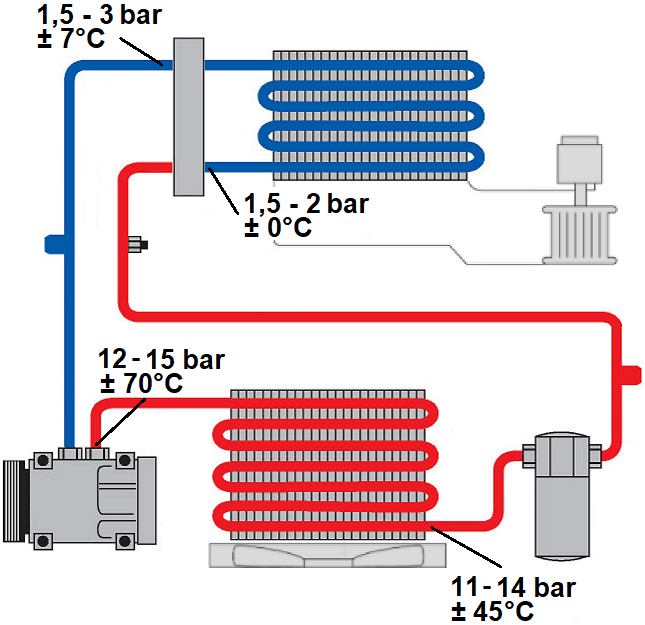
In the next image, the A/C system is shown, with the condenser at the bottom. The refrigerant flows into the condenser at a temperature of about 70°C and a pressure between 12 and 15 bar. Of course, this pressure and temperature vary depending on several factors, such as the air temperature, the compressor speed, and the amount of refrigerant in the system. When leaving the condenser, the refrigerant has a temperature of about 45°C and the pressure has dropped slightly to 11 to 14 bar. This decrease in temperature causes a corresponding decrease in pressure.
Cooling fans:
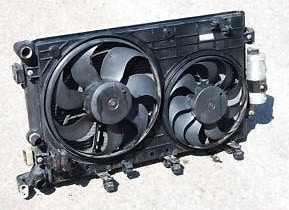
As soon as the air conditioning is switched on, the cooling fan for the condenser is also activated. Together with the airflow from vehicle speed, this cooling fan ensures that enough air flows through the condenser.
The number of fans differs by car brand and model. Sometimes there is one fan that serves both the radiator and the condenser, while in other cases one fan provides engine cooling and a separate, often smaller fan is used for the air conditioning (see image).
Possible malfunctions and defects:
When an air conditioning system is not working properly, the technician will often first check the system pressures. Depending on the issue, the condenser may be the culprit. These are the most common malfunctions and defects of the condenser:
- Leak: One of the most common problems is a leak. This can be caused by corrosion, stone impacts, or other damage to the condenser. The condenser is often mounted at the front, behind the front bumper and grille openings, which makes it easy for stones kicked up from the road to strike it. Leaking refrigerant can reduce the performance of the A/C system, eventually resulting in a completely empty system. When all refrigerant has escaped and the pressures are too low, the compressor will no longer engage for safety reasons.
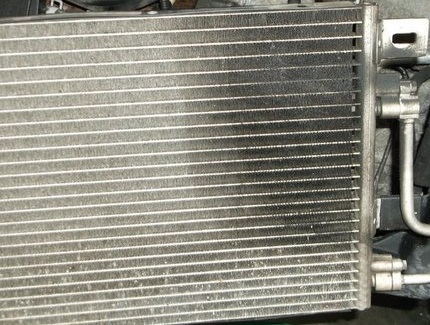
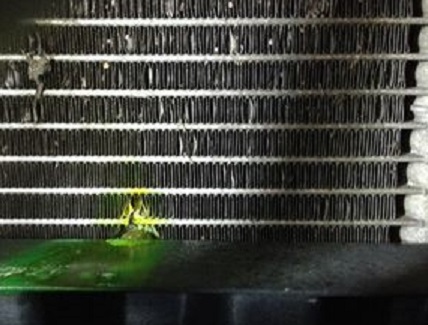
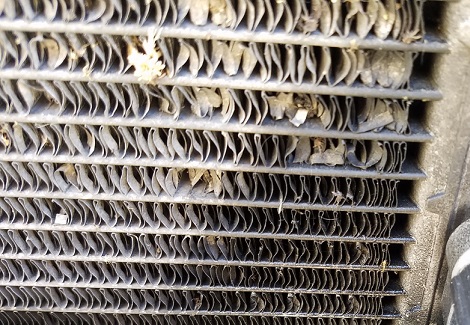
When checking for leaks, we use a leak detector. When the system is filled with a UV additive, yellow/green spots can be seen around the leak. See the images below for a leak where refrigerant (1) and refrigerant + UV (2) are visible. - Restriction or blockage: Contamination such as dirt, insects, or other material can restrict the airflow through the condenser. The condenser fins can also be folded over by external objects (stones), so air can no longer flow through, leading to reduced cooling performance. By measuring pressures and temperatures, we can identify whether this is the case.
- Deformation or damage: Physical damage, such as bending or dents in the condenser, can reduce the efficiency of the heat-transfer process. The third image below shows a damaged condenser.
- Cooling fan not working properly: The cooling fan for the condenser can be damaged or may no longer switch on due to an electrical fault. Especially without airflow from vehicle speed, the condenser is no longer able to cool the refrigerant.
- Corrosion: Exposure to moisture and road salt can cause corrosion, which affects the structure of the condenser and shortens its service life.
Related page: