Introduction:
The windows in the car primarily ensure good visibility. Additionally, the windows also provide a protective function. The windshield must not obstruct visibility when an object (such as a small stone) hits it and causes damage. Side windows must not shatter into sharp pieces upon breakage, minimizing the risk of injury.
All windows also have standard UV protection, typically with a slight green or blue tint to block UV radiation and reduce heat. This UV protection provides a tint of about 20% and can block temperatures up to 20°C.
This page describes the different types of car windows and their applications.
Windshield:
In passenger cars, windshields are always glued nowadays. In older passenger cars and some modern trucks, the window is clamped in rubber seals within the body frame. Glued windows (both the windshield and rear window) provide additional rigidity to the car’s body. With the special window adhesive, the windows essentially form a single unit with the body.
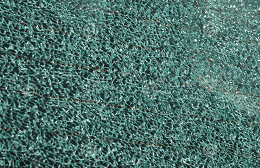
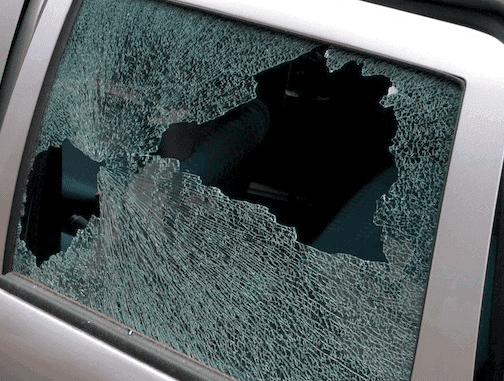
In the past, windshields were made of tempered glass. When an object (like a small stone) struck the windshield from the outside, there was a high chance that the entire window would shatter. This would result in a network of small cracks across the entire window surface, completely obstructing visibility (as seen in the image).
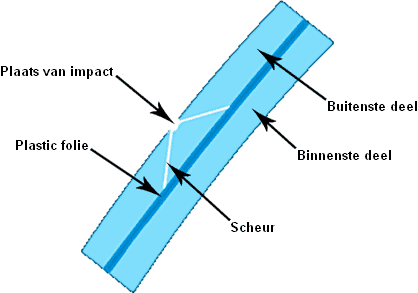
Today’s windshields are made of laminated glass. The advantage is that in an impact, only a small chip or crack develops. Visibility is never completely obstructed as with tempered glass, and minor damage has a high chance of being reparable. Laminated glass consists of two layers with a transparent film in between. Both the inner and outer layers of the glass are 3 millimeters thick. In case of damage, small hairline cracks form on the outer layer of the glass.
Repairing windshield damage:
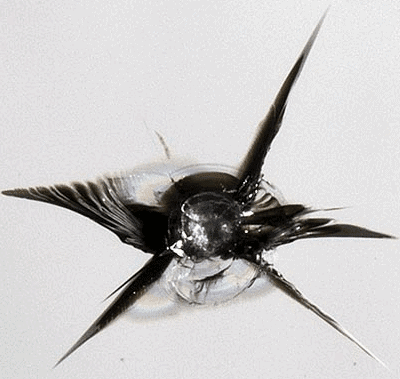
The image below shows damage to a laminated window. A small stone has hit it, resulting in small hairline cracks in the outer layer of the glass. Because the light now reflects off the cracks, these parts appear darker. Damage as shown in the image below can be repaired as long as it is no larger than a 10 Eurocent coin.
During the repair process, special repair resin is injected under pressure into the cracks. Once the space between the cracks is filled, light no longer reflects off the two separated parts of the glass. This way, the damage can be made almost invisible. Additionally, the risk of further cracking is minimized. A window repair is never completely invisible; the point of impact will always remain visible as a small chip. However, through polishing, the point of impact can be minimized as much as possible.
Replacing the windshield:
If the damage or cracks are too large, the windshield can be replaced. According to vehicle inspection standards, damage less than 20mm in the driver’s field of vision is permissible. However, if the damage is larger or the cracks branch out in various directions, the windshield is likely to be disapproved. The windshield must be replaced.
When replacing the windshield, the old window is cut out. The adhesive is cut out of the frame using special blades or cutting wire. The windshield is then lifted out, and old adhesive residues are removed. Any damage caused by removal needs to be repaired to prevent future rust. The frame also needs to be cleaned and degreased. The adhesive layer is usually applied to the windshield next, but sometimes it is applied directly to the car. After applying adhesive, the windshield is placed in position as soon as possible. The top of the window is secured with tape or special suction cups to the roof to prevent it from sliding down before the adhesive dries.
It takes some time for the adhesive to dry, so it is advised not to slam the doors with the windows closed (due to air pressure in the car) and to leave the car stationary for a while (at least 2 hours).
If the windshield is not properly installed, the following issues may arise:
- Leakage due to improper adhesive application
- Whistling sound while driving (Windshield may be too high or too low)
- A new crack develops after a short time (Windshield is mounted under too much tension)
If these issues occur, you may seek warranty from the company that replaced the windshield.
Damage to other car windows:
The side and rear windows of the car are made of tempered glass. Upon breaking, the window should shatter into small granules. These granules must not be sharp to minimize injury to occupants in a collision. Passengers must also be able to easily break the window in emergencies, such as if the car becomes submerged. The image below shows how a side or rear window looks after being broken. The remaining parts easily break away when gently pushed. While there is still a risk of injury when handling the glass, this is much safer than sharp shards.
Side windows can be either clamped or glued. Often, the rear passenger windows that cannot be opened (such as in a 3-door vehicle) are glued. In a 5-door vehicle, rear windows are often partly clamped in rubber seals (small window) and partly mounted to the window mechanism (to allow opening and closing). The same applies to the front doors. More information about the attachment to the window mechanism can be found on the window mechanism page.
Rear window:
The rear window contains visible wires that heat up when an electrical current passes through them. Moisture on the rear window will quickly evaporate when the rear defroster is activated. The defroster wires in the rear window carry the full vehicle voltage of 12 volts. The defroster requires roughly between 10 and 15 amps to function.
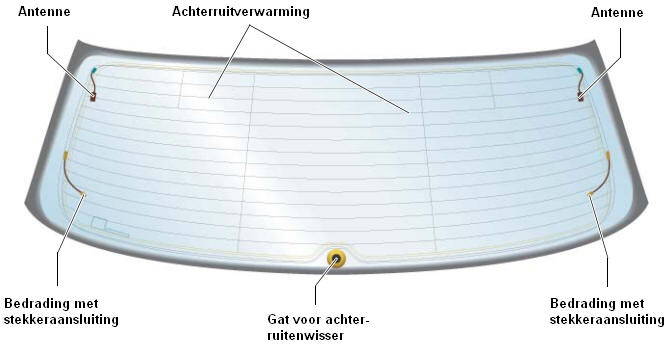
If damage occurs to one or more wires, part of the defroster may stop functioning. Upon activation of the rear defroster, a moist spot may remain along the entire length of the affected wire. If the wire circuit is broken, current cannot pass through, and the wire will not heat up. The most common cause of a broken wire is when an object in the trunk scrapes against it.
Using a voltmeter can measure the voltage on the wires. The positive probe of the voltmeter should be held on the wire, and the negative probe should touch the vehicle ground. This can help locate where the wire break has occurred.
Repair kits are available to reconnect the broken wires using conductive fluid. Brush the fluid onto the break. Once dried, the rear defroster will function again, although the repair site remains visible.
Nowadays, antennas are increasingly being integrated into the rear window. By adding antennas at multiple points (sometimes also on the rear side windows), optimal radio reception is maintained. The radio automatically chooses the strongest signal.
Windshield heating and defrosting:
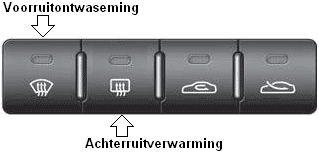
In winter, the windows can fog up from the inside. The windshield defroster, which is mandatory on every car, blows warm air against the window to evaporate moisture. The defrosting function only works once the engine coolant has warmed up. Every car is equipped with a rear window defroster. The rear window contains heating elements (visible as horizontal lines) that heat up when current flows through them. Every car has a switch for the rear defroster, and cars with automatic climate control also have a control for the windshield defroster. In cars without automatic climate control, the rotary knobs should be set to the windshield and warm air.
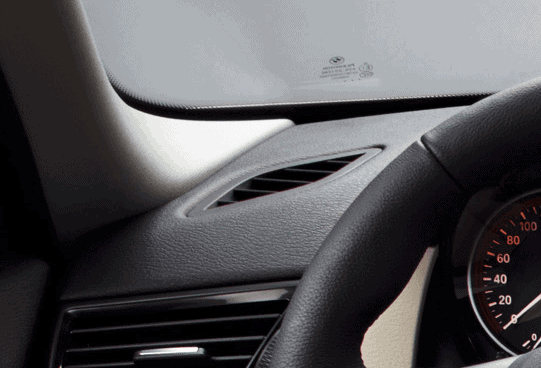
The windshield defroster works by blowing warm air through the grille along the width of the dashboard against the windshield. The side windows are defrosted using smaller vents in the dashboard that cannot be adjusted (see the image below). These vents direct air at a specific angle to efficiently clear the entire glass surface of condensation.
If the windshield defroster fails to function (for instance, if the heater blower is defective or the heater box valves do not adjust), it is a point of failure in the vehicle inspection. During the inspection, airflow along the windshield is always checked. If the windshield continues to fog up, it often indicates a moisture problem (water leakage along door seals, window mechanisms, or door foils), or the cabin filter is clogged with damp leaves.
Some luxury cars have electrical heating elements in the windshield. These heating elements typically run vertically and are barely noticeable. The benefit is that the coolant does not need to be warmed up for the windshield defroster to work effectively, and any frozen wipers can be defrosted.
Double glazing:
Double glazing is sometimes used in cars, usually in higher-end models. This is mainly for enhanced security. It involves placing two windows, each 3mm thick, against each other with a special film in between to prevent moisture and condensation. The benefits include significant noise reduction from outside and strong insulating properties. The downsides are that the entire door assembly must be reinforced by the manufacturer; the window mechanism, window motor, and door hinges need to be more robust, and the door panel must be modified. Additionally, double-glazed windows cannot be easily broken in an emergency, such as if the car becomes submerged.
Rain / Light Sensor:
The rain/light sensor is mounted behind the interior mirror in luxury vehicles. This sensor detects raindrops and light intensity. The functions of the windshield wipers and the car’s lighting are controlled based on these sensor readings. More information on the RLS will be provided later.
Tinting / Privacy window films:
Standard car windows are tinted up to 20%, typically recognized by a green/blueish sheen. The standard tint helps reduce heat by partially blocking UV rays. The temperature with a tinted window can decrease by up to 20°C. Windows can also be further tinted, usually by applying film. This film is often dark gray and enhances the UV-blocking effect. Windows are often tinted for aesthetic reasons; a car with tinted windows looks neat and sporty.

There are regulations regarding extra tinting of car windows:
- The windshield and front side windows may have a film applied as long as the light transmission is at least 55%.
- The rear passenger windows, side windows in the trunk area of a station wagon, and the rear window may be tinted without a maximum value. These windows may even be coated with black film that blocks all light.