Introduction:
A tire has several functions that every sold tire, regardless of price, must fulfill:
- Rolling
- Supporting the vehicle
- Transmitting drive and braking forces
- Steering
- Damping vibrations
- Long lifespan.
This page describes all the parts of a tire, their names, and different properties.
Various Parts of a Tire:
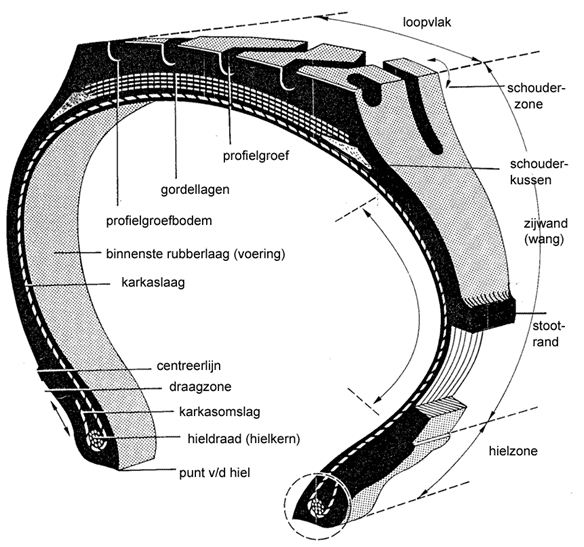
The side of the tire is called the “Sidewall.” The sidewall is constructed to be as flexible as possible to contribute positively to comfort. Sportier tires have thicker and stiffer sidewalls to provide better steering responsiveness. However, this comes at the cost of reduced comfort as road bumps become more noticeable and can be experienced as unpleasant. The construction of the tire carcass gives the tire its strength. The tread is designed to provide grip on the road and to channel rainwater. The tread includes main grooves and tread between those grooves. (See the Tire Tread section for more details.)
The bead keeps the tire airtight on the rim. Unlike classic tires, there is no longer a need for an inner tube. The outer tire alone suffices, hence they are called tubeless tires.
Data and Size Indications on the Tire:
The sidewall of a tire always displays the brand and type of the tire. There are also various numbers and letters. These numbers and letters indicate the tire’s size (width, height, and the diameter of the hole where the rim fits), the maximum speed you may drive, and the weight the tire can carry. Below is an explanation of what this data means:
Here is an example of a tire size 205 / 55 R16 91v
205 = the width of the tread in mm (thus 20.5 cm wide).
55 = the aspect ratio of the tire’s sidewall compared to the tread width (the height of the tire’s sidewall is 55% of the tread width). This means if the tread width is 20.5 cm, the sidewall height is 55% of that, making it 11.2 cm high.
R = Radial tire (there are radial and diagonal tires). Nowadays, only radial tires are used for passenger cars due to their strength.
16 = the diameter in inches of the rim the tire fits.
91 = Load index (the maximum weight the tire can carry). The load capacity must always be equal to or greater than the weight the fully loaded vehicle is allowed to be. (See the table below)
V = Speed rating (the maximum allowed speed for the tire). By law, tires with a lower speed rating than what the car can achieve must not be mounted, even if the driver never exceeds 75 mph.
The tables below show the load index (load-bearing index) and the speed rating. Weights are in kg and speeds in km/h.
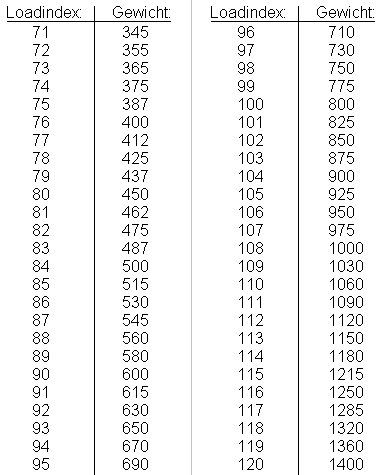

The example tire (205 / 55 R16 91v) can be mounted on a vehicle with a maximum factory-declared speed of less than 150 mph and should not be loaded with more than 615 kg on one tire.
It is not correct to divide the “Gross Vehicle Weight Rating” stated on the registration certificate by 4 to calculate the maximum weight per tire. To calculate it correctly, the weight of one axle should be divided by 2. The maximum axle loads for the front and rear need to be known. These axle loads can then be divided by 2 to determine the maximum weight per tire.
Choice of Tire Size:
The same tire size must always be mounted as the one that was removed. The speed rating and load index may differ, as long as the minimum is not undercut.
When intentionally choosing to mount a different size (e.g., choosing larger rims or a smaller winter wheel set), care must be taken to ensure the static rolling circumference remains the same. The static rolling circumference is the distance the wheel covers after one full rotation. There can be a significant difference in circumference between sizes like 225/40R18 and 225/45R18.
If the tire’s circumference changes, the car’s speedometer will show a higher or lower speed than actually driven. It can also cause problems with the ABS system if two different sizes are mounted on one vehicle.
To prevent this, the other tire size should still have the same static rolling circumference. To check this, the currently mounted tire size can be compared with the desired tire size using the handy calculator on this page: tire height and static rolling circumference calculator. This calculator allows for accurate calculation of the tire circumference and can help choose a tire size that barely deviates from factory specifications.
DOT Code:
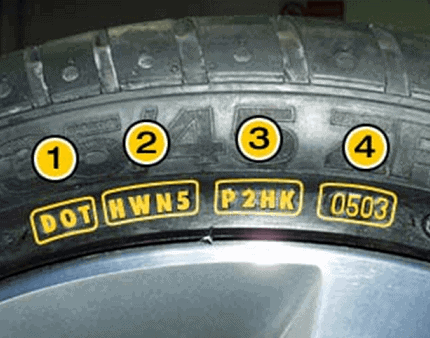
Every tire has a DOT code. This is determined during the tire’s production and applied to the tire. This code can be used to trace the identification code, manufacturer codes, and most importantly, the production date. Below is a summary of the different characters in the DOT code. These codes correspond to the image below.
- (DOT): The “Dot” designation, an abbreviation for: Department Of Transportation. This indicates that the tire meets U.S. safety standards.
- (HWN5): Factory identification code
- (P2HK): Additional manufacturer codes
- (0503): Production date: The first two digits indicate the production week (the 5th week), and the last two digits indicate the production year (2003).
For tires produced before the year 2000, this comprises only three digits (the last digit stands for the year).
Examples:
319: Week 31 of the year 1999
2812: Week 28 of the year 2012
A tire that is 6 years or older is more prone to drying out and other defects. Therefore, it is important to pay attention to this when purchasing used tires. Tires older than 10 years are at the end of their lifecycle. Even if the tread is still sufficient, it is wise to replace the tires anyway.
Tire Tread:
The tire tread consists of a number of channels that ensure rainwater is drained away. When driving at 100 km/h in rainy weather on a wet road surface, the tire rolls over up to 10 liters of water per second. With too low tread depth, the tire might not drain water quickly enough and could float on the water. This makes braking and steering impossible. This is called hydroplaning. Hence, it is essential that there is always enough tread on the tire. With worn or unevenly worn tires, water drainage properties are also significantly reduced.
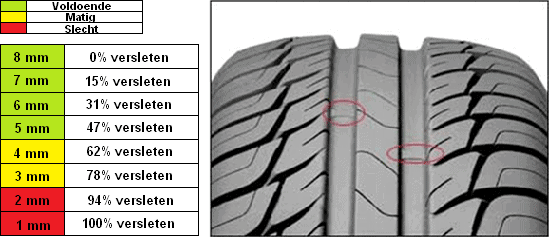
New tires have a tread of 8mm. Tires with a tread of 2.5mm or less are noted as an A.C. point for the MOT. If the tires are 1.6mm or less, they are rejected. Therefore, it’s wise to replace the tires if they are below 3mm. At 2.5mm, hydroplaning can occur in heavy rain.
The table provides a good indication of tread depth. The red markings on the image of the tire indicate the wear indicators. These have a height of 1.6mm. Once the indicator is level with the rest of the tire, the tire has a tread of 1.6mm or less. It is then necessary to replace the tires.
Wear:
Tires naturally wear out as the car is driven frequently. With a calm driving style, tires will last longer than with a sporty driving style involving frequent hard acceleration. There are also other causes that lead to faster tire wear, namely due to:
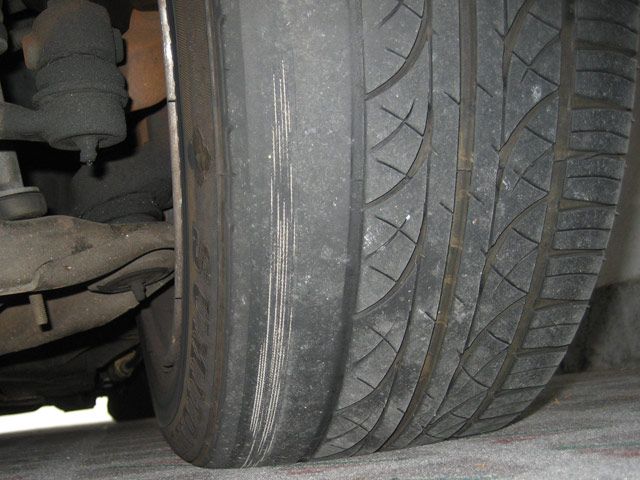
- Incorrect wheel alignment, where tires do not sit straight on the road while driving. This can be in an incorrect camber angle or incorrect tracking adjustment. (See the Wheel Alignment section.) Tires can then wear unevenly, so that the outer edge is entirely worn but still has 4mm tread in the middle (see the image below).
- Defective and worn (thus too flexible) shock absorbers. The tires will oscillate more, following the spring’s movement more. This can lead to cupping. This means the tire is no longer perfectly round, but has height differences in various places. While driving, this can cause a humming noise, which can be very annoying.
- Imbalance in the wheels. Constant vibration on the same spot leads to higher wear there than elsewhere.
- Tire pressure. With (much) too low tire pressure, tires will wear up to 2 times faster. Therefore, it is always advised to check tire pressure every month or at least every other month. Other important advantages of correct tire pressure are safety; fuel consumption; as too low pressure can significantly increase due to increasing rolling resistance. Low pressure can also affect safety. The tire might have little grip on the road. The car could skid more easily. The correct tire pressure is often indicated on a sticker in the fuel cap or inside a door opening. Never let tire pressure drop below 2 bar.
- Driving style. A brisk driving style, with hard acceleration and sharp cornering, also significantly increases wear.
Wear indicators are present in the tire tread. These wear indicators are 1.6mm thick. When the tire tread is worn such that the depth of the main groove is level with the wear indicators, it is necessary to replace the tire. From this wear limit, it is dangerous to continue driving in rainy weather.
The image shows a tire from a car with too much positive camber. The carcass is visible, while the outside seems fine.
Flat Tire & Repair:
Any tire can get a flat tire. This typically occurs when a sharp object, like a nail, pierces the tread. In modern cars, the driver is alerted by the TPMS tire pressure monitoring light. If not driven on, but a spare tire is mounted in time, it can often still be repaired. If driven on and a lot of air has escaped, the sidewall of the tire might get damaged. If this happens, the tire must be replaced.
If the tire is flat due to a nail through the outermost piece of the tread, or if the tire is stabbed in the sidewall with, for example, a screwdriver, the tire cannot be repaired. The tire’s sidewall is very vulnerable due to much movement in this area. The tire compresses here, and when cornering, the sidewall also accommodates lateral movement of the tread (known as the slip angle).
A tire must also never be repaired when the hole is larger than 7mm, or when the damage is outside the tread area, such as in the sidewall of the tire or just next to the tread. Additionally, multiple repairs on one tire (due to various leaks) are not recommended. The tire is somewhat weakened by a repair. Manufacturers cannot guarantee safety with more than 2 or 3 repairs to one tire.
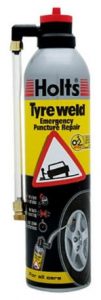
Nowadays, a tire repair kit is often provided instead of a spare tire. This liquid is meant to temporarily seal the leak. If there is a nail in the tire, the fluid will form a solid bond around the nail. This will prevent air from escaping. However, this is a temporary repair. It is then necessary to visit a garage to carry out a permanent repair. The downside of the liquid is that it does not seal long-term (the tire may leak again). It also causes significant imbalance in the wheels due to the weight of the liquid that moves as the wheel rolls, but this is not a catastrophe for a short drive to the garage. It is also difficult to remove when the tire is dismantled from the rim.
External Repair:
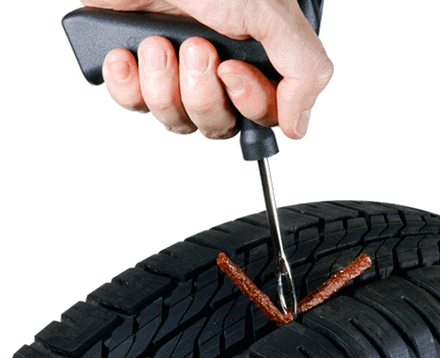
The tire can be repaired both from the inside and the outside in a garage. External repairs do not require dismantling the tire and involve inserting a plug to seal the hole. This method should be seen more as a temporary fix and not a permanent repair. The plug may be ejected from the tire at high vehicle speeds. Additionally, this emergency repair does not allow inspection of the tire’s interior; if driven too long on a tire with low pressure, there could be visible damage to the inside of the sidewalls. Over time, this could lead to a blowout.
Most roadside services or garages performing this type of repair advise customers to have the tire repaired from the inside shortly thereafter. Once the tire is removed from the rim, the interior can be checked for damage, and a permanent repair with a “mushroom plug” can be executed.
Internal Repair:
For an internal repair, the tire must be dismantled and a plug in the form of a mushroom is pulled through from the inside to the outside. This fills the hole. The flat end inside ensures the plug cannot be removed and seals the hole better. Internal repair is always recommended as the safest method. However, it takes more time, which is why sometimes external repair is deliberately chosen. The disadvantages and risks are described above.
Due to frequent confusion about the correct repair sequence, the repair process is described in 11 steps below:
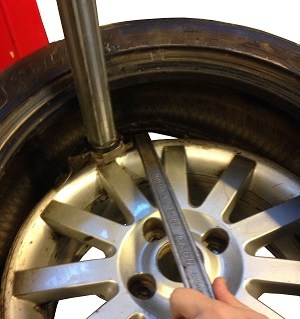
Step 1:
Remove the tire from the rim.
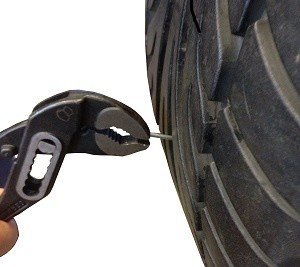
Step 2:
Remove the object from the tire.
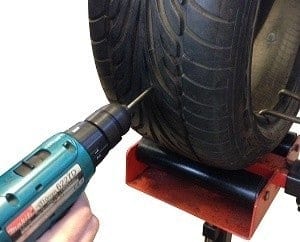
Step 3:
Enlarge the hole with a drill bit so it’s big enough to push the plug through.
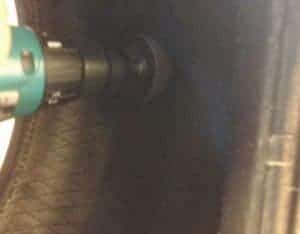
Step 4:
Lightly sand the area around the hole and thoroughly degrease it. Do not sand too hard; dislodging rubber pieces makes repair much harder. Sanding is only meant to roughen the surface so the glue can adhere well.
Step 5:
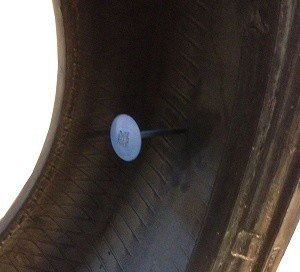
Insert the plug through the hole, but do not pull it all the way tight. Make sure the flat portion of the plug does not touch the tire’s interior.
Step 6:
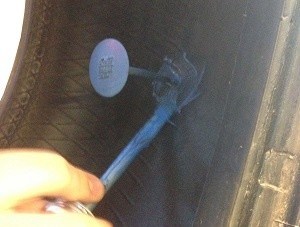
Apply the special blue glue on the surface of the tire and on the underside of the plug. Ensure a layer of glue is present, but do not apply too much! Thick blobs or droplets will not dry.
Step 7:
Wait 10 to 15 minutes until the glue dries and pull the plug completely through the tire. If the glue has not fully dried, the plug will not stay in place. So wait long enough.
Step 8:
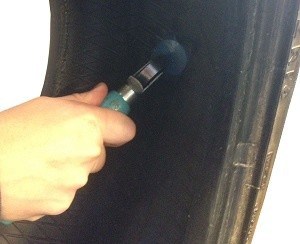
Roll over the plug with the designated roller to press it well. If lacking this roller, use the back of a screwdriver to roll over the plug. If the edges around the plug slowly rise and do not stick, the glue was not dry enough. In that case, release the plug again. If the flat part of the plug adheres neatly around, proceed to step 9.
Step 9:
Coat the entire repaired area with vulcanizing glue to create a protective layer over the plug’s edges.
Step 10:
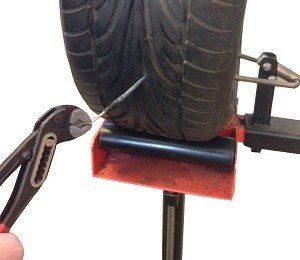
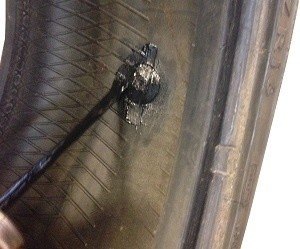
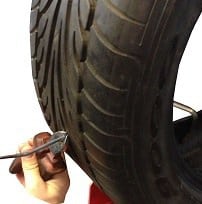
Cut off the end of the plug that protrudes from the outside of the tire as close to the tire as possible. Tug on the plug to ensure no piece sticks out after cutting.
Step 11:
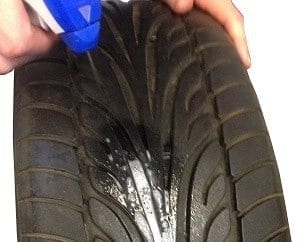
Check with soapy water or a leak detection fluid if the tire is no longer leaking. If bubbles form, the tire needs to be removed again and the repair should be restarted from step 1.
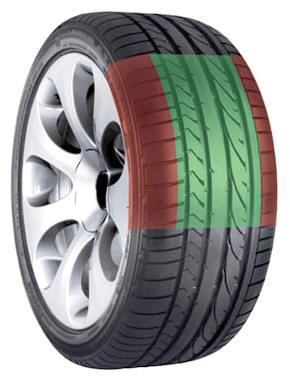
The repair can only be made in the tread area. This is indicated in green in the figure below. If the object is too close to the side (in the red part) of the tire, repairing is not allowed for safety reasons. This is too close to the tire wall, where the tire flexes the most. Approximately three-quarters of the surface can be repaired. Three-quarters corresponds to the green mark in the figure.
If driven too long with a flat tire, the tire’s carcass can get damaged. The tire on the right in the image comes from a VW Caddy. It’s a wonder this tire didn’t blow out while driving. The tire is clearly beyond repair and must be replaced. If there’s a small bulge, like the one seen on the right at 3 o’clock, it’s already rejected for the MOT because it’s not safe.
Ensure the spare tire always has enough pressure. Check this every year. A full-size spare tire should be inflated to approximately 43 psi and a space-saver (emergency wheel) to approximately 61 psi.
Run-Flat Tires:
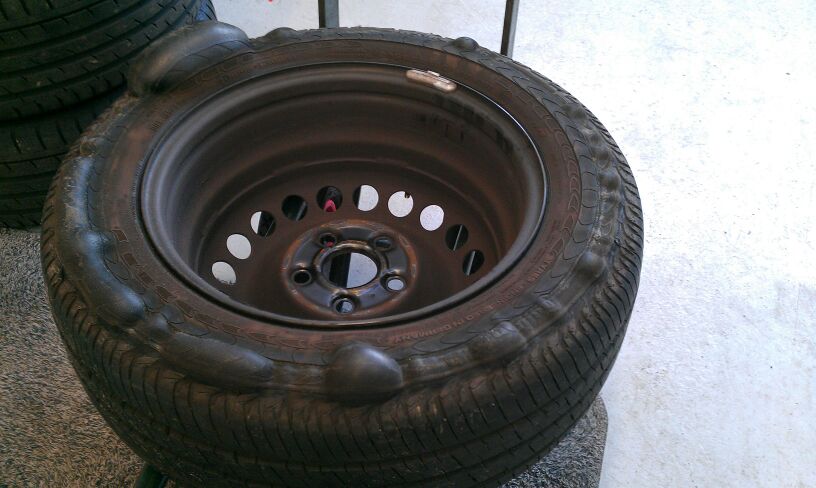
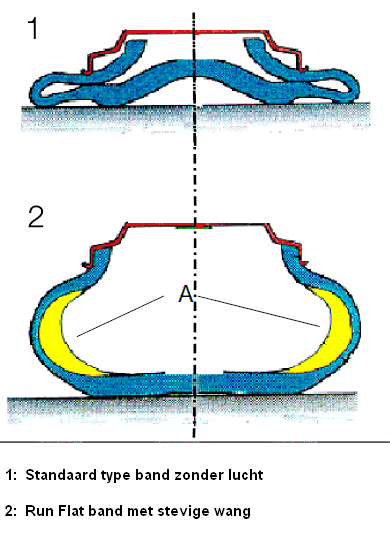
The benefit of Run-Flat tires is that they can be driven on even when flat. This is because the sidewall stiffness is high. If the tire loses air, the stiffness ensures the rim doesn’t come into contact with the ground. It’s usually not apparent that the tire is flat. The sidewall remains upright, even with insufficient air pressure. A message on the onboard computer must indicate a tire is flat, otherwise it’s not detectable. This is achieved through the TPMS (Tyre Pressure Monitoring System).
It can, however, be noticeable while driving as the car may exhibit different handling characteristics. Many people mistakenly believe that if a Run-Flat tire is flat, it can always be driven on until it is repaired. This is incorrect. A flat Run-Flat tire must always be kept at a pressure above 14 psi. If driven with pressure below 14 psi, the sidewall gets damaged and the tire must be replaced. If the tire is kept above 14 psi with a compressor from the trunk, it can usually still be repaired afterwards. Disadvantages of Run-Flat tires are primarily the price (often much higher than a regular tire) and the comfort. Due to the sidewall stiffness, the tire is also much stiffer and thus less comfortable. Run-Flat tires cannot be mounted on standard rims. The shape of the rim is unsuitable for this. Conversely, standard tires can be mounted on Run-Flat-compatible rims, but the risk is that often no tire pressure monitoring system is present in the car and a flat tire is not detected quickly enough.
Price-/Quality Ratio:
There are a vast number of types and brands of tires. For a specific size, there is often a choice of different price ranges. Typically, the price also reflects the quality of the tire. For a particular tire size, you can often find prices ranging from 60 to 200 euros. The cheapest tires are often of lesser quality. This is noticeable in driving characteristics (such as more leaning in corners, slipping more easily on wet surfaces). A cheap tire may wear unevenly and noisily due to the rubber quality. Fuel consumption can also increase due to possibly higher rolling resistance. Therefore, choosing a premium brand is often the best option.
Rims; Names and Indications (e.g., bolt pattern and offset):
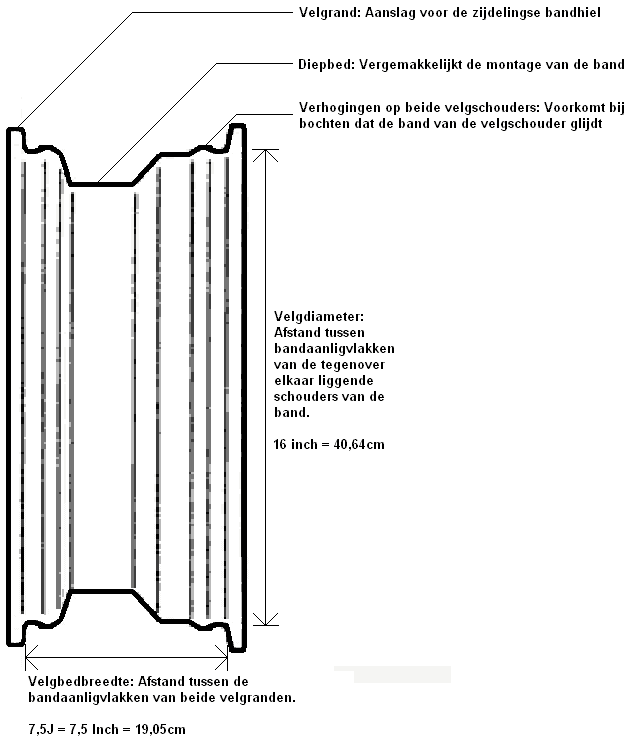
The image shows a drawing of a rim. The bead of the tire, once mounted, sits between the rim lip and the humps of both rim shoulders. The raised areas prevent the tire from slipping off the rim position. If this were to happen, air would spontaneously escape, causing the rim to hit the road. This could also occur with a blowout or when driving with a flat tire.
Various indicators are listed on a rim. These are usually inscribed inside a spoke or on the hub. An example would be: 7.5J x 16 LK 112ET 35.
The numbers 7.5J (width) and 16 (height) are visible in the image above. We will now continue with the remaining information, such as bolt pattern (112) and ET value (35);
Bolt Pattern:
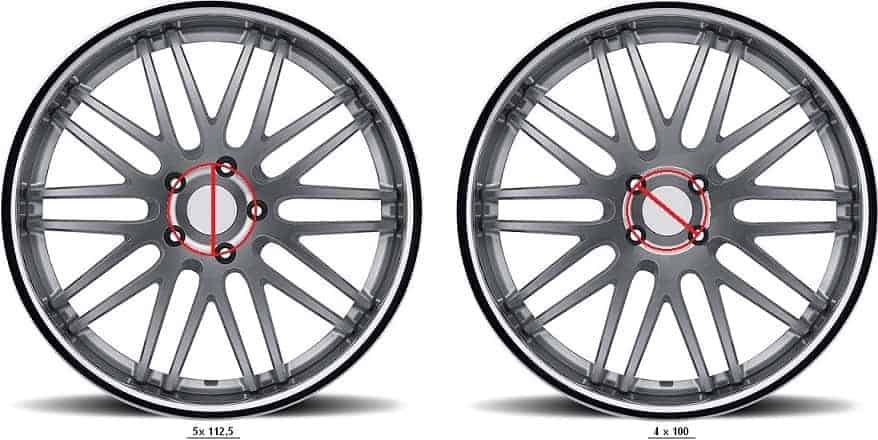
The number 112 is the diameter in millimeters where the wheel bolt holes are located. This is also known as the bolt pattern. Every car has a specific bolt pattern, noted in the factory specifications or on the rims mounted on the car. For a pattern of 5 x 112.5, an imaginary circle must be drawn through the center of the bolt holes. An example of this can be seen in the two images below. The diameter of the circle is the bolt pattern. With a pattern of 4 x 100, it can be measured from the center of one bolt hole to the center of another.
Multi-Bolt Pattern:
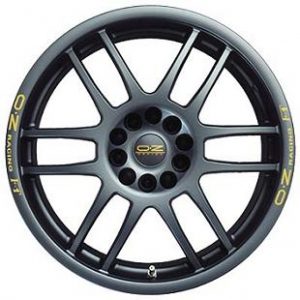
Some rims have multiple wheel bolt holes (in the image up to 10). These rims can be mounted onto different types of cars with varying bolt patterns.
Offset (ET value):
ET 35 indicates the offset. The offset (from the German “Einpress Tiefe”) represents the distance between the hub and the center of the rim. In English, it is also called “wheel offset” or “offset value.” The greater the distance between the hub and the center of the rim, the higher the offset value. An explanatory image is shown below:
Most rims have a positive offset. This means the hub of the rim is further outward than the exact center of the rim. For a rim with an offset of 35, the hub is 35mm (or 3.5cm) from the rim’s centerline (the red dotted line). The distance between the hub and the rim’s centerline is highlighted in yellow in the images. If one decides to mount different rims on the car, the offset must be accounted for. For instance, the car’s rims might have an indication of 7.5J ET 35, and the 7.5J ET 50 rims might not fit.
With ET 50, the yellow mark in the top-right image becomes larger. a0
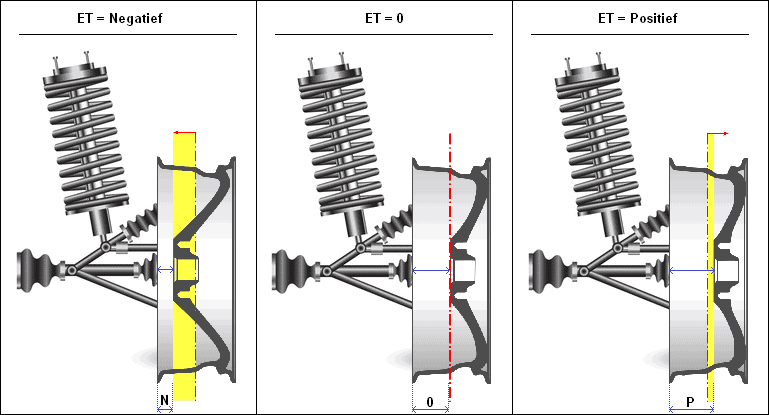
This means the rim is shifted more inward. Consequently, the rim might hit the shock absorber. This not only increases the risk of interference, but also compromises driving characteristics. This issue can be resolved with wheel spacers. These are metal discs mounted on the wheel hub – between the brake disc and the rim. In this case, the difference between the ET 30 and ET 50 is 20mm (2cm). By mounting 2cm spacers, the issue is resolved. A note on wheel spacers: In the aforementioned example, the lack of distance is compensated with spacers. However, it is not recommended to mount them when the offset value is correct. While the wheels will stand further outward, the scrub radius (and thus the driving characteristics) changes outside of factory tolerances. Even if this looks visually appealing and sporty, there are definite downsides.
Valve and Air Pressure:
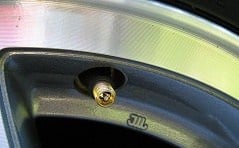
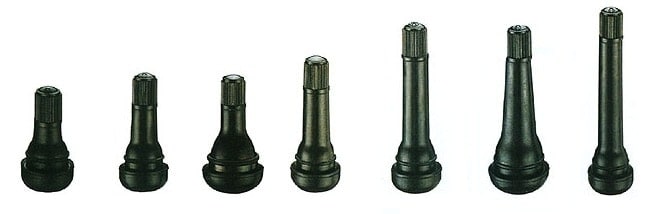
The valve is mounted in the rim of a car, so the air stays in the tire. Air is pumped into the tire through the valve. It is recommended to replace the valve when the tires are changed because they dry out over the years. This can cause leaks, causing the tire to deflate faster.
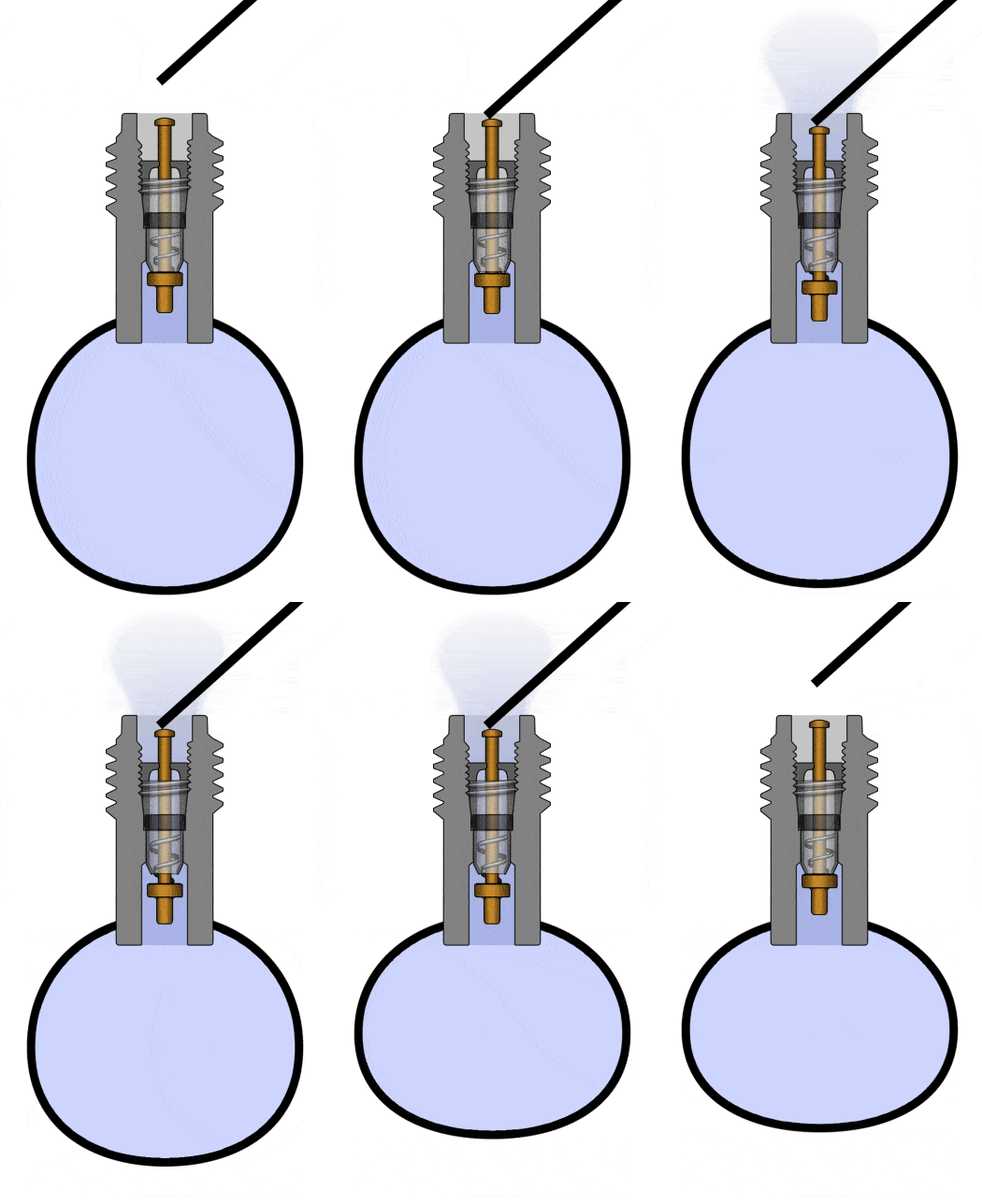
The valve is made of rubber and is closed with a valve cap. The cap does not aim to maintain tire pressure but to keep dust and dirt out of the valve. Inside the valve is a metal core with a spring that is screwed into the valve housing (see the image below). When air is pumped into the tire, the outside pressure is higher than inside the tire. When the air pressure in the tire inflator (external) is at 8 bar and inside the tire is 2 bar, this forces air past the core into the tire.
In the image, air escapes because the core is pressed by an object, against the valve spring’s force. The air inside the tire (e.g., 2 bar) is higher than the ambient air pressure (1 bar), so the tire’s air pressure can escape. When the tire pressure is higher than the ambient pressure, the air pushes against the underside of the core, sealing it off. The air cannot escape due to its own pressure.
Wheel Bolts:
Wheel bolts come in two types, aside from diameter and length: conical and ball seat. When mounting different wheels, attention must be paid to possible differences in the head that clamps into the rim. The image shows the difference between wheel bolts; conical on the left and ball seat on the right. If accidentally switched, there’s a high chance the bolts will come loose while driving.
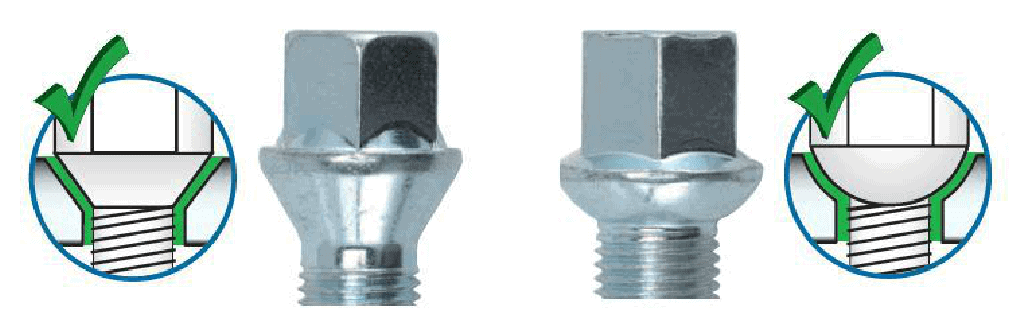
Ensure that the correct wheel bolts are also used for the spare wheel. If different wheels with conical wheel bolts are mounted, and the vehicle originally has rims with ball seat bolts, the spare wheel cannot be mounted with the bolts of the wheels on the vehicle in the event of a flat tire. In this case, always keep a set of correct bolts in a compartment near the spare wheel and inform a customer (if applicable) about this.