Introduction:
The steering system of a car is very complex. Steering movements must be correctly transferred to the road surface; without play and without heavy spots while steering. This page explains the types of steering systems that exist and how power steering is applied to the steering gear. The operation of power steering is described on the page power steering.
Steering Column:
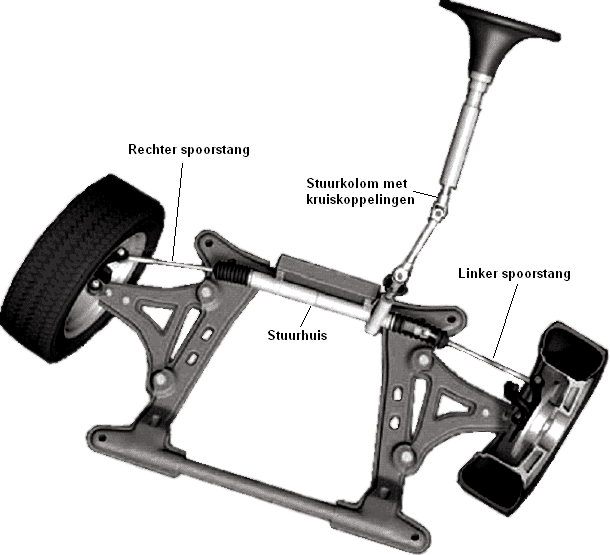
The complete steering system of a car is shown in the image below. The part between the steering wheel and the flexible rubber boot is mounted in the dashboard. It is usually covered with plastic covers and is not visible. Steering movements are transmitted via the steering column to the steering shaft. The steering shaft is mounted on the steering gear; this is explained further on this page.
Often it is not possible to use a straight shaft between the steering wheel and the steering column, and one or more bends are present. This is also visible in the image below. There is a universal joint mounted at the level of the flexible rubber boot, which makes it possible to transmit steering movements at a certain angle from the steering column to the steering shaft. The flexible rubber boot serves to seal the hole in the bulkhead where the steering column or steering shaft passes from the interior to the engine compartment. The boot ensures that engine noise and heat do not escape from the engine compartment into the interior. When squeaking sounds are heard while steering, it may be that the steering shaft is squeaking in the boot. Applying a small amount of lubricant may resolve this.

The steering column in the image above is adjustable. By unlocking the adjustment lever, the entire steering column (depending on the car version) can be moved up and down, pushed in and pulled out. The latter is possible because a large part of the steering shaft consists of two shafts mounted over each other, allowing them to slide longitudinally. This occurs in the steering column in the image in the section between the adjustment lever and the flexible rubber boot. The lower end of the steering shaft is connected to the steering gear. This is clarified further on this page.
Direct Steering Gear:
In the image, a direct steering gear is depicted. The steering column drives the steering shaft through two universal joints. The steering shaft is connected to the rack of the steering gear; here, the rotational movement of the steering shaft is converted into a back-and-forth movement to the tie rods. The steering gear is mounted on the subframe. The tie rods push against the ends of the knuckles of the suspension. Because the pivot points of the knuckles are in the middle, a rotational movement will occur. This movement turns the wheels.
In the image, the connection between the rack and the steering gear is shown. At the “Mounting point shaft from steering column,” a metal bracket clamps over this shaft. This bracket is secured with a bolt in the bolt hole on the steering shaft. Because there is a single notch, the steering shaft can only be installed one way. Make sure that the steering wheel is not turned a full revolution after assembly, as this will break the slip ring of the steering airbag.

When the steering wheel turns left or right, the steering shaft rotates over the rack on the steering gear. The steering shaft remains in a fixed position, and the rack moves from left to right. This angled transmission ensures that the wheels can turn from left to right. In the image below at “Connection of the steering shaft,” the shaft with rack from the previous image is shown as it is in reality.

In the steering gear (in the image above under the connection of the steering shaft), two hydraulic lines can be seen. These lines are from the power steering. These lines have a constant oil pressure supplied by a plunger pump (the power steering pump, or servo pump). This pressure applies to both sides of the steering gear and helps amplify the steering movements.
More about this on the page power steering.
Indirect Steering Gear:
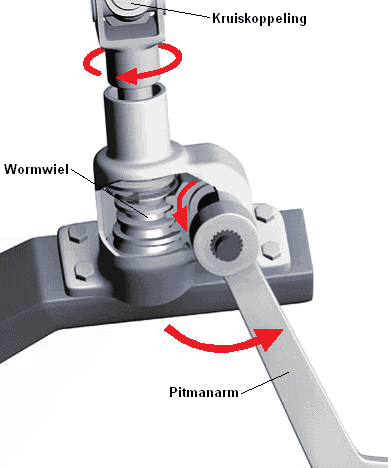
An indirect steering gear features a pitman arm and an idler arm. A drag link is mounted between these pitman arms, transmitting the steering movements from the pitman arm to the idler arm. The indirect steering gear is mounted on the subframe. An indirect steering gear is depicted in the image.
Unlike the direct steering gear, steering movements are not transmitted via the steering shaft to the rack, but via a worm gear to the pitman arm. The worm gear will rotate with steering movements, causing the gear on the pitman arm shaft to rotate as well. This causes the pitman arm to move.
In the image below, the steering movement is indicated with arrows.

Variable Gear Ratio:
A steering gear can be equipped with a variable gear ratio. When the steering wheel is in the straight-ahead position, the teeth are close together. Steering wheel movements cause a small steering movement of the wheels. This is very convenient when driving straight, as the driver does not need to correct much.
When the steering wheel is turned further, teeth that are farther apart will be reached. As a result, the same steering movement of the steering wheel will cause a larger steering movement of the wheels. This makes parking easier, because the steering wheel needs to be turned less to reach the maximum steering stop.

Related pages: