Topic:
Serpentine Belt:
The serpentine belt is often confused with the timing belt. This belt is, of course, entirely different. The serpentine belt is always situated at the very front or the side of the engine block. This belt provides the drive for the alternator and, in modern cars, also for the power steering pump and air conditioning compressor. The crankshaft provides the driving power. The belt drives other components, such as the alternator. There are various ribs (usually 6 or 8) on the belt and on the pulleys (these are the wheels on the components, such as the crankshaft pulley, air conditioning compressor pulley, etc.) so that the belt cannot slip off these pulleys.
In the past, this was called the V-belt. Back then, cars didn’t have as much luxury, and in most cases, the V-belt only had to drive an alternator. Now that many additional components have been added, the belt endures more stress. Hence, this (Multi V-belt) has been made significantly wider and has more bearing surface for a longer lifespan.
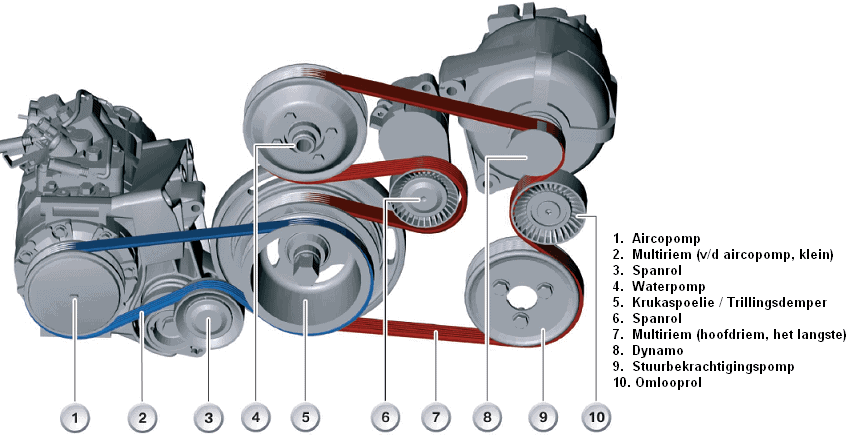
When the small belt is removed, the tensioner (3) must be moved against the spring tension. When a Torx socket is inserted into the star-shaped recess at the bottom of the tensioner and pushed down, the tensioner 3 will move down against the spring tension. As a result, the (now blue) belt has enough room to be removed from the pulleys. By then placing a new belt around and letting tensioner 3 spring back slowly, it is immediately remounted at the correct tension.
In this case, there are 2 separate belts installed. Sometimes the engine is equipped with one serpentine belt and one V-belt in series, or one serpentine belt that drives all components.
The idler pulleys function to guide the belt over them. With the use of idler pulleys, belt flapping and slippage are prevented. If you look at idler pulley 10 in the above image, the belt loops around it. If the pulley were not there, and the belt ran directly from the alternator to the power steering pump, it could start flapping and slipping.