Roll Center:
Every vehicle has a roll center. The construction of the control arms and springs determines the height of the roll center (the roll axis), which is responsible for the tilting or rolling of the body. In modern cars, the roll axis is usually slightly below the center of the wheels, almost parallel to the road surface and as close as possible to the vehicle’s center of gravity. The distance between the center of gravity and the roll axis should be minimized to keep the “rolling effect” as small as possible. More about this is explained in the next chapter on this page.
To minimize rolling, stabilizers, appropriate shock absorbers, and springs with the correct spring characteristics are used.
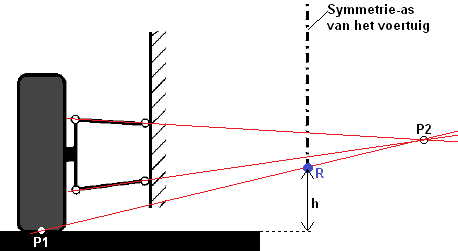
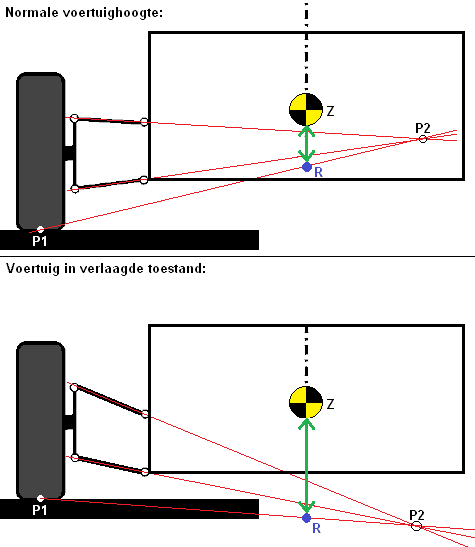
The roll center of a vehicle is determined from points P1 and P2 (see image on the right), which are calculated by (imaginarily) extending the springs/control arms (see images). By extending both control arms, point P2 is found (where the lines intersect). Then the line can be drawn from point P1 (the center of the tire-road contact) to the previously found point P2. The roll center R is now on the symmetry axis of the vehicle (the exact middle).
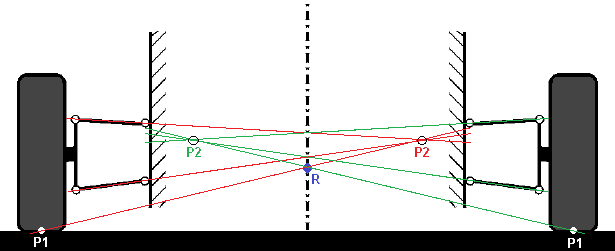
To clarify this image further, the right wheel is also drawn in the image on the right with the corresponding lines. It shows that the roll center is in the same location, as the vehicle is completely symmetrical. That means both the left and right sides of the vehicle are identical.
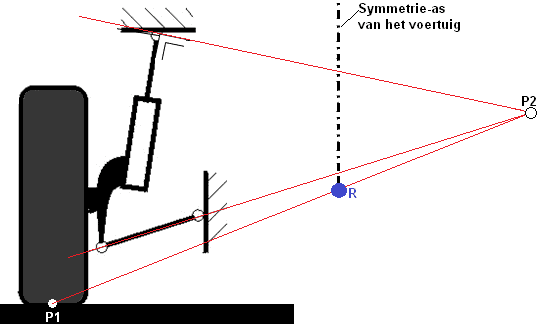
This image shows the situation with a McPherson strut. The top line must be perpendicular to the shock absorber. The line below it is drawn through the control arm to the point where it intersects the top line. This is the common point P2. Then, the line P1 is drawn from the center of the tire to P2. The roll axis R is on the line from P1 to P2, precisely on the symmetry axis of the vehicle.
Effects of Lowering on the Roll Center:
Lowering a car negatively affects the roll center. When the roll center shifts too far and creates too large a distance between the car’s center of gravity and the roll axis, the vehicle will roll more around its axis. Various measures must then be taken to prevent a decline in drivability, such as;
- Shock absorbers with a greater damping factor
- Springs with stiffer spring characteristics
- Stabilizer bars (possibly stiffer than the original)
The images on the right show two different situations; the top one of a non-lowered car and the bottom one of a lowered car. The center of gravity (Z) indicated with the yellow-black marking moves downward with the vehicle. The distance between both vehicles (indicated by the green arrow) has increased significantly.
In the lowered state, the roll center is in the road surface.
For circuit cars, this is done deliberately. The roll center is then 2 to 3 cm in the road surface. The entire chassis is then adjusted accordingly (springs, shock absorbers, and stabilizers). If this is not done (by only fitting lowering springs), the larger distance (the green arrows) causes the center of gravity (Z) to pivot around the roll axis (R). A force x arm situation arises.
There are conversion possibilities where large ball joints bring the control arms more horizontally to the chassis. The roll center then returns closer to the center of gravity. In this last case, lowering has been achieved bringing the center of gravity down without adversely affecting the roll center. This way, the driving characteristics will be greatly improved.
More information about wheel alignments and settings can be found on the wheel geometry page.