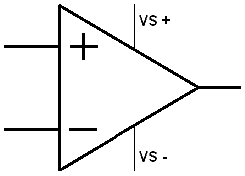
Introduction op-amp:
Op-amp stands for operational amplifier. Op-amps are used in integrated circuits (such as on printed circuit boards in computers) with a very high gain factor, which amplifies the input voltage (e.g., from a sensor). The amplified signal is then suitable as an input signal for a control device, such as the ECU. The gain factor can reach 100,000 and more.
Through resistors, the gain factor can be reduced, so the output voltage can never exceed the (predefined) maximum value.
The image shows the symbol of an op-amp. The connections VS + and VS – are often omitted.
When there is a voltage difference across the op-amp and the voltage on the + is greater than on the -, the output voltage is amplified. Conversely, when the – is greater than the +, the output voltage is negatively amplified. This can be deliberately used with an inverting amplifier. In an inverting amplifier, the output voltage will be negative. The plus and minus signs in the op-amp image will also swap. As the op-amp is currently depicted, it is a non-inverting amplifier. The output voltage will be positive.
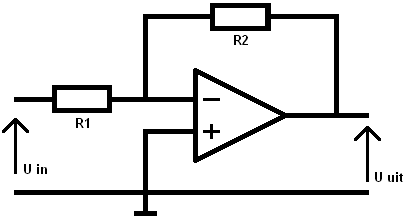
Inverting op-amp:
The positive input of the op-amp is grounded. Therefore, the positive voltage is always 0. The resistance values determine the gain factor (A). The “U in” can be a sensor signal that is amplified to the ECU which is connected to the output U out.
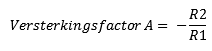
The gain factor of an inverting op-amp can be calculated using the following formula:
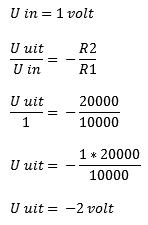
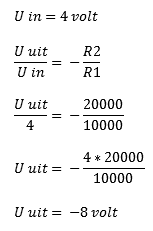
A calculation example follows with U in = 1 Volt and U in = 4 Volt. By cross-multiplying the fractions, the voltage U in is multiplied by the gain factor. This calculates the output voltage (U out).
When the gain factor is increased (for example, to 100), you will see that with a minimal increase of U in, the U out rises significantly. Never forget that the outgoing voltage of the inverting op-amp is negative.
R1 = 10kΩ = 10000Ω
R2 = 20kΩ = 20000Ω
Non-inverting op-amp:
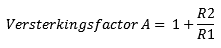
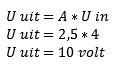
The non-inverting op-amp can be compared to the inverting op-amp. The difference is, as the name suggests, that this op-amp does not invert (reverse) the voltage. Thus, the outgoing voltage is positive. We perform the following calculation simply by multiplying the gain factor A by the input voltage.
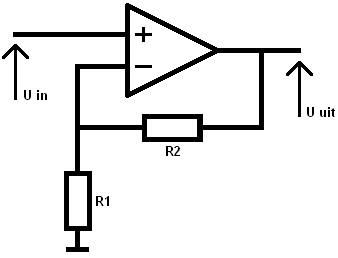
R1 = 10kΩ = 10000Ω
R2 = 20kΩ = 20000Ω

Differential amplifier:
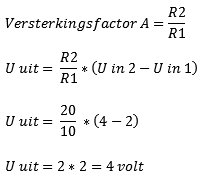
The differential amplifier compares the 2 input signals (U in 1 and U in 2) and then amplifies them. In the image below, the voltages U in 1 and U in 2 are compared. These are 2 and 4 Volts. The difference here is 2 Volts, which is amplified by the gain factor, which depends on the resistance values R1 and R2:
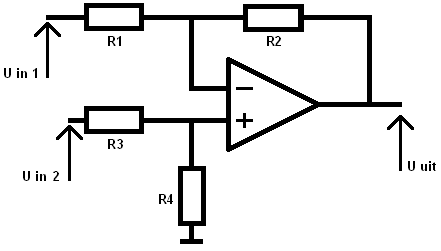
U in 1 = 2 Volts
U in 2 = 4 Volts
R1 = 10kΩ
R2 = 20kΩ
R3 = 10kΩ
R4 = 20kΩ
Inverting summer:
The calculation of the inverting summer can be done in two ways. The simplest way is if the resistors R1, R2, and R3, as in the example, all have the same resistance values (method 2). If these resistors are unequal to each other (for example, R1 has a different value than R2 and R3), then method 1 should be used:
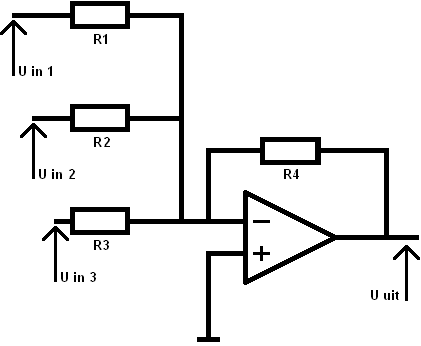
U in 1 = 0.1 Volt
U in 2 = 0.2 Volt
U in 3 = 0.3 Volt
R1 = 2.5 kΩ
R2 = 2.5 kΩ
R3 = 2.5 kΩ
R4 = 10 kΩ
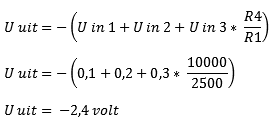
Method 1 (R1, R2, and R3 are not equal to each other)
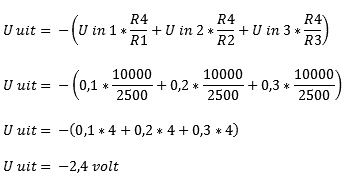
Method 2 (R1, R2, and R3 are equal to each other)