Introduction:
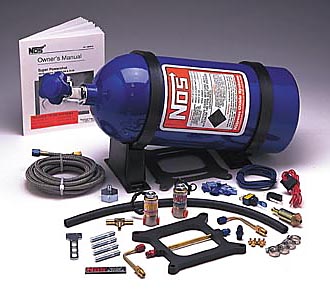
NOS (N2O) stands for Nitrous Oxide Systems. For the engine, Nitrous Oxide, sometimes also called laughing gas, is a purer form of normal air. Because we are only interested in the oxygen in the air, Nitrous Oxide is a straightforward way to increase the amount of oxygen in order to gain more horsepower. The extra power always comes from additional fuel. Nitrous Oxide is not a fuel. Nitrous Oxide is an easier method to get more oxygen needed to burn more fuel. When Nitrous Oxide is delivered to the engine, the combustion is accelerated. The Nitrous Oxide only ensures that larger amounts of fuel can be burned in the same amount of time. The overall effect is a significant increase in engine power.
History of NOS systems:
You wouldn’t think it, but the use of Nitrous Oxide in engines dates back to World War II. The Allies used it in their aircraft to have extra power available in emergencies so that the aircraft could go faster and climb to higher altitudes. With the arrival of jet engines, interest waned. In the 1970s, interest resurfaced, but now in racing. Since then, it has not disappeared. In the beginning, these were quite primitive systems where things often went wrong. But thanks to companies like Nitrous Oxide Systems (NOS), Nitrous X-press, the product has been further developed so that safety has been significantly improved compared to the past.
During the 1950s, the famous stock-car racer ‘Smokey Yunick’ rediscovered laughing gas injection as one of his many tricks to win races until it was discovered and banned by NASCAR. Nevertheless, over the years, various scandals have surfaced within NASCAR regarding the misuse of laughing gas, and it is likely that it is still used today by the slowest among racers. In the late ’70s and early ’80s, laughing gas was discovered by street racers.
Dry and Wet systems
There are 2 different kinds of Nitrous systems: the Dry and Wet systems.
- Dry System: There is the most confusion about the “dry” system. A “dry” Nitrous system simply means that the required fuel is delivered through the standard injectors. The upper part of the intake manifold remains dry (no fuel). This is achieved using two methods. First, pressure is increased by administering Nitrous when the system is activated. This leads to an increase in the fuel flow. The second way to administer the required fuel is by extending the injector open time. This is done by altering what the computer “sees”; forcing the computer to add the necessary fuel. Now that there is enough fuel, the extra fuel can be burned with the help of the Nitrous, providing more power.
- Wet System: The second type of a Nitrous kit is a “wet” system. The kit delivers Nitrous and fuel simultaneously. This system wets the upper part of the intake manifold with fuel. This system is recommended for turbo/supercharged engines.