Introduction:
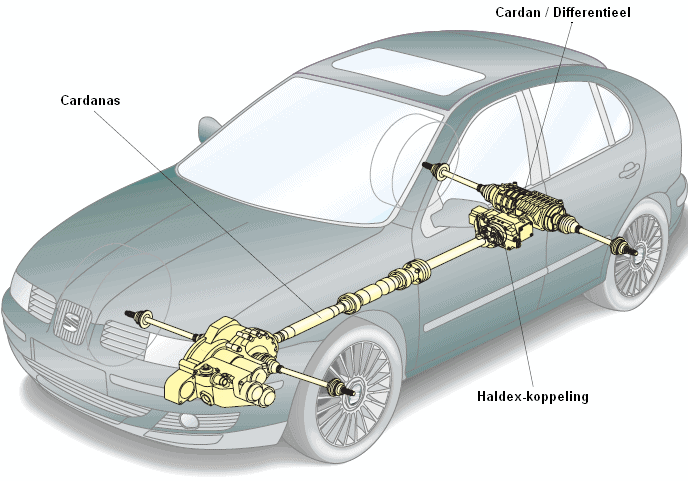
A Haldex clutch is a hydraulic clutch that is electronically controlled and transfers mechanical forces. A Haldex clutch is mounted on cars with four-wheel drive (such as Audi’s Quattro and VW/Seat/Skoda’s 4-motion) and sits between the drive shaft and the driveshaft (the differential).
In these four-wheel-drive systems, the front wheels are constantly driven, just like a front-wheel-drive car. The rear wheels are only driven when accelerating or when the front wheels slip (due to, for example, a soft surface or high engine power). Only in these situations is there four-wheel drive. Because the rear wheels are not driven at constant speed, this system with a Haldex clutch is more fuel-efficient than a system with permanent four-wheel drive.
Operation of the Haldex Clutch:
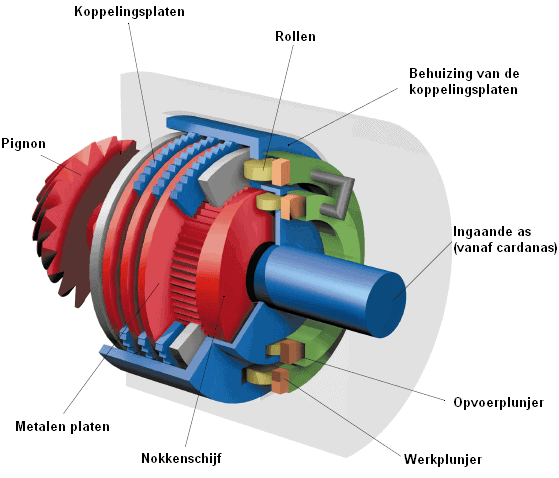
The torque is transferred to the Haldex clutch from the input shaft (the blue shaft in the image below). The pinion drives the differential. When driving straight, the speed of the input (blue) shaft and the output shaft (the red) pinion are equal, because the front and rear wheels rotate at the same speed. There is still drive to the rear wheels because the clutch plates of the Haldex do not lie against each other. When the input and output shafts have a speed difference, for instance, when the front wheels slip and the rear wheels simply roll over the road surface, the (yellow) rollers in the lift plunger (see image below) ensure that the clutch plates are mechanically pressed against each other. The rollers are placed in a narrowing of the cam plate when twist occurs, causing the gray ring to be pushed further inward.
The image also shows that the cam plate has a bulge. When this bulge is on top, it pushes the gray ring against the blue clutch plates.
Hydraulic Circuit:
There is also a hydraulic system connected that builds up a certain pressure even in uncoupled condition. This is the lift pressure. This pressure ensures that there can be no play on the lift and work plunger of the Haldex clutch.
The pump of the hydraulic system is controlled by a control unit. This regulates the lift pressure and the working pressure. At maximum working pressure, the clutch plates are pressed against each other. It is also possible, through the control of the overpressure valves, to allow less pressure to the clutch, so that the clutch plates have some slip. In this way, not all power is transmitted to the rear wheels.
Oil:
The Haldex clutch contains special oil that must be periodically changed. If this is not done, just as with motor oil in the engine, extra wear will occur. The total oil capacity in a Haldex clutch is often less than 1 liter, sometimes even less than half a liter.
In a BMW, four-wheel-drive cars do not have a Haldex clutch, but a transfer case mounted on the transmission. This is described on a separate page. Click here for more information about the BMW transfer case.