Topics:
Flywheel:
A flywheel ensures that the engine runs more smoothly. A combustion engine delivers power to the crankshaft when ignition occurs in the cylinder; this causes the engine’s crankshaft to ‘kick’ forward slightly again. This happens twice every crankshaft rotation. The flywheel has a large mass and absorbs part of that energy. The engine will make less jerky movements and therefore run more quietly and smoothly. The heavier the flywheel, the harder it is for the engine to get the flywheel moving. Once the flywheel is spinning, it is harder to slow it down. Because of these properties, the shocks released during power strokes will be reduced.
When the engine has more cylinders, (e.g., 8 instead of 4) there are far more exhaust strokes per crankshaft rotation. As a result, the engine runs more stably on its own, and a lighter flywheel can be installed.
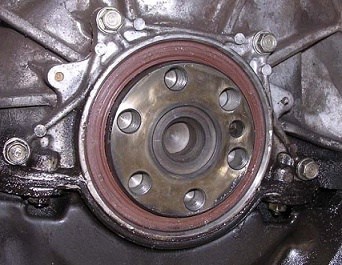
The flywheel is mounted at the end of the crankshaft. The clutch is fitted on the flywheel, with the transmission attached over it. The starter motor is attached to the outside of the flywheel.
In racing, a flywheel is often machined; this means that a piece is ground off to make it lighter in weight. The advantage is that due to the weight reduction, the engine will increase speed faster because less mass needs to be driven. The disadvantage is that the engine will not idle as smoothly as with an original flywheel.

Dual Mass Flywheel:
Nowadays, a dual flywheel, also known as a dual mass flywheel or two-mass flywheel, is increasingly installed. The advantage of this flywheel over a single flywheel is that it dampens even more minor vibrations. It also reduces noises that would normally arise from vibrations between the engine and transmission.
In a dual flywheel, the total mass of a regular flywheel is divided into two parts, namely the primary and secondary flywheel. These two parts of the flywheel are mounted together with ball bearings and a damping system with coil springs. The primary part is attached to the crankshaft, and the secondary part is on the clutch side with a pressure plate. The driving force is transferred from the primary part to the secondary part. It is possible to move the secondary part approximately 1 to 2 cm back and forth in relation to the primary part. On both sides, the movement is dampened by internally mounted springs. Because this play is possible, the vibrations are dampened accordingly. The vibrations move in the space where there is play and are dampened by the springs. The secondary part, therefore, reacts slowly to the direct movements of the primary part.
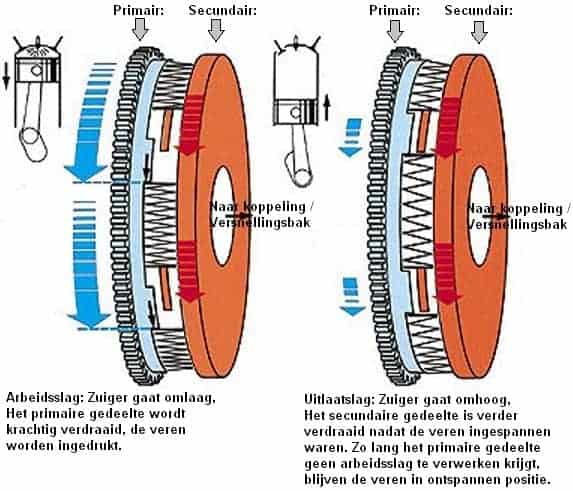
When the car’s transmission is disassembled, the condition of the flywheel can be checked. The play can be checked by moving the secondary part (where the clutch pressure plate is mounted) back and forth. If this play is too great (more than 2cm) or noises are audible, it is likely that the flywheel is worn out. The play has become too large, and the vibrations are no longer well dampened. At this point, the function of the dual mass flywheel can even counteract; the vibrations are amplified.