Engine Mount:
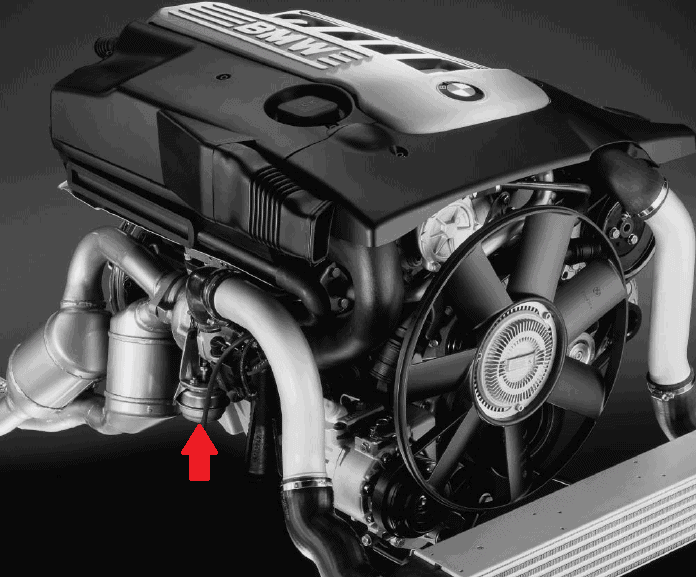
A car engine typically has 3 engine mounts; 2 on the sides and 1 at the back. In cars with transverse engines, the mounts are located on the timing side, on the transmission, and at the bottom on the subframe (the torque rod). In longitudinal engines (like the BMW engine in the image below), the mounts are positioned on the sides exactly in the middle (where the red arrow points and, of course, also on the other side). There is also another mount in the back against the body to prevent tilting.
The engine block hangs or stands in the rubber parts of the mounts. In these mounts, the engine has some play; it can move slightly within the mounts. This is necessary to dampen vibrations and absorb large engine forces resulting from idling and movements during acceleration/deceleration.
The rubber of the engine mount must be of good quality. Not too hard, as that would poorly dampen vibrations. Not too soft either, as the engine block could move too much, resulting in increased wear. The appropriate engine mount is designed based on the engine block’s weight.
As they age, the rubbers often become more pliable. This can be noticed by a “thumping” feeling and noise when releasing the clutch, or noises when suddenly accelerating or decelerating. (Note, this may also have other causes such as worn control arm bushings, a defective dual-mass flywheel, etc.)
Worn engine mounts can also transmit engine vibrations into the interior. This can be recognized as a droning sound, or even vibrations in the interior depending on the RPM. It’s best to replace the engine mounts before other components break due to the vibrations.
Hydraulic Engine Mount:
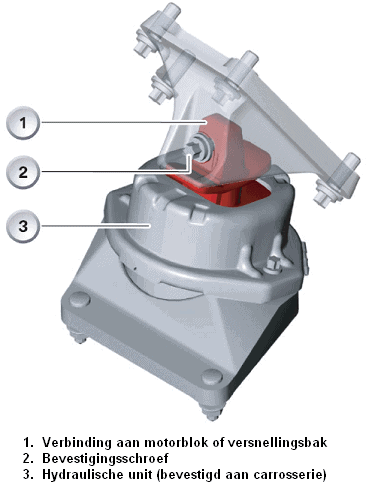
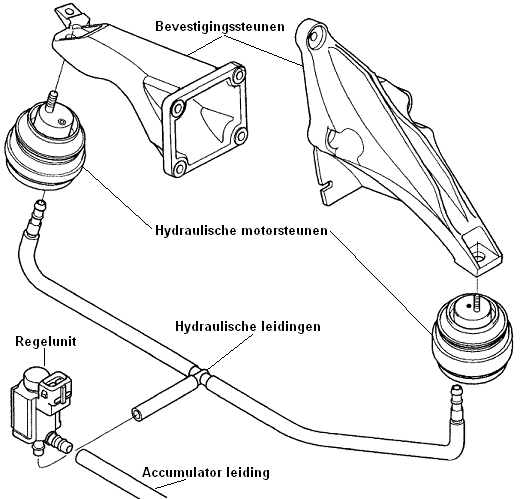
In luxury cars, hydraulic engine mounts can be used. These mounts increase comfort as they dampen vibrations better than conventional ‘rubber’ mounts. The hydraulic unit (no. 3 in the image) stores oil under pressure. The oil is situated between two parts of this mount. The engine’s weight rests on the oil. This oil takes over the rubber’s role from other mounts; vibrations and movements are dampened here.
Active (Adjustable) Engine Mount:
In cars where the comfort level can be set in the onboard computer (e.g., BMW / Mercedes), the damping of the engine mounts can be adjusted. By activating the ‘sport mode’ in the onboard computer, extra oil from the accumulator is pumped through the control unit into the hydraulic engine mounts. These mounts become stiffer due to the larger amount of oil and can thus move less easily. Also, vibrations are more easily transmitted to the interior. The engine block now has fewer movement possibilities in the engine bay, which benefits a sporty driving style (with a lot of cornering). The extra engine vibrations can also be interpreted as sporty by the driver.
In the comfort mode, the control unit lets some oil escape from the mounts. This provides, as the name suggests, more comfort. Often, a scale from 1 to 5 can be chosen between sporty and comfortable. The damping of the air suspension is simultaneously adjusted in the same way.
In cars without adjustable engine mounts, a certain level of comfort has been chosen by the manufacturer. Comfort should be as high as possible, but at the same time, the road holding must also be optimal. A compromise must always be made, where the car is both ”comfortable and sporty”. Only by replacing parts of the suspension (e.g., springs and shock absorbers) can the driver adjust this.
Torque Rod:
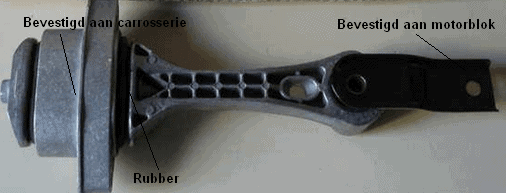
A torque rod is an engine mount installed at the bottom of the car. This mount is attached to the engine’s underside (at the bottom of the oil pan and transmission) and the other end is attached to the body or subframe. The torque rod ensures that the engine block does not tilt when accelerating or decelerating. This mount is only found in cars with a transverse engine (meaning with the hood open, the cylinders run from left to right, not front to back).