Introduction:
In hybrid and fully electric vehicles, we find converters. The converter transforms a high DC voltage into a low DC voltage. Therefore, this component is referred to as a DC-DC converter. The high voltage from the HV battery ranging from 200 to 600 volts (depending on the vehicle) is converted to 14 volts DC for the onboard battery. The electrical components inside and outside the vehicle (such as lighting, radio, door locks, electric window motors, etc.) are supplied with voltage and current from this battery.
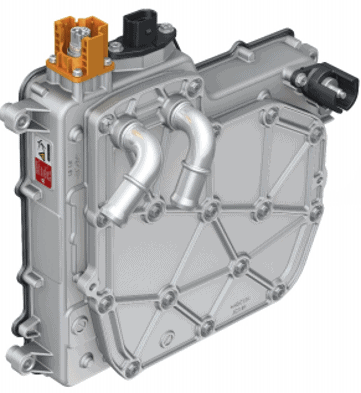
The converter is built into the vehicle as a standalone high-voltage component. The connection for the high-voltage cable can be recognized by the orange plastic cap.
Inside the converter are two coils with a soft iron core between them. A high current flows through the coils. Due to heat development, the converter is connected to the cooling system. The circulating coolant absorbs the heat and carries it away to the radiator.
Overview of the HV System:
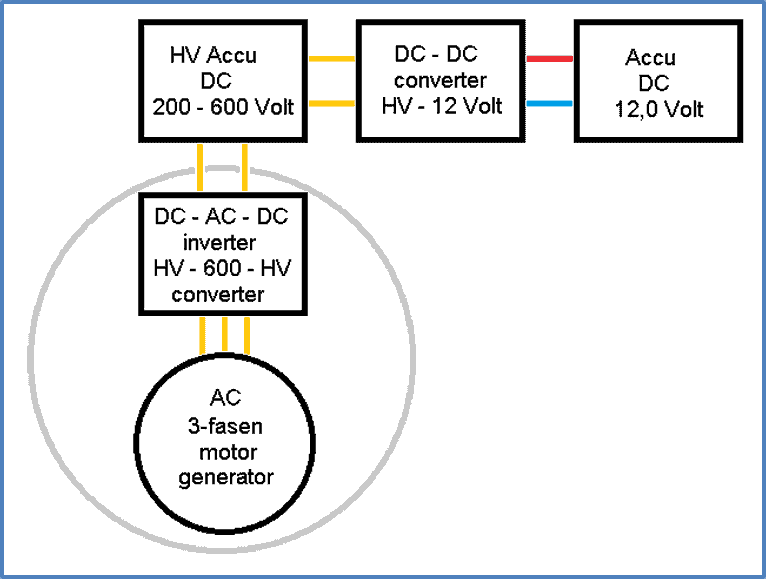
The high voltage from the HV battery is conducted via high-voltage cables to the inverter. In the inverter, the conversion from DC to AC takes place (the voltage inverts from direct current to alternating current). The HV electric motor (synchronous or asynchronous) is set in motion with this alternating current.
The HV battery also feeds the DC-DC converter, which converts the high voltage to a 12 to 14-volt onboard voltage.
The following image schematically shows the components of the HV system.
Operation of the Converter:
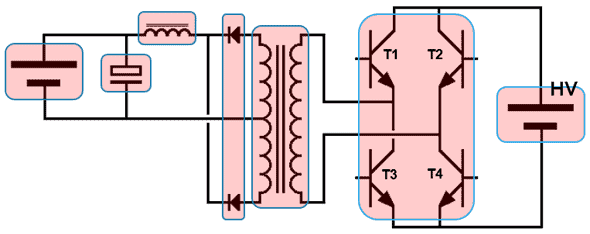
The converter is mounted between the HV battery and the 12-volt onboard battery. In the following image, the components are shown from left to right:
- 12-volt onboard battery;
- capacitor (elco);
- smoothing coil (to filter high-frequency peaks);
- diodes (rectifiers);
- transformer with galvanically isolated coils;
- H-bridge with four transistors;
- HV battery
The transfer from high voltage to 14 volts occurs through the induction of coils. The connection between the low-voltage and high-voltage systems is galvanically isolated: this means there is no conductive connection between the two systems.
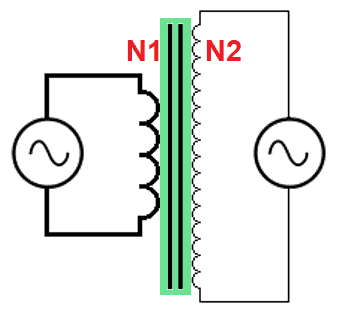
The input coil (N2, HV side) provides a varying magnetic field in the soft iron core. The output coil (N1, 14-volt side) is located in a varying magnetic field. Voltage is induced here.
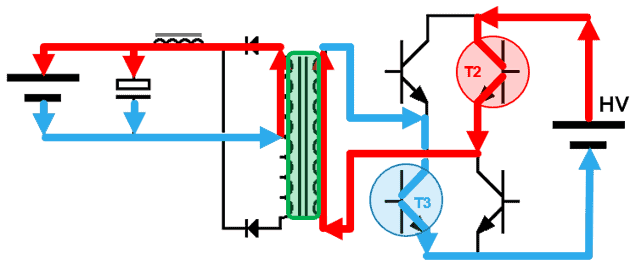
The ECU of the HV system switches on transistors T2 and T3 (see the next image). Transistor T2 thus connects the positive of the HV battery to the bottom of the primary coil. The current leaves the top of the coil and flows back via transistor T3 to the negative of the HV battery. a0
The primary current strength causes a magnetic field in the transformer, which induces a voltage in the secondary coil. The induced magnetic field and thus also the voltage in the secondary coil are lower than in the primary coil. The left battery and capacitor are charged with a direct voltage of around 14.4 volts.
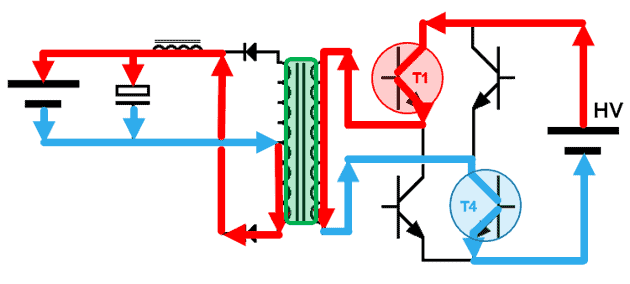
The transformer only works with alternating voltages. Since batteries supply only direct voltage, a varying magnetic field is created by turning the transistors on and off.
For this reason, transistors T2 and T3 switch off, after which T1 and T4 switch on immediately. The current in the primary coil now flows in the opposite direction (from top to bottom). This creates an opposing magnetic field in the transformer and therefore also an opposing voltage in the secondary coil. In this situation, the charging voltage of the battery and the capacitor is also around 14.4 volts.
Example:
- AC input: 201.6 volts;
- N1: 210 turns, R = 27.095 0;
- N2: 15 turns, R = 0.138 0;
- Turn ratio (i) = N1 : N2 = 210:15 = 14;
- AC output = AC input : i = 201.6 : 14 = 14.4 volts;
- P in = U^2 : R = 201.6^2 : 27.095 = 1500 Watts;
- P output (lossless) = U^2 : R = 14.4 : 0.138 = 1500 Watts;
- Efficiency = 90%;
- P output (actual) = P output * efficiency = 1500 * 0.9 = 1350 Watts;
- Battery current (I) = P : U = 1350 : 14.4 = 93.75 Amperes.
Boost Converter:
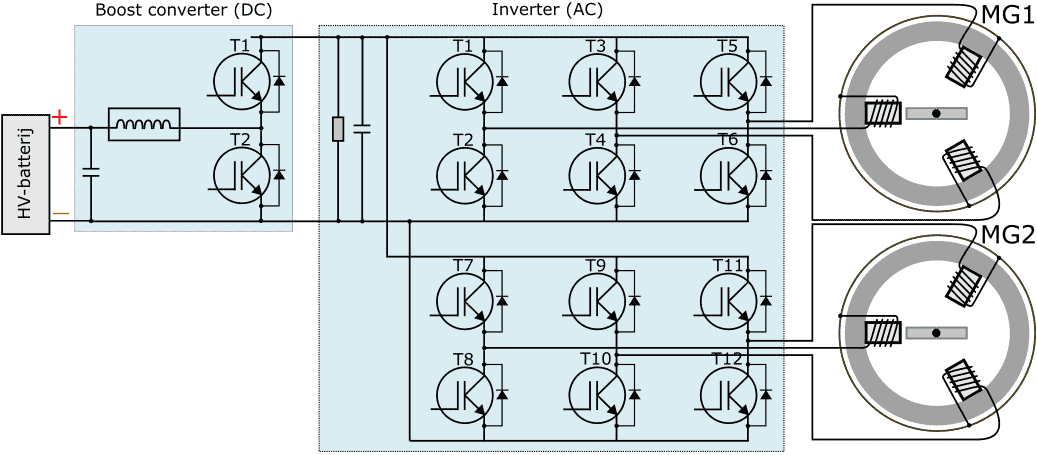
The image below shows a system overview including the boost converter and the inverter of a Toyota Prius.
The battery voltage of 201.6 volts is converted into an equivalent direct current of 650 volts in the boost converter. An induction voltage is generated using a coil and a pair of IGBTs (transistors). The reactor coil is depicted in the boost converter between the capacitor (left) and the IGBTs T1 and T2. By continuously controlling the transistors, an induction voltage is generated in the reactor coil, charging the capacitor.
The diode ensures that the charging voltage continues to increase until the voltage reaches 650 volts.
Related pages:
- Electric Drive (overview)
- HV Battery
- Inverter