Vehicle Identification Number:
A vehicle identification number (VIN) is a unique code, which includes a serial number, used by the automotive industry to identify individual motor vehicles. Every car has a VIN stamped somewhere. Usually on most cars, it’s found on the firewall under the hood, but sometimes also in the interior under the floor mat. There are often stickers present, but these are not official. A VIN must always be stamped. On the vehicle’s registration document, the location where the VIN is stamped is always specified.
When a car is imported from another country, it will receive different license plates. The VIN remains the same, so it’s always traceable.
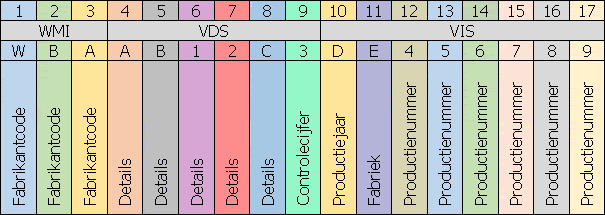
The table below shows the seventeen characters that are legally required and applied worldwide by manufacturers as identification. The composition of the seventeen characters is internationally standardized by ISO 3779. The first three characters indicate the World Manufacturer Identification (WMI), the next six characters the Vehicle Description Section (VDS), and the last eight characters the Vehicle Indicator Section (VIS).
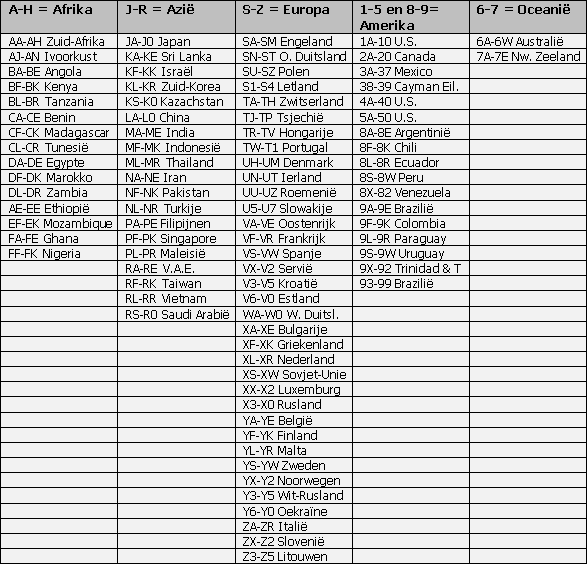
The first character of the VIN represents the code of the country where the car was manufactured. In the table below, you can see the codes that are applied worldwide. For instance, the range 2A-20 stands for Canada, but in the VIN, only the number 2 is shown. Therefore, if the first character is a V, you cannot determine whether the car was manufactured in France or Spain. For that, you need to look at the factory code in the eleventh character.
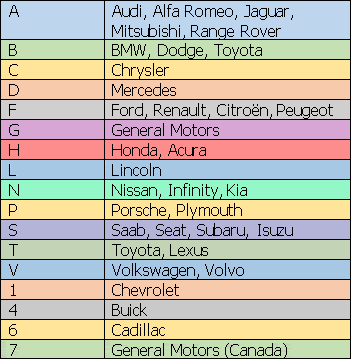
The second character indicates the brand. Below are some brands listed. Some brands have different characters, and not all brands are represented in the table.
The ninth character represents the model year. It has been applied since 1980. The year is represented as either a letter or a number. In the columns below, there is an overview of the model years.
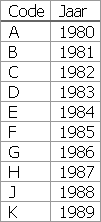
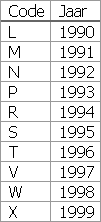
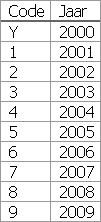
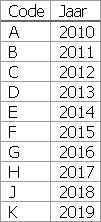
The tenth character indicates the factory where the car was produced. Each manufacturer assigns its own letter or number here. Volkswagen uses the “W” to indicate the factory in Wolfsburg, but another manufacturer might use the letter W for an entirely different location.
Volkswagen VIN:
This section describes the structure of the Volkswagen VIN. It elaborates on the information provided in the previous chapter with an example.
W | V | W | Z | Z | Z | 3 | D | Z | 9 | 8 | 0 | 0 | 0 | 0 | 0 | 9 |
1 | 2 | 3 | 4 | 5 | 6 | 7 | 8 | 9 | 10 | 11 | 12 | 13 | 14 | 15 | 16 | 17 |
Positions 1, 2 & 3: Factory Code:
WVW = VW AG/passenger cars
WVG = VW AG/ Touran
WV2 = VW AG/Transporter (Type 2) and LT
WAU = Audi
1WV = Volkswagen America, passenger cars
1V1 = Volkswagen America, pickup models
Positions 4, 5 & 6: Filler Numbers:
(3x Z, except USA and Canada)
Positions 7 & 8: Type Designation:
2-digit abbreviated type designation, from the first 2 digits of the official type designation
e.g., 1J = Golf 4, 1K = Golf 5, 3B and 3C old and new type Passat
Position 9: Filler Number:
Z, except North America and Canada.
Position 10: Indicates Production Year:
A = 1980
B = 1981
C = 1982
5 = 2005
6 = 2006
etc.
Position 11: Place of Production:
0 = Anchieta, Brazil
1 = Gyoer “Hungary” since 1997
2 = SVW / Shanghai “People’s Republic of China” since 1998
3 = FAW-VW / Changchun “People’s Republic of China” since 1998
4 = Curitiba “Brazil” since 1998
5 = Taubate, Brazil
6 = Düsseldorf “Federal Republic of Germany” Volkswagen: LT
7 = Ludwigsfelde “Federal Republic of Germany” Volkswagen: LT
8 = Dresden “Federal Republic of Germany” since 2000
9 = Hino/Toyota “Japan” 1989 to 1997
9 = Sarajevo “Bosnia and Herzegovina” since 2002
A = Pacheco, Argentina
A = Ingolstadt
B = Brussels
C = SB Cambo Plant 4, Brazil
C = Taipei, Taiwan
D = Ipiranga, Brazil
D = Bratislava, since 1995
E = Emden
F = Resende “Brazil”
G = Steyr-Daimler Puch “Austria” until 1995
H = Hanover
J = Jakarta “Indonesia” since 1998
K = Osnabrück
L = Leipzig “Federal Republic of Germany” since 2001
M = Puebla, Mexico
N = Neckarsulm
N = Mlada / Boleslav “Czech Republic” (Skoda: 1U,6Y)
P = Mosel, Saxony
P = Anchieta “Brazil”
R = Martorell “Spain” since 1996 (Seat)
R = Resende “Brazil”
S = Salzgitter “Federal Republic of Germany” 1970 to 1975
T = Sarajevo “Yugoslavia” until 1994
T = Taubate “Brazil”
U = Uitenhage, South Africa (until mid-80s Westmoreland, USA)
V = Palmela “Portugal” since 1994 (Auto Europa)
V = Westmoreland “USA” 1979 to 1989
W = Wolfsburg
X = Poznan “Poland” since 1995
Y = Navara / Pamplona “Spain” since 1986 (Seat)
Z = Zuffenhausen “Federal Republic of Germany” 1995
Z = SKD for Ukraine “Ukraine” since 2005
Positions 12 – 17: Serial Numbers
Starting with 000 001 for each new model year.
The fictitious VIN in the above example is thus from a VW Phaeton, produced in Dresden (Germany) in the year 2009.
Fraud:
It occasionally happens that the VIN of a stolen car is changed, for example, by using the VIN from another (identical) damaged car that is totaled and cannot be repaired. The VIN of the stolen car then no longer exists, and the damaged car is falsely ‘repaired’ and subsequently sold. This is called “car cloning.”
Fortunately, it often happens that the thieves are caught, and the stolen cars (with the new VINs) are seized. If the owner has not yet been compensated by the insurance company, the original VIN is stamped somewhere on the car again, but not in the same place where, for example, the VIN of the previously mentioned damaged car resides. That number is altered with X. Only X’s are visible, making the number unrecognizable. The original VIN is stamped on a different part of the chassis. A new registration certificate is then created on which the location of the new VIN can be traced.