Introduction:
In modern vehicles, all safety belts in the front seats are equipped with a belt pretensioner. This pretensioner tightens the belt during a frontal or side collision (at an angle of up to 30 degrees relative to the centerline of the vehicle).
When the belt is pulled hard, in any system – even those without a pretensioner – the retractor will lock. The belt cannot be further extended at that point. (The retractor should not be confused with the pretensioner.) Once the belt is released slightly, the retractor unlocks and the belt can be extracted again. This can be easily tested on any belt in the vehicle. This is also checked during major maintenance and the vehicle inspection. If the retractor does not lock, wearing the belt theoretically offers little benefit.
In the event of a frontal or side collision (at an angle of up to 30 degrees), the vehicle experiences heavy deceleration. As a result, the belt retractor locks, preventing the occupant from being propelled forward and sustaining injuries. In systems with a pretensioner, the belt is pulled even tighter. After the collision, a small explosive charge causes the belt buckle to be pulled down within 30 milliseconds. This causes the belt to be very tightly fastened. The retractor locks immediately at that moment, just as when the belt is given a strong tug. The occupant’s movement is further restricted, reducing the risk of injury.
The pretensioner may be located at the buckle (next to the front seats) or at the retractor in the B-pillar. Both types are explained below.
Buckle Pretensioner:
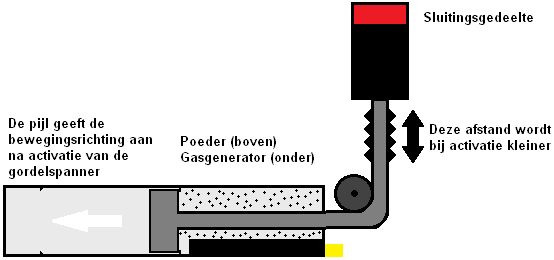
In a collision, the airbag control unit applies voltage to the gas generator, igniting the pyrotechnic component. The working piston is shot to the left by this explosion (see image below) and remains in the left section. Because the cable is connected to both the buckle and the working piston, the buckle is pulled downward. As a result, the belt is tightened by about 80 mm (8 cm).
Retractor Pretensioner:
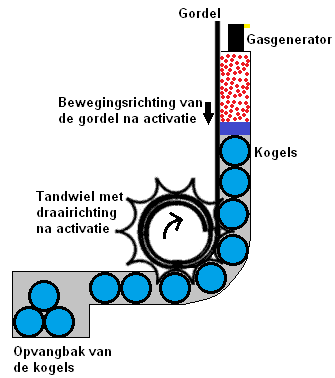
This pretensioner is mounted in the B-pillar (approximately next to the seat, behind the bodywork trim). Here too, the airbag control unit applies voltage to the gas generator after a collision. The powder (indicated in red) is ignited. The blue plunger pushes the balls down with great force. The hollows of the gearwheel are exactly the same size as the balls. As the balls move downwards with significant force, the gearwheel rotates. On the extended part of the gearwheel, the belt is retracted, as shown in the image.
The retraction shortens the belt. For this pretensioner, the belt is retracted by approximately 80 mm, occurring within 30 milliseconds after the collision.
Post-Activation:
When a vehicle is involved in a collision and the belt pretensioner is activated, it becomes unusable after deployment and must be replaced. Pretensioners are designed to break the connection between two metal contacts upon activation. The airbag control device continuously monitors the system’s resistance and will register a fault in case of an interruption (infinitely high resistance). In such a case, the airbag warning light will illuminate. The error message cannot be cleared as long as a faulty or missing pretensioner is installed.
In some older types of pretensioners, it is possible to check visually whether the system has been activated. At the end of the metal tube, in the direction in which the piston moves, there is a colored plastic cap that is ejected after activation. This cap serves as an indicator that the pretensioner has been deployed. Additionally, the buckle mechanism is noticeably lower after activation, making it more difficult to reach.
It is important that after any collision in which a belt pretensioner or airbag has deployed, all components of the safety system are checked and replaced in accordance with the manufacturer’s instructions.