Introduction:
Bearings are used to reduce friction between two bodies. With the help of bearings, it becomes possible, for example, to rotate a rotating shaft within a stationary housing, as is the case with a wheel bearing.
There are two types of bearings; plain bearings and rolling bearings. The rolling bearings can be divided into six types. These are described in the following chapters.
Plain Bearing:
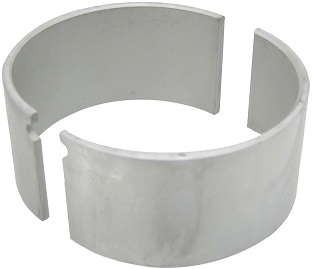
A plain bearing itself has no moving parts. This bearing is used, for example, as a connecting rod bearing. The bearing slides along the moving parts and therefore requires external lubrication. A crankshaft contains oil channels so that there is always a certain amount of oil present between the bearing and the crankshaft. This minimizes frictional resistance. In the absence of lubrication, such as when driving without oil, the plain bearing is immediately damaged.
Ball Bearing:
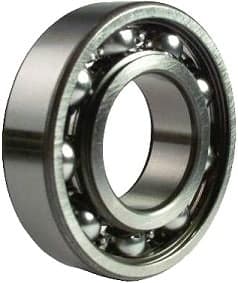
The ball bearing is one of the most commonly used types of rolling bearings, consisting of an inner and outer ring with balls in between. The balls are enclosed by grooves in the inner and outer rings. Ball bearings are suitable for high rotational speeds and require little maintenance.
Tapered Roller Bearing:
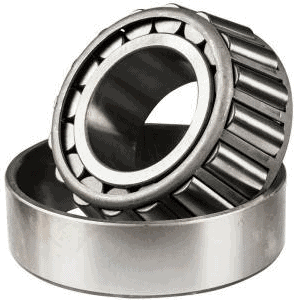
Tapered roller bearings have an inner and outer ring with a cage containing tapered rollers in between. Tapered roller bearings are used to absorb axial loads. The advantage of the tapered rollers is that they have a larger surface area, allowing them to handle larger forces. This type of bearing is used, for example, in the transmission as a pilot bearing or as a wheel bearing in cars equipped with drum brakes.
Angular Contact Bearing:
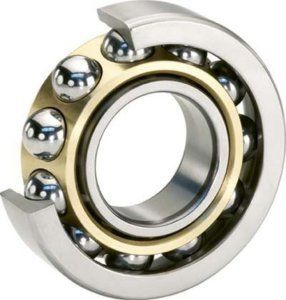
An angular contact bearing can efficiently handle radial forces, but axial forces in only one direction. The raceways of the inner and outer rings are shifted relative to each other, forming a contact angle. The angle determines the direction in which axial forces can be absorbed. In principle, the ball bearings are “pressed more against the outer ring” under axial load. This type of bearing can be designed with one or two rows of ball bearings. In the image below, the bearing is designed with a single row of ball bearings.
Cylindrical Roller Bearing:
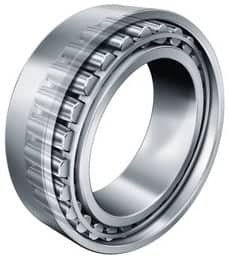
The cylindrical roller bearing consists of an inner and outer ring with cylindrical rollers in a cage in between. A cylindrical roller bearing can only take radial forces. Due to its cylindrical shape, the bearing can also handle impact movements.
Needle Bearing:
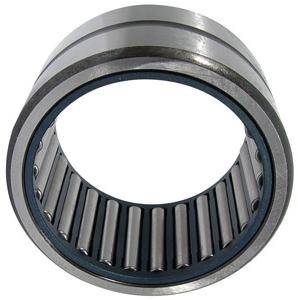
The needle bearing consists, among other things, of a cage with a large number of needle rollers. Due to the small diameter of a needle roller, needle bearings can be used in small installation spaces. Other advantages of the needle bearing include high load capacity, suitability for high speeds, and easy assembly.
Thrust Bearing:
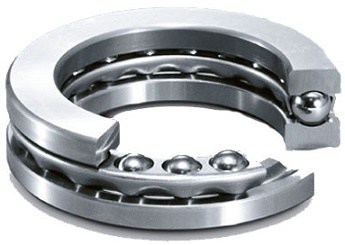
The thrust bearing can only absorb axial forces. The bearing consists of rings with raceways. The lower ring can be mounted on a shaft and the upper one on the housing. The thrust bearing is often used as a thrust bearing in the clutch of a car.
Spherical Roller Bearing:
The spherical roller bearing is suitable for taking very heavy radial loads and accommodating shaft misalignment. The barrel-shaped rollers align themselves in the outer raceway. The spherical roller bearing also features a lubrication groove and several lubrication holes to press grease into the bearing during maintenance.