Introduction:
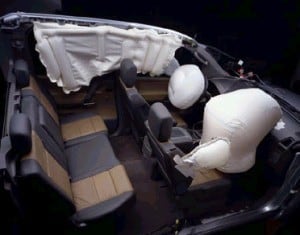
An airbag is a supplementary protection system. Together with seatbelts, airbags are designed to protect vehicle occupants in the event of a collision. Almost every modern car is equipped with one or more airbags. These include the driver-side airbag located in the steering wheel and the passenger-side airbag located in the dashboard. More advanced models also have side airbags in the roof lining, doors, or seats.
The airbags are deployed when the vehicle experiences a deceleration greater than 12 m/s8 squared. Crash sensors detect the deceleration and send this information to the airbag control unit. The control unit then activates the airbags, which fully inflate within milliseconds.
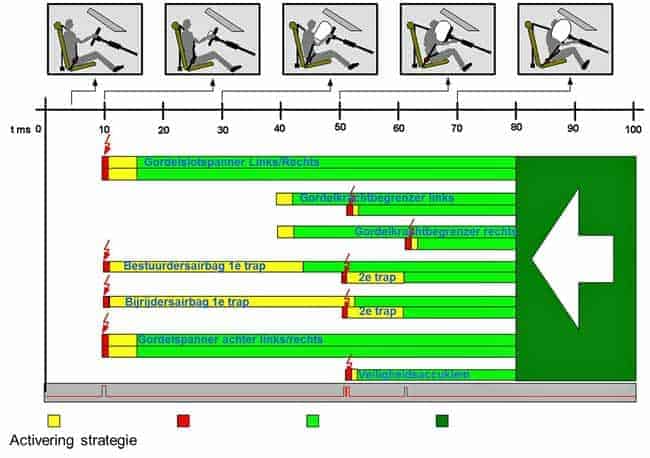
Besides the airbags, the control unit activates more safety components to protect vehicle occupants as effectively as possible. Not all components are deployed simultaneously. The timing is programmed into the control unit’s software. Depending on the severity of the collision, the following safety components are activated:
- In a minor collision: nothing happens;
- In a slightly more severe collision: the seatbelt tensioners are activated. If the vehicle is equipped with occupant detection, the passenger seatbelt tensioner is only activated when the sensor detects a person on the seat;
- In an even more severe collision: the airbag is deployed. Modern systems are equipped with a dual-stage airbag.
- In a minor deceleration, where the airbag is involved, the time between the first and second stage is 100 ms.
- In greater deceleration, the time between the first and second stage is shorter.
- The first and second stages can even occur simultaneously if the deceleration is very high.
9b
Deceleration Sensors:
The vehicle’s deceleration is measured by deceleration sensors. If the deceleration exceeds the car’s maximum braking deceleration, it is likely caused by a collision. When the airbag sensors detect a deceleration greater than 12 meters per second squared, they send a signal to the airbag control unit, which then activates the airbags. A typical passenger car with good brakes can achieve a braking deceleration of between 5 and 7 meters per second squared; sports cars can reach up to a maximum of 8 meters per second squared. This means that braking alone does not achieve the maximum deceleration of 12 m/s squared. Even at low speeds against a pole or wall, this deceleration may not be reached, and the airbags will not be activated.
Most modern deceleration sensors are integrated into the control unit, but sometimes they are mounted separately on the vehicle’s body parts. They react to inertia in one direction, making it crucial that the sensor is installed correctly (not upside down, as this may prevent airbag deployment in a collision). Deceleration sensors can be electronic or electro-mechanical. An electronic deceleration sensor contains a piezoelectric crystal. When a force is applied to the piezoelectric crystal, it generates a voltage. The force on the sensor is due to deceleration during a collision. The generated voltage is proportional to the force of the collision.
The system can also use an electro-mechanical deceleration sensor that mechanically closes at a certain force. At this point, an electronic contact is closed, and the generated signal is then sent to the control unit. When both the electronic sensor with piezoelectric crystal and the safety switch send a signal to the control unit, it activates the airbags in the interior.
Airbag Modules:
Each driver, passenger, and side airbag is equipped with separate airbag modules. When the control unit supplies voltage to the airbag modules, they activate. An explosion occurs, releasing a large amount of gas that is 99% nitrogen. This gas fully inflates the airbag. An airbag emerges at a speed of approximately 300 km/h. After inflation, the airbag rapidly deflates for safety reasons. The rear of the airbag modules has large vents through which the hot gas escapes.
Airbag Control Unit:
The airbag control unit commands the airbag modules to deploy the airbag. Another function of the airbag control unit is to activate only the airbags where passengers are present. A special sensor mat under the seat upholstery detects if someone is sitting in the seat. If this is the case, the airbag control unit will activate the respective airbag. If no one is in the seat, the airbag will not deploy. This also helps save costs, as airbags are expensive. As a safety measure, the airbag warning light is activated when there is a fault in the sensor mat.
There are also dual-stage airbags that deploy based on the occupant’s body weight. The aforementioned sensor mat measures weight. If it is low, stage 1 is activated. If the weight exceeds, for example, 100 kg, stage 2 is activated. In stage 2, the airbag’s air volume is increased for greater inflation.
The control unit always supplies a low voltage to the airbag and monitors its resistance to ensure the airbag is present and functional. This check occurs four times per second. If an airbag is removed, the control unit detects this, causing the airbag warning light to illuminate immediately. This can occur when the ignition is turned on with a system component disassembled. For safety, the light remains on until reset using a diagnostic computer via the OBD system.
Driver and Passenger Airbag:
The driver airbag is located in the center of the steering wheel. During a frontal impact, it rapidly inflates. The purpose of this airbag is to cushion the forward-moving occupant. After inflation, the airbag immediately deflates to prevent suffocation risk.
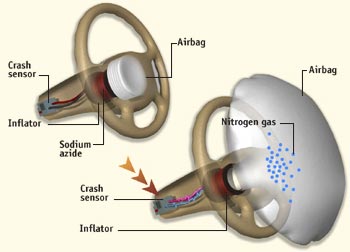
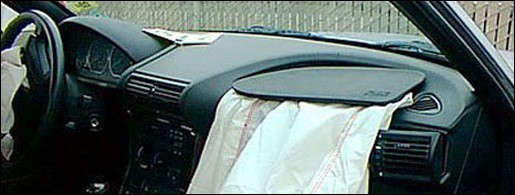
The driver airbag has a volume of approximately 35 liters, while the passenger airbag has a volume of 65 liters. The larger volume of the passenger airbag is due to the dashboard being further from the seat.
The driver and passenger airbags are not activated in side impacts, vehicle rollovers, rear-end collisions, or when driving on rough terrain/curbs. These airbags are only deployed in frontal collisions.
Clock Spring:
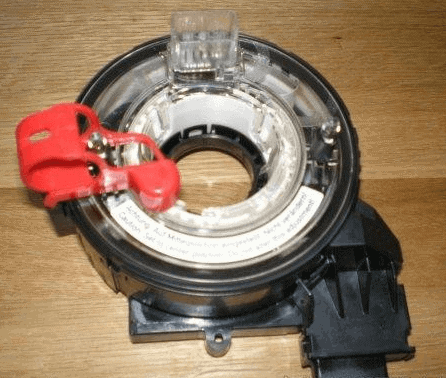
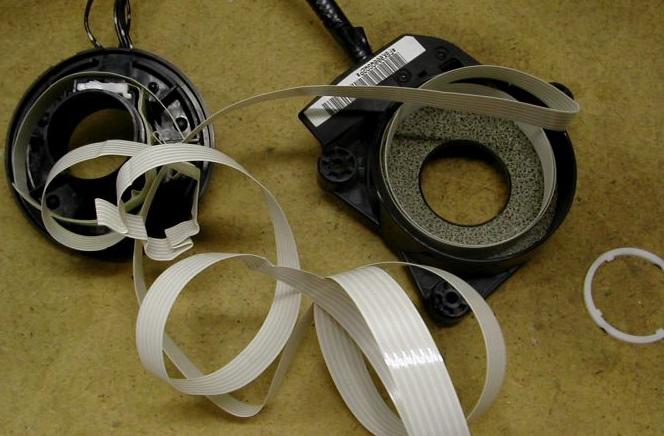
A special wire is needed to connect the steering wheel airbag to the control unit. A regular wire could wear out over time with frequent steering. This wire is also known as a slip ring, clock spring, or spiral spring, with the most common term being clock spring. It is a long, wide, flat wire (or ribbon) wound around the steering shaft. This design allows for maximum steering input. When dismantling the clock spring, it’s important to note its position, as twisting it before installation can cause the spring to break upon steering. This would trigger the airbag warning light since no voltage can be sent to the steering wheel airbag. A broken clock spring should not be repaired but replaced.
Side Airbag:
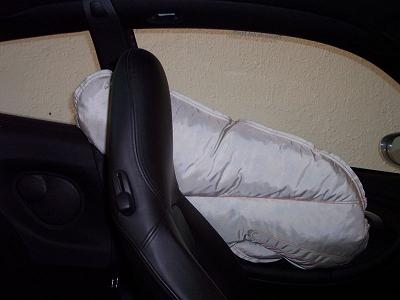
Side airbags, also known as door or seat airbags, are designed to protect occupants during side impacts. These airbags can be located in either the door or the seatback. The door or seat upholstery has specially prepared tear seams for this purpose.
Curtain Airbag:
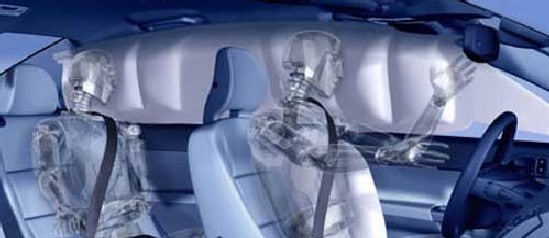
The curtain airbag is mounted above the headliner. It inflates during a side impact to protect both front and rear passengers.
Knee Airbag:
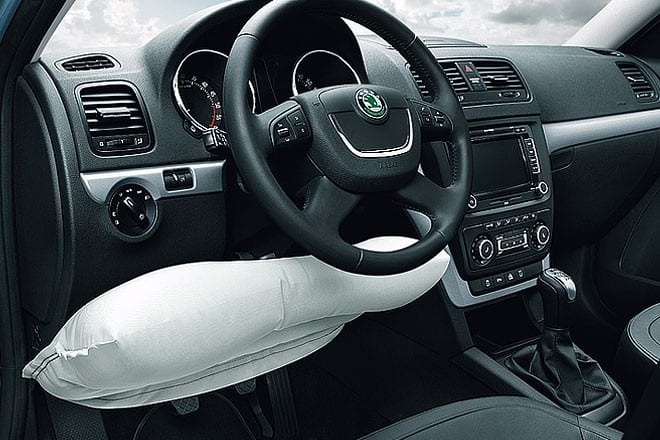
As the name suggests, the knee airbag protects the knees during a frontal collision. Annually, many injuries result from knees striking the dashboard. These robust cushions aim to prevent such injuries as much as possible. Knee airbags are the most recent on the market and are not yet widely implemented.
Seatbelt Tensioner:
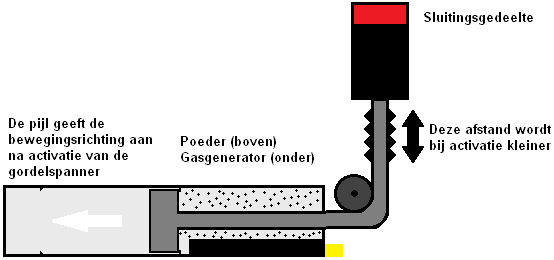
Safety systems are also often equipped with seatbelt tensioners. The seatbelt tensioners are also controlled by the airbag control unit. The operation of the seatbelt tensioners, with the tensioner near the retractor closing mechanism, is described on the page Seatbelt Tensioner.